
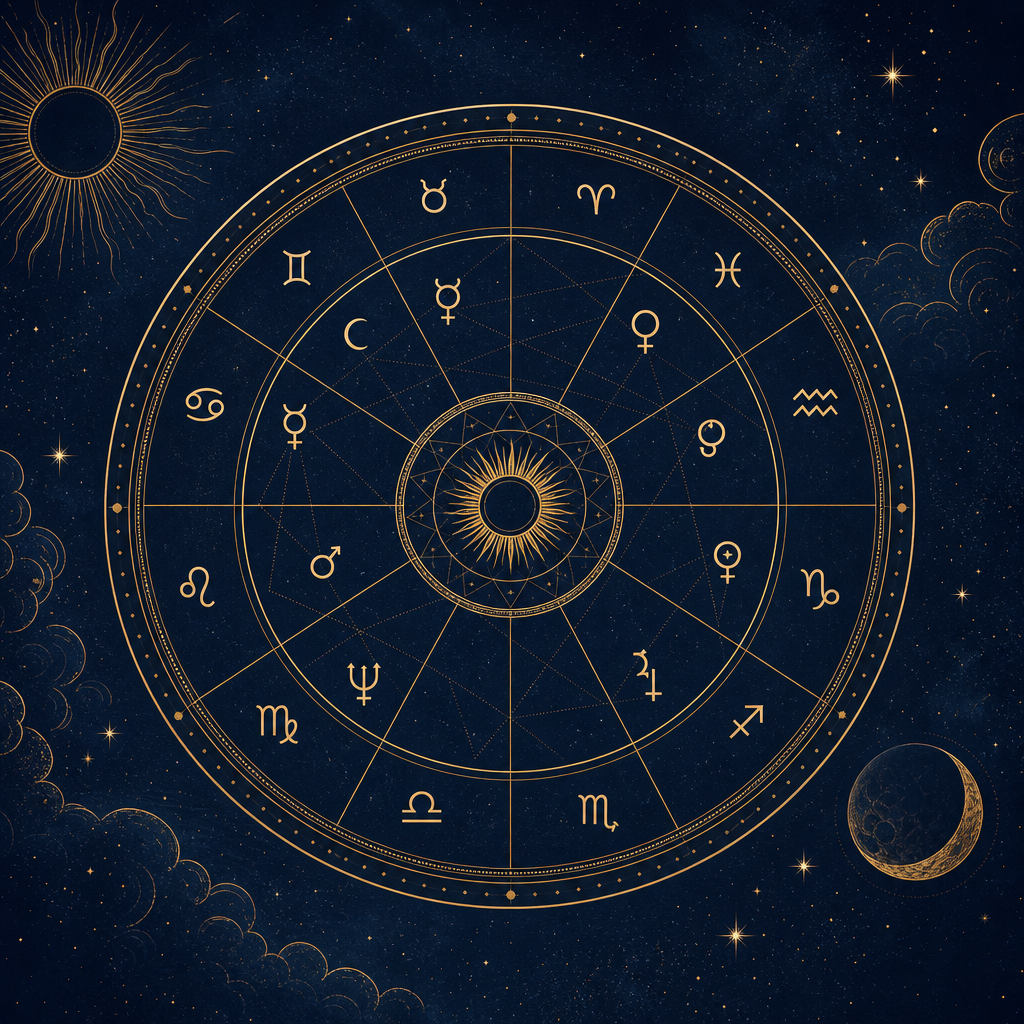
In astrology, the twelve houses divide a birth chart into twelve areas of life. If planets describe what kind of energy is involved and zodiac signs describe how that energy tends to express itself, houses describe where in life the symbolism may be most visible.
Understanding houses is one of the biggest steps from reading a simple Sun sign to reading a complete birth chart. A planet in the first house is interpreted differently from the same planet in the tenth house because the life area changes.
What Are Astrology Houses?
A birth chart is a circular map of the sky calculated for a specific time and place. The circle is divided into twelve sections called houses. Each house is associated with a different area of experience, such as identity, money, communication, home, creativity, relationships, work, shared resources, beliefs, career, community, and inner life.
The houses are not the same as zodiac signs. The first house is not automatically Aries, the second is not automatically Taurus, and so on. Those associations can be useful as learning shortcuts, but in an actual birth chart each house may begin in a different sign depending on the rising sign and house system.
The First House: Self and Approach
The first house begins at the Ascendant and relates to identity, appearance, first impressions, personal style, and the way you approach life. Planets here are often highly visible in the personality.
For example, Mars in the first house may suggest a direct, energetic, or assertive presentation. Venus in the first can emphasize charm, aesthetics, or a desire for harmony. The exact meaning depends on sign and aspects.
The Second House: Resources and Values
The second house is associated with personal resources, money, possessions, self-worth, priorities, and what you consider valuable. It is not only about income. It can describe your relationship with security and how you manage what belongs to you.
A strong second house may encourage questions about earning, saving, spending, confidence, and the difference between material value and personal value.
The Third House: Communication and Learning
The third house relates to communication, thinking, everyday learning, siblings, local environment, short journeys, and the exchange of information. It can describe how you gather facts and interact with the people and systems around you.
Mercury in the third house, for instance, may emphasize curiosity, writing, study, or frequent communication.
The Fourth House: Home and Foundations
The fourth house is connected with home, family, roots, private life, ancestry, and emotional foundations. The lowest point of the chart, the IC, is often associated with this house.
Planets in the fourth can highlight the importance of home life, family patterns, privacy, or creating a stable inner foundation.
The Fifth House: Creativity and Pleasure
The fifth house is associated with creativity, play, romance, hobbies, self-expression, children, and activities done for enjoyment. It describes the part of life where you take creative risks and express something personally meaningful.
Strong fifth-house symbolism can show a need to create, perform, compete, play, or experience romantic spontaneity.
The Sixth House: Work, Habits, and Daily Systems
The sixth house relates to routines, work habits, service, skills, organization, health habits, and the systems that keep daily life functioning. It is less about public career status and more about the practical work done every day.
Planets here can emphasize discipline, efficiency, responsibility, or the need to improve routines.
The Seventh House: Partnership
The seventh house begins at the Descendant, opposite the Ascendant. It is associated with one-to-one relationships, marriage, business partnerships, contracts, and the qualities we encounter through significant others.
This house is central in relationship astrology, but it does not automatically predict whether someone will marry or how many relationships they will have.
The Eighth House: Shared Resources and Transformation
The eighth house is associated with shared finances, debts, taxes, inheritance, intimacy, trust, vulnerability, endings, and psychological transformation. It often deals with things that are shared, merged, or not entirely under individual control.
Because its symbolism is intense, it is frequently oversimplified. It should not be treated as a literal “death house.”
The Ninth House: Beliefs and Exploration
The ninth house relates to philosophy, higher education, long-distance travel, religion, worldview, publishing, and the search for meaning. It describes how experience expands perspective.
Planets here can suggest a strong interest in learning, teaching, travel, belief systems, or cross-cultural experiences.
The Tenth House: Career and Public Role
The tenth house is associated with career, public reputation, achievement, responsibility, leadership, and long-term goals. The Midheaven, or MC, is often linked to this part of the chart.
It does not tell you one exact job. Instead, it can describe how you approach ambition, recognition, authority, and public contribution.
The Eleventh House: Community and Future Goals
The eleventh house relates to friendships, groups, networks, communities, collective causes, and hopes for the future. It describes participation in something larger than the individual.
Strong eleventh-house placements can emphasize collaboration, social networks, communities, technology, or long-term aspirations.
The Twelfth House: Inner Life and Retreat
The twelfth house is associated with solitude, the unconscious, retreat, hidden processes, spirituality, endings, and experiences that happen behind the scenes. It can represent the need for rest and reflection as much as difficulty or isolation.
Because the twelfth house is subtle, it is best interpreted carefully rather than fearfully.
Angular, Succedent, and Cadent Houses
The houses can also be grouped by modality. Angular houses—1, 4, 7, and 10—are often associated with direct action and major life axes. Succedent houses—2, 5, 8, and 11—tend to stabilize and develop what the angular houses initiate. Cadent houses—3, 6, 9, and 12—are linked with learning, adjustment, transition, and perspective.
This grouping helps explain why planets can feel more outwardly prominent in some houses than others.
House Systems
Astrologers use different methods to divide the chart into houses. Common systems include Placidus, Whole Sign, Equal House, Koch, and others. A planet can sometimes change houses when a different system is used.
That does not mean the calculation is necessarily wrong. It means the practitioner is using a different geometric framework. Consistency is important when comparing interpretations.
Why Birth Time Matters
The houses depend on the rotation of Earth and the local horizon. Without an accurate birth time, the Ascendant and house cusps cannot be calculated reliably.
If your birth time is unknown, you can still interpret planets in signs and many aspects, but house-based conclusions should be treated as uncertain.
How to Read a Planet in a House
Start with three questions: What does the planet represent? What sign is it in? What area of life does the house represent?
For example, Mercury represents communication and thought. In Capricorn, its style may be structured and practical. In the seventh house, that combination might emphasize careful communication in partnerships.
Do Empty Houses Mean Nothing Happens There?
No. Most charts have several empty houses because there are fewer planets than houses. An empty house does not mean the area of life is absent or unimportant.
Astrologers often look at the sign on the house cusp and the planet that rules that sign to understand how the house operates.
Related Astrology Guides
- What Is a Birth Chart?
- How to Read a Birth Chart
- The Planets in Astrology
- Astrology Aspects Explained
- Astrology Transits Explained
Frequently Asked Questions
What do the 12 astrology houses represent?
The houses organize a birth chart into areas of life such as identity, money, communication, home, relationships, career, community, and inner development.
Does a planet change meaning in a different house?
The planet keeps its core symbolism, while the house describes the area of life where that symbolism is expressed.
Final Thoughts
The twelve houses turn a birth chart into a map of life areas. From identity and resources to relationships, career, community, and inner life, each house provides context for the planets and signs.
Once you understand the houses, a chart becomes more specific. Instead of asking only “What does Venus mean?” you can ask “How is Venus expressed, in what sign, and in which area of life?” That layered approach is the foundation of meaningful birth-chart interpretation.