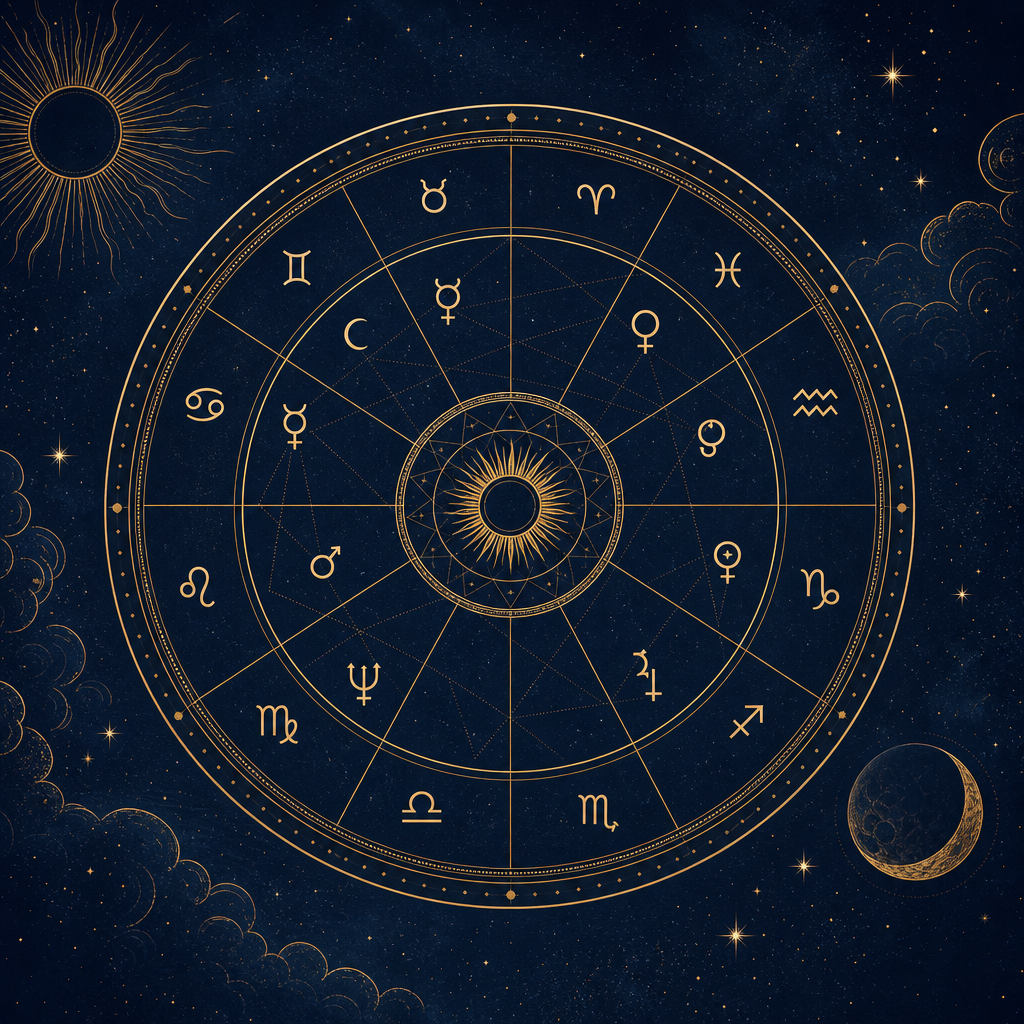
Sun, Moon, and rising signs are often called the “Big Three” in modern astrology because together they offer a simple introduction to three different layers of a birth chart. The Sun is associated with identity and purpose, the Moon with emotional needs and instinctive reactions, and the rising sign with approach, first impressions, and the way a person enters situations.
None of the three is your entire personality. A complete chart includes many other planets, houses, and aspects. But understanding the Big Three is a useful starting point because it shows why two people with the same Sun sign can seem very different.
Your Sun Sign: Identity and Direction
The Sun changes zodiac signs roughly once a month, which is why most people know their Sun sign from their birthday. In astrology, the Sun is linked with vitality, identity, confidence, creativity, purpose, and the qualities a person is developing more consciously over time.
Your Sun sign can describe what feels central to your sense of self. An Aries Sun may emphasize initiative, a Taurus Sun stability, a Gemini Sun curiosity, and so on. But the expression depends on the rest of the chart.
Your Moon Sign: Emotional Needs
The Moon moves much faster than the Sun and changes signs approximately every two and a half days. It is associated with emotional habits, instincts, memory, comfort, security, and the responses that happen before you have time to think them through.
Your Moon sign can help describe what helps you feel safe or emotionally regulated. A fire Moon may need movement or direct expression. An earth Moon may prefer stability and practical reassurance. An air Moon may process feelings through conversation or ideas. A water Moon may need emotional depth and privacy.
Your Rising Sign: Approach and First Impression
The rising sign, also called the Ascendant, is the zodiac sign rising on the eastern horizon at the moment of birth. Because it changes quickly, calculating it requires an accurate birth time and birthplace.
The Ascendant is associated with the way you approach new situations, the style you project before people know you well, and the overall structure of the houses in your birth chart.
Why Birth Time Matters for the Rising Sign
The Ascendant can change signs about every two hours on average, though the exact timing varies by latitude and season. If your recorded birth time is significantly wrong, your rising sign and house placements may change.
If you do not know your birth time, it is better to say that the rising sign is unknown than to guess.
Sun vs. Moon: Conscious and Instinctive
A useful simplification is to think of the Sun as the part of you that moves toward conscious expression while the Moon describes habitual or instinctive responses.
For example, someone with an outgoing Leo Sun and a private Scorpio Moon may enjoy visibility while still protecting deeper emotions carefully. Someone with a practical Capricorn Sun and a spontaneous Aries Moon may look disciplined but react quickly under pressure.
Sun vs. Rising: Identity and Presentation
The Sun is often experienced as an internal sense of identity, while the rising sign can be more obvious to other people at first meeting.
A sensitive Pisces Sun with a direct Aries rising may initially appear bold and decisive. A confident Leo Sun with a reserved Capricorn rising may seem more formal or cautious until people know them better.
Moon vs. Rising: Inner Comfort and Outer Style
The Moon describes emotional comfort; the rising sign describes how you meet the outside world. These can reinforce each other or feel very different.
A Cancer Moon with Cancer rising may show sensitivity openly. A Cancer Moon with Aquarius rising may appear detached or analytical while privately needing strong emotional connection.
When All Three Share an Element
If the Sun, Moon, and rising sign are concentrated in one element, that elemental style may feel especially prominent. Strong fire can emphasize energy and confidence, strong earth practicality and stability, strong air communication and ideas, and strong water emotional sensitivity and intuition.
However, the rest of the chart may introduce balancing elements.
When the Big Three Are Very Different
Different signs can create a more varied personality. Instead of being a contradiction, this can describe how a person behaves differently across contexts.
A Gemini Sun, Taurus Moon, and Scorpio rising, for example, may combine curiosity, emotional steadiness, and an intense first impression. The individual does not have to choose which sign is “really” them. All three describe different layers.
The Role of Houses
The rising sign establishes the house structure. Once the Ascendant is known, astrologers can see which areas of life contain the Sun, Moon, and other planets.
A Sun in the tenth house may emphasize public role and achievement, while a Sun in the fourth house may place more symbolic focus on home, family, and private foundations. This is why knowing only the zodiac sign gives an incomplete picture.
The Role of Aspects
Aspects are angular relationships between planets. If the Sun and Moon form a harmonious aspect, their needs may feel easier to integrate. A square or opposition can describe tension between conscious goals and emotional habits.
Again, tension is not automatically bad. It can create motivation and self-awareness.
Examples of Big Three Combinations
Aries Sun, Virgo Moon, Libra Rising
This combination may show a direct core identity, an emotionally analytical inner life, and a socially diplomatic presentation. The person may act decisively but privately review details and try to maintain harmony with others.
Taurus Sun, Sagittarius Moon, Cancer Rising
Here, stability and consistency may be central, while the Moon seeks emotional freedom, exploration, or meaning. Cancer rising can create a protective first impression. The result may be someone who wants both security and room to grow.
Aquarius Sun, Pisces Moon, Capricorn Rising
This mix can combine independent ideas, sensitivity, and a controlled or responsible outward style. Other people might initially see seriousness while the inner emotional life is much softer and more imaginative.
Which of the Big Three Is Most Important?
There is no universal answer. Traditional and modern astrologers may prioritize chart factors differently. The Sun is central to identity, the Moon is highly important for emotional life, and the Ascendant is essential for house structure and chart rulership.
Rather than ranking them, it is more useful to ask how they interact.
What if You Do Not Identify With Your Sun Sign?
One reason people say they do not “feel like” their zodiac sign is that they are comparing themselves with simplified Sun-sign stereotypes. A strong Moon, Ascendant, chart ruler, or cluster of planets elsewhere in the chart may be very noticeable.
A complete chart often provides more context than a Sun sign alone.
How to Find Your Big Three
You need your birth date to calculate the Sun, your birth date and usually time to determine the Moon precisely, and your exact birth time and birthplace to calculate the Ascendant.
Use a reliable chart calculator and check that the time zone and location are correct. If the birth time is uncertain, mark the rising sign as uncertain too.
How to Interpret Them Together
Start with one sentence for each placement: “My Sun tends to seek…,” “My Moon feels secure when…,” and “My rising sign approaches new situations by….” Then look for cooperation or tension between the three.
This turns astrology into a reflective exercise instead of a list of fixed personality claims.
Related Astrology Guides
Frequently Asked Questions
Which is more important: Sun, Moon, or Rising?
None is universally more important. The Sun, Moon, and Rising sign describe different layers of identity, emotional needs, and outward expression.
Why can someone feel unlike their Sun sign?
Other placements, especially the Moon, Rising sign, planets, houses, and aspects, may strongly shape how a person experiences and expresses the chart.
Final Thoughts
The Sun, Moon, and rising sign describe three major dimensions of a birth chart: conscious identity, emotional instinct, and outward approach. They help explain why people with the same Sun sign can behave very differently and why personality rarely fits one zodiac label.
Use the Big Three as an introduction, not a final diagnosis. The deeper picture comes from combining them with planets, houses, aspects, and your real-life experience.