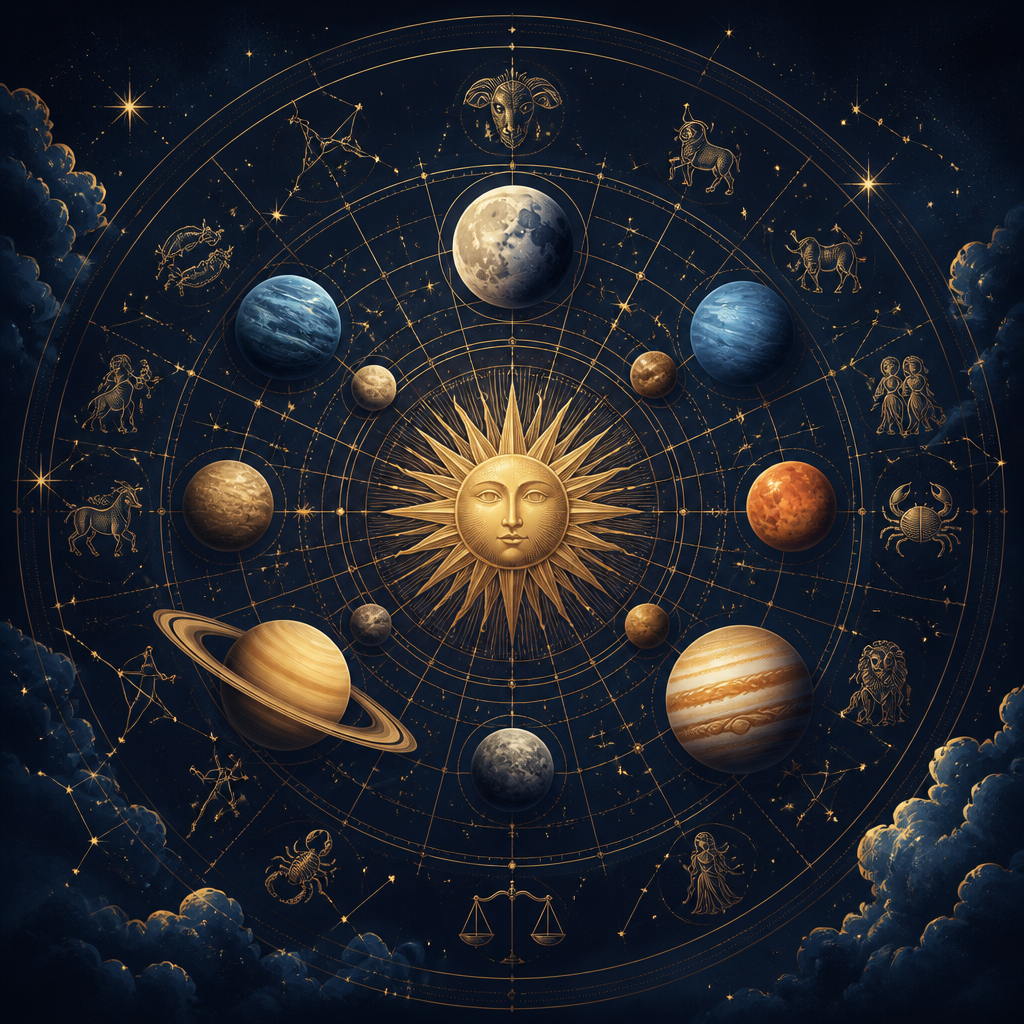
In astrology, planets represent different functions, drives, and areas of psychological experience. The zodiac sign shows how a planet tends to express itself, the house shows where that symbolism becomes active, and aspects describe how the planet interacts with other parts of the chart.
Learning the planets first gives you a strong foundation for reading a birth chart. Instead of memorizing hundreds of combinations, begin by understanding what each planet represents.
The Sun: Identity and Vitality
The Sun is the center of the solar system and, symbolically, one of the central points in a natal chart. It is associated with identity, purpose, vitality, creativity, confidence, and conscious self-expression.
Your Sun sign describes the style through which these themes are expressed. The house shows where you may seek visibility or a stronger sense of purpose. Aspects to the Sun can describe how identity interacts with emotions, discipline, relationships, ambition, or other functions.
The Moon: Emotion and Instinct
The Moon symbolizes emotional needs, habits, memory, instincts, comfort, and security. It can describe how you react before conscious analysis takes over and what helps you feel emotionally regulated.
The Moon changes signs quickly, which is why it adds important personal detail beyond the Sun sign. Its house often shows where emotional attention is concentrated.
Mercury: Communication and Thought
Mercury is associated with communication, reasoning, language, learning, curiosity, and the exchange of information. Its placement can describe whether someone tends to communicate directly, analytically, emotionally, imaginatively, or in another style.
Mercury also relates to how information is organized and how decisions are processed.
Venus: Values, Attraction, and Pleasure
Venus represents attraction, affection, relationships, pleasure, aesthetics, taste, values, and what you find desirable. It can describe how you give and receive appreciation and what qualities you value in connection.
Venus also has financial symbolism because it relates to value and resources, though financial interpretation requires looking at the rest of the chart.
Mars: Drive and Assertion
Mars represents motivation, action, desire, competition, anger, sexuality, and the way you assert yourself. Its sign can describe how you pursue goals, while its house shows where energy and conflict may be concentrated.
Mars is not simply aggression. It is the force that helps you act, defend boundaries, and move toward what you want.
Jupiter: Growth and Expansion
Jupiter is associated with growth, optimism, belief, opportunity, education, travel, meaning, generosity, and expansion. It often describes where you seek broader experience or where confidence can grow.
Jupiter can also exaggerate. Expansion is not always automatically beneficial; more of something can become excessive.
Saturn: Structure and Responsibility
Saturn symbolizes boundaries, discipline, responsibility, limitation, authority, patience, and long-term development. It often points to areas where progress requires time and effort.
Saturn is sometimes feared because it is associated with restrictions, but its constructive side includes mastery, commitment, realistic planning, and resilience.
Uranus: Change and Independence
Uranus represents disruption, innovation, independence, originality, rebellion, technology, and sudden change. It moves slowly, so people born within several years may share the same Uranus sign.
Its house and aspects to personal planets often reveal how its symbolism becomes more individually relevant.
Neptune: Imagination and Ideals
Neptune is linked with imagination, spirituality, compassion, ideals, dreams, creativity, sensitivity, and sometimes confusion or escapism.
Neptune can dissolve boundaries. Constructively, this may support empathy and artistic inspiration. Challenging expressions can include idealization, unclear expectations, or difficulty seeing a situation accurately.
Pluto: Transformation and Power
Pluto is associated with transformation, intensity, power, compulsion, endings, regeneration, and deep psychological processes. Like Uranus and Neptune, it moves slowly and has a generational sign placement.
Its personal importance often becomes clearer through house placement and close aspects to the Sun, Moon, Mercury, Venus, Mars, or chart angles.
Personal, Social, and Generational Planets
Astrologers often group planets by speed and function. The Sun, Moon, Mercury, Venus, and Mars are personal planets because they move relatively quickly and describe everyday individual functions.
Jupiter and Saturn are sometimes called social planets because they connect personal life with broader structures, growth, responsibility, and society. Uranus, Neptune, and Pluto are generational because their slow movement means large age groups share the same sign placements.
Planetary Rulerships
Each zodiac sign is traditionally associated with a ruling planet. Aries is ruled by Mars; Taurus by Venus; Gemini by Mercury; Cancer by the Moon; Leo by the Sun; Virgo by Mercury; Libra by Venus; Scorpio traditionally by Mars; Sagittarius by Jupiter; Capricorn by Saturn; Aquarius traditionally by Saturn; and Pisces traditionally by Jupiter.
Modern astrology commonly associates Pluto with Scorpio, Uranus with Aquarius, and Neptune with Pisces. Traditional and modern approaches differ, so it helps to know which system is being used.
What Does a Planet in a Sign Mean?
The planet represents a function, while the sign describes its style. Mars in Aries may act quickly and directly. Mars in Taurus may move more steadily and persistently. Mercury in Gemini may communicate rapidly and flexibly, while Mercury in Capricorn may prefer structure and practical conclusions.
No sign is inherently better for a planet. Each combination has strengths and challenges.
What Does a Planet in a House Mean?
The house identifies the life area where the planet’s symbolism is emphasized. Venus in the fifth house may connect attraction and pleasure with creativity, romance, or play. Venus in the tenth house may link aesthetics, diplomacy, or values with career and public role.
The same planet changes context when the house changes.
Why Aspects Matter
Planets rarely operate alone. Aspects describe their relationships. Mercury square Mars can make communication more forceful or argumentative. Mercury trine Saturn may support organized thinking and disciplined study.
An interpretation that ignores aspects can miss important dynamics.
Planetary Dignity
Traditional astrology includes a system known as essential dignity, which evaluates how comfortably a planet is considered to function in a sign. Categories include domicile, exaltation, detriment, and fall.
Beginners do not need dignity to start reading charts, but it can add nuance later. A planet in detriment is not “bad”; it may simply operate in a style that requires different strategies.
Retrograde Planets
Mercury through Pluto can appear retrograde from Earth. In a natal chart, retrograde planets are often interpreted as more internalized, reflective, or unconventional in expression.
A natal retrograde should never be treated as a defect. It is one additional condition affecting how the planet functions.
Planets Near the Angles
Planets close to the Ascendant, Descendant, Midheaven, or IC are often considered especially prominent. Mars near the Ascendant may be more visible in the person’s presentation, while Saturn near the Midheaven can emphasize responsibility or long-term career development.
Accurate birth time is important for angle-based interpretations.
How to Practice Planet Interpretation
Choose one planet and write down five core themes. Then add the sign, house, and strongest aspect. Build one sentence from those layers.
For example: “Venus represents values and relationships; in Virgo it expresses carefully and selectively; in the eleventh house it emphasizes friendships and communities; a trine to Saturn adds commitment and stability.”
This method is more reliable than memorizing a paragraph for every possible placement.
Avoid Planet Stereotypes
Saturn does not mean punishment, Mars does not mean violence, Neptune does not mean deception, and Pluto does not automatically mean crisis. Every planet has a spectrum of expression.
Interpretations become more balanced when both constructive and challenging possibilities are considered.
Related Astrology Guides
- What Is a Birth Chart?
- How to Read a Birth Chart
- Astrology Houses Explained
- Astrology Aspects Explained
- Astrology Transits Explained
Frequently Asked Questions
What does a planet represent in astrology?
Planets represent symbolic functions such as identity, emotion, communication, attraction, action, growth, responsibility, and long-term transformation.
Do planets mean the same thing in every chart?
The planet keeps its core symbolism, while its sign, house, aspects, and overall chart context shape how that symbolism is interpreted.
Final Thoughts
The planets are the main actors in astrology. The Sun describes identity, the Moon emotion, Mercury communication, Venus values and attraction, Mars drive, Jupiter expansion, Saturn structure, Uranus change, Neptune imagination, and Pluto transformation.
To read them well, always add the sign, house, aspects, and chart context. Once you understand what each planet represents, the birth chart becomes a connected symbolic system rather than a list of unrelated placements.
3 thoughts on “The Planets in Astrology: What Each Planet Represents”
Comments are closed.