Quick answer: The Ten of Swords Tarot card represents an ending, a painful conclusion, exhaustion, acceptance, and the moment when a difficult cycle can no longer continue in the same form. Upright, it can indicate that something has reached a decisive endpoint or that you are finally seeing the full reality of a situation. Reversed, it often points toward recovery, surviving a difficult period, resisting an inevitable conclusion, or slowly rebuilding after a setback. The Ten of Swords does not predict literal disaster. Its practical message is to recognize what has genuinely ended, stop investing energy in what cannot be restored in its previous form, and identify what becomes possible next.
Ten of Swords Tarot Card Meaning at a Glance
- Upright keywords: ending, painful conclusion, exhaustion, finality, acceptance, defeat, closure, truth, rock bottom, transition
- Reversed keywords: recovery, survival, rebuilding, release, resilience, resisting an ending, gradual improvement, second perspective
- Element: Air
- Suit: Swords
- Core question: What has actually reached its end, and what can I do once I stop fighting that reality?
What Does the Ten of Swords Mean in Tarot?
The Ten of Swords is one of the most visually dramatic cards in the Tarot, which is why it is frequently misunderstood. Traditional imagery can look severe, but the card should not be read as a prediction of physical harm, death, catastrophe, or unavoidable tragedy.
In practical readings, the Ten of Swords usually represents completion through difficulty. A situation has reached a point where continuing exactly as before is no longer realistic. This may involve a relationship dynamic, job, project, belief, conflict, expectation, habit, or period of intense mental strain.
The important word is completion. Ten is the final number of the numbered cards in each Minor Arcana suit. The Ten of Swords therefore often describes not an endless crisis, but the culmination of one. Something has reached its limit.
This distinction changes the card’s message. Instead of asking, “How bad will this become?” a grounded reading asks, “What is already showing me that this chapter cannot continue unchanged?”
Sometimes the answer is external: a contract ends, a project closes, a relationship reaches a clear conclusion, or a decision is made. At other times the ending is internal: you stop defending an unrealistic expectation, accept information you did not want to accept, or recognize that an old strategy no longer works.
Ten of Swords Upright Meaning
Upright, the Ten of Swords often appears when a difficult process reaches a decisive point. You may feel mentally exhausted from trying to maintain, repair, understand, or control something that has already changed significantly.
The card can represent disappointment or defeat, especially when expectations have collapsed. Yet defeat in this context does not mean permanent failure. It can mean that one specific approach, assumption, relationship pattern, or chapter has reached its endpoint.
There is also a strong theme of truth. The Ten of Swords can arrive when ambiguity is disappearing. You may not like what you now understand, but clarity can eventually be more useful than remaining trapped in uncertainty.
If you have been repeatedly trying the same solution without improvement, the card asks whether persistence has become attachment. There is a difference between working through a difficult period and refusing to acknowledge that the situation itself has fundamentally changed.
The healthiest expression of the upright Ten of Swords is acceptance without unnecessary dramatization. Name what has ended. Identify what remains. Preserve the lessons. Then begin directing energy toward recovery rather than repeatedly reopening the same conclusion.
Ten of Swords Upright Keywords
Ending, completion, exhaustion, painful truth, finality, closure, disappointment, surrender, acceptance, transition, reaching a limit, ending a cycle.
Ten of Swords Reversed Meaning
Reversed, the Ten of Swords often suggests recovery after a difficult ending. The worst part of a situation may be behind you, even if the consequences still require time and attention.
You may be rebuilding confidence after rejection, recovering professionally after a setback, adjusting to a relationship ending, or gradually releasing an old belief that kept you stuck. Improvement may be slow, but the direction has changed.
Another reversed interpretation is resistance. Sometimes the ending is clear, but you continue trying to return to the previous state. This can happen because the familiar feels safer than the unknown, even when the familiar is no longer working.
Ask whether you are genuinely repairing something viable or postponing an acknowledgment that has already become necessary. The answer depends on observable circumstances, not the card alone.
As a constructive reversal, the Ten of Swords emphasizes resilience. You survived something difficult. The next task is not to pretend it never happened, but to rebuild with better information.
Ten of Swords Reversed Keywords
Recovery, resilience, survival, rebuilding, improvement, releasing pain, resisting closure, delayed ending, learning from failure, starting again.
Ten of Swords Love Meaning
In love readings, the Ten of Swords can indicate that a painful relationship pattern has reached a limit. However, it should not automatically be translated as “breakup.” The ending may concern a specific dynamic rather than the relationship itself.
If You Are in a Relationship
Upright, the card can appear after prolonged conflict, repeated disappointment, damaged trust, emotional exhaustion, or a difficult truth. Something about the existing way the relationship functions may no longer be sustainable.
For some couples, this does coincide with separation. For others, what ends is a destructive communication pattern, unrealistic expectation, unresolved conflict cycle, or avoidance of a necessary conversation.
The Ten of Swords cannot prove infidelity, betrayal, or another person’s intentions. If you are concerned about those issues, use direct communication, observable evidence, boundaries, and appropriate professional support rather than treating the card as confirmation.
If both people want to continue the relationship, the useful question is whether the old pattern can end so that a healthier structure can begin. Repair requires more than reassurance; it requires changed behavior, accountability, and realistic expectations.
Reversed, the card may show recovery after a serious relationship crisis. It can also indicate difficulty accepting that a relationship or pattern has already ended. Context matters.
If You Are Single
For singles, the Ten of Swords can represent the final emotional stage of processing a past relationship. You may have spent considerable time replaying what happened, questioning your decisions, or hoping for a different conclusion.
The card encourages closure based on reality rather than perfect emotional certainty. You do not need to understand every detail of the past before moving forward.
Reversed, you may be gradually becoming available for new experiences. The goal is not to erase the past but to prevent an old ending from becoming the template for every future relationship.
Ten of Swords Career Meaning
In career readings, the Ten of Swords can represent the end of a job, project, professional chapter, strategy, or period of severe workplace stress. It may appear when a role is no longer sustainable or when an outcome you hoped for does not materialize.
If you recently experienced redundancy, rejection, a failed project, or a difficult performance outcome, the card acknowledges disappointment without defining your entire career by that event.
A practical reading focuses on what is now known. Which skills remain valuable? Which contacts can you maintain? What did the experience teach you about management, workload, company culture, or your own priorities?
If you are still employed but deeply exhausted, the Ten of Swords can signal that the current method of working has reached a limit. That does not automatically mean quitting. It may mean renegotiating responsibilities, changing teams, setting boundaries, seeking support, updating your skills, or creating an exit plan.
Reversed, professional recovery may be underway. You may begin interviewing again, rebuilding confidence, receiving new opportunities, or seeing that one setback did not eliminate your broader options.
Ten of Swords Money Meaning
Financially, the Ten of Swords can symbolize the culmination of a difficult financial period, an unsustainable spending pattern, the end of an income source, or the need to confront a financial reality directly.
The card should not be used to predict bankruptcy, financial ruin, or unavoidable loss. Instead, it asks whether a current approach has reached its limit.
If debt or cash-flow pressure is significant, gather exact numbers. Review balances, interest rates, minimum payments, income, essential expenses, due dates, and available assistance. A clear financial picture may be uncomfortable, but it creates a foundation for decisions.
Reversed, the card can indicate gradual stabilization: a repayment plan begins, expenses are restructured, income starts recovering, or you receive qualified advice. Recovery may take time, but the direction can improve once the old pattern is no longer repeated.
Ten of Swords as Advice
As advice, the Ten of Swords asks you to stop negotiating with a conclusion that reality has already made clear.
This does not mean giving up at the first difficulty. The card appears at ten, not two or three. It is associated with culmination. Before deciding that something is truly over, look at the evidence: What has been tried? What has changed? Is improvement occurring? Is the situation still viable?
If the answer shows genuine finality, acceptance becomes a form of efficiency. You can stop spending emotional, financial, or mental resources trying to recreate an earlier version of the situation.
Then ask a second question: what survives the ending? Your experience, skills, relationships, knowledge, values, and capacity to choose may remain even when a particular outcome does not.
Reversed as advice, focus on recovery rather than repeatedly proving how difficult the experience was. Let the lesson influence future decisions without allowing the setback to define your identity.
Ten of Swords as a Person
As a person, the Ten of Swords may describe someone who has recently experienced a significant disappointment or ending. They may feel exhausted, skeptical, guarded, or ready to leave a difficult chapter behind.
At their best, they can possess hard-earned realism. They understand that some situations cannot be repaired indefinitely and that accepting an ending can protect future energy.
At their most challenged, they may identify too strongly with being defeated or betrayed. Recovery involves separating the event from identity: something ended, but that does not mean the person is permanently defined by the ending.
Reversed, this person may be rebuilding resilience and becoming more willing to imagine a future beyond the setback.
Ten of Swords as Feelings
As feelings, the Ten of Swords can symbolize emotional exhaustion, disappointment, hurt, resignation, or the sense that a situation has reached a limit.
It may also indicate that someone is trying to process a difficult conclusion. However, Tarot cannot verify another person’s exact private thoughts or intentions. Use this position as a symbolic description of an emotional pattern, then rely on communication and observable behavior for real-world conclusions.
Reversed, feelings may be shifting from pain toward recovery. A person may still be hurt but increasingly ready to release the situation, rebuild trust in themselves, or consider what comes next.
Ten of Swords Yes or No
For a yes-or-no question, the Ten of Swords generally leans toward “no in its current form” or “this approach has reached its limit.”
That does not mean every future possibility is closed. It means the existing version of the situation may need to end before a different option can emerge.
Reversed, the answer may become more flexible if the question concerns recovery, rebuilding, or trying a genuinely different approach rather than repeating the same pattern.
Ten of Swords Symbolism
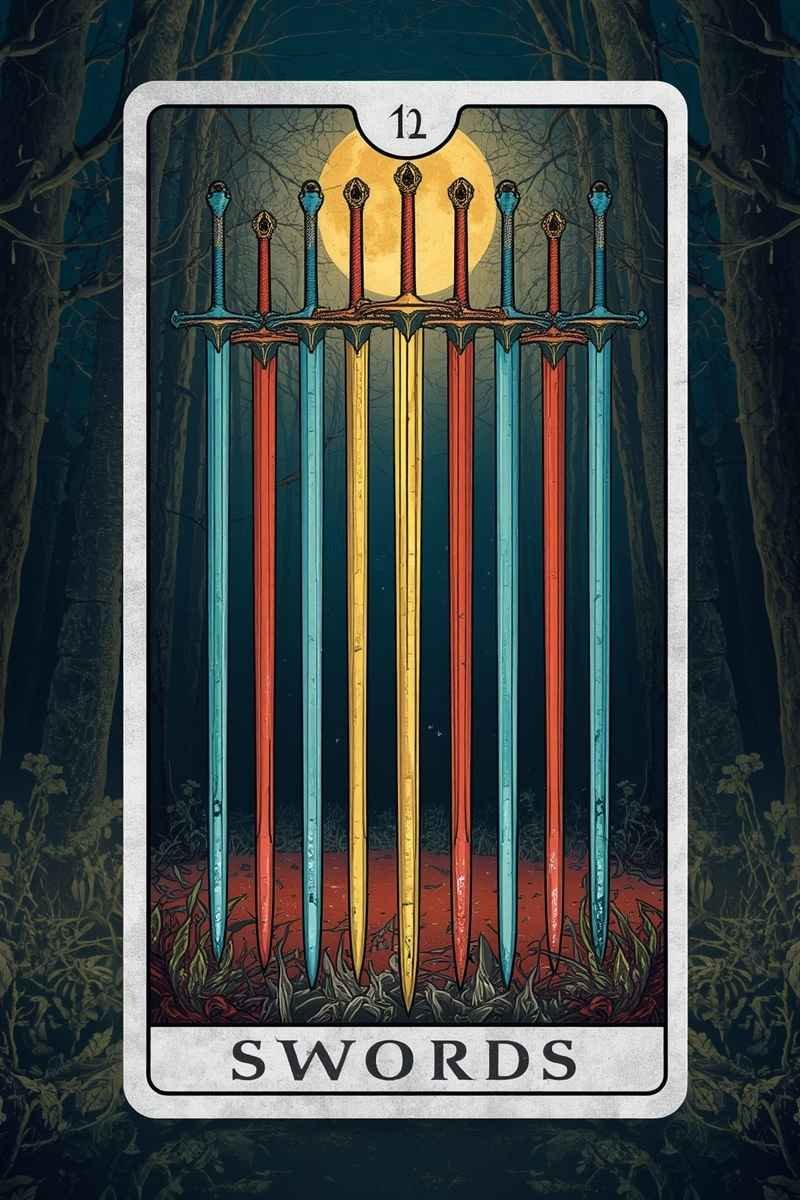
Traditional Rider-Waite-Smith imagery depicts a figure lying on the ground beneath ten swords. The image is dramatic and intentionally communicates finality. Yet the horizon often contains light, an important visual detail suggesting that an ending and a beginning can exist in the same scene.
The swords represent thought, communication, conflict, decisions, and truth. Ten swords can therefore symbolize mental overload or a situation in which there is nothing useful left to add to the argument.
The stillness of the figure contrasts with the coming light. Action may not begin by fighting harder. It may begin by accepting that one phase has completed.
This symbolism is why the Ten of Swords can ultimately be a card of transition. The ending is painful, but it also establishes a boundary between what has happened and what can happen next.
Ten of Swords in a Tarot Spread
Surrounding cards help identify what is ending and what follows. Pentacles may connect the conclusion to work, money, property, health routines, or practical stability. Cups can emphasize relationships, grief, attachment, or emotional closure. Wands may indicate burnout, ambition, conflict, or the end of a creative direction. Additional Swords can intensify themes of decisions, communication, truth, or mental exhaustion.
In a past position, the Ten of Swords can describe a difficult ending that still influences current expectations. In the present, it may indicate that a conclusion needs acknowledgment. In a future position, it can warn that an unsustainable pattern cannot continue indefinitely if nothing changes.
A future-position Ten of Swords should not be treated as a fixed prediction. Tarot is more useful when it identifies patterns and decision points than when it is used to declare unavoidable outcomes.
Ten of Swords vs. Nine of Swords
The Nine of Swords focuses on worry, guilt, fear, and anticipating painful possibilities. The Ten of Swords more often represents culmination: something has reached a conclusion or the limits of its current form have become difficult to deny.
With the Nine, the mind may be suffering before the facts are settled. With the Ten, more information may already be available and acceptance becomes central.
When both cards appear, distinguish between the actual ending and the additional mental suffering surrounding it. You may need both practical closure and emotional recovery.
Ten of Swords vs. Death Tarot Card
Both cards can represent endings, but their emphasis differs. Death is a Major Arcana card associated with broad transformation, transition, release, and the movement from one life phase into another. The Ten of Swords is usually more specific to a difficult culmination, mental exhaustion, painful truth, or a particular cycle reaching its limit.
Neither card predicts literal death. In most everyday readings, both are symbolic. The surrounding cards and the question determine which area of life is changing.
Ten of Swords vs. The Tower
The Tower often represents disruption, sudden revelation, instability, or the collapse of a structure that can no longer hold. The Ten of Swords focuses more on the endpoint after strain has accumulated.
The Tower can feel like the moment something breaks open. The Ten of Swords can feel like the moment you recognize that the chapter is finished.
If both appear, avoid assuming catastrophe. Look for the concrete structure, expectation, or pattern under pressure and consider what practical preparation or support is appropriate.
Does the Ten of Swords Mean Betrayal?
It can sometimes appear in readings involving betrayal, especially when trust has been seriously damaged. But betrayal is not the only meaning, and the card cannot prove that someone has deceived you.
The broader theme is a painful conclusion or realization. That can arise from many circumstances: incompatibility, burnout, failed expectations, poor communication, a business decision, an ending that both parties understand, or simply recognizing that something no longer works.
If you suspect betrayal in real life, use evidence, direct communication, appropriate boundaries, and qualified support where necessary. Do not use the Ten of Swords as proof.
Does the Ten of Swords Mean a Breakup?
Not automatically. In a relationship reading, it can indicate a breakup, but it can also describe the end of a destructive pattern within a continuing relationship.
For example, repeated avoidance may finally end because both people agree to communicate differently. An unrealistic expectation may be released. A long-running conflict may reach a point where a clear decision becomes necessary.
Look at the relationship itself rather than forcing the card into a predetermined outcome.
Is the Ten of Swords a Bad Tarot Card?
The Ten of Swords is difficult because it acknowledges pain, disappointment, exhaustion, and finality. But “difficult” is more accurate than “bad.”
An ending can protect you from continuing to invest in something that is no longer viable. A painful truth can be more useful than indefinite uncertainty. Reaching a limit can motivate boundaries, recovery, and a different strategy.
The card becomes constructive when it helps you recognize that the end of one specific situation is not the end of every possibility.
Practical Questions to Ask When You Draw the Ten of Swords
- What has genuinely reached its limit?
- Am I grieving an actual ending or resisting a change in form?
- What evidence tells me this chapter is complete?
- What have I already tried?
- What lesson should I carry forward?
- Which resources, skills, relationships, or opportunities remain?
- What would recovery look like in practical terms?
- Am I defining myself by a setback that happened to me?
- What can I stop doing now that the situation is clearer?
- What is the smallest constructive next step?
Ten of Swords Tarot Card FAQ
What is the main meaning of the Ten of Swords?
Its main meaning is a difficult ending, culmination, exhaustion, or acceptance that a cycle cannot continue in the same form. It also contains the possibility of recovery because finality creates space for a new phase.
What does the Ten of Swords mean in love?
It can represent relationship exhaustion, a painful truth, the end of a destructive pattern, or sometimes separation. It does not automatically predict a breakup or prove betrayal.
What does the Ten of Swords reversed mean?
Reversed, it often suggests recovery, resilience, rebuilding, surviving a difficult period, or gradually releasing pain. It can also indicate resisting an ending that has become difficult to avoid.
What does the Ten of Swords mean for career?
It can indicate the end of a job, project, strategy, or unsustainable work pattern. It may also represent professional disappointment followed by the need to regroup and identify new options.
Does the Ten of Swords mean someone betrayed me?
No. Betrayal is one possible context, but the card cannot verify another person’s actions. Use real evidence and communication to evaluate concerns about trust.
Does the Ten of Swords mean death?
No. The dramatic imagery is symbolic and should not be used to predict literal death. The card generally refers to endings, completion, exhaustion, truth, and transition.
Is the Ten of Swords yes or no?
It usually leans toward “no in its current form” or indicates that the existing approach has reached its limit. A different path may become possible after accepting the conclusion.
What is the advice of the Ten of Swords?
Recognize what is truly finished, stop spending resources trying to restore an unsustainable situation, preserve the lesson, and begin focusing on recovery and the next practical step.
Final Meaning of the Ten of Swords
The Ten of Swords is a Tarot card of endings, painful conclusions, exhaustion, acceptance, and transition. Its dramatic imagery can make it appear frightening, but a grounded interpretation does not treat it as a prediction of catastrophe.
Upright, it often indicates that a situation, strategy, expectation, or cycle has reached its limit. The challenge is to recognize the conclusion without turning one ending into a judgment about your entire future.
Reversed, the Ten of Swords can show recovery, resilience, rebuilding, or the gradual release of a difficult experience. It can also ask whether you are resisting an ending because the unknown feels less comfortable than the familiar.
In love, career, money, and personal development, the card offers a practical message: accept what the evidence shows, distinguish a specific ending from total defeat, preserve what you have learned, and redirect your energy toward what can still be built. The end of one chapter creates a boundary, not an empty future.