

Angel numbers and numerology both use numbers symbolically, but they are not the same system. Numerology is a structured interpretive framework that derives meaning from calculated numbers connected to your birth date, name, and personal cycles. Angel numbers usually refer to repeating or noticeable number sequences such as 111, 222, 333, 444, or 11:11 that people interpret as meaningful signs or spiritual messages.
The overlap is real: both systems assign symbolic meaning to numbers such as 1, 2, 3, 4, 5, and 9. But their methods, sources, and intended use are different. Numerology generally starts with a calculation. Angel-number practice usually starts with noticing a pattern.
This guide explains the difference between angel numbers and numerology, how each system works, where their interpretations overlap, and how to use both without mixing their rules or treating symbolic meanings as guaranteed predictions.
Quick Answer: Angel Numbers vs. Numerology
Numerology is a system of calculating and interpreting numbers from information such as your birth date and birth name. It includes numbers such as the Life Path Number, Expression Number, Birthday Number, Personal Year Number, and other chart positions.
Angel numbers are repeating, mirrored, or noticeable number sequences—such as 111, 222, 444, 777, 1111, or 12:12—that are interpreted by some spiritual traditions as synchronicities, reminders, or messages.
The simplest distinction is:
- Numerology asks: What numbers are mathematically derived from my personal data?
- Angel-number practice asks: What might this number sequence mean when I keep noticing it?
Numerology is usually chart-based and calculation-driven. Angel numbers are usually event-based and observation-driven.
What Is Numerology?
Numerology is an interpretive system that studies symbolic meanings assigned to numbers and number patterns. In popular Western numerology, calculations are often based on a person’s full birth date and birth name.
Common numerology calculations include:
- Life Path Number: calculated from the full birth date
- Birthday Number: based on the day of birth
- Expression or Destiny Number: calculated from the letters of the full birth name
- Soul Urge Number: often calculated from vowels in the birth name
- Personality Number: often calculated from consonants
- Personal Year Number: a changing annual cycle derived from the birth month, birth day, and calendar year
- Personal Month Number: a shorter cycle derived from the Personal Year and calendar month
Different numerology schools may use different rules, but the defining feature is that the numbers come from a repeatable calculation rather than from randomly noticing them during the day.
What Are Angel Numbers?
Angel numbers are number sequences that people interpret as meaningful because they appear repeatedly or at emotionally significant moments. Common examples include 111, 222, 333, 444, 555, 777, 888, 999, 1111, and mirrored times such as 12:12.
Someone might notice 444 on a receipt, then see 4:44 on a clock, and later encounter the number again on a license plate. In angel-number practice, that repetition may be treated as a synchronicity or symbolic prompt.
The term “angel number” is modern and does not belong to one universally standardized numerology tradition. Meanings vary across authors, spiritual communities, and social media sources. Some interpretations refer explicitly to angels or spirit guides, while others use the idea more loosely as a form of synchronicity or intuitive symbolism.
The Core Difference: Calculation vs. Observation
The biggest difference between numerology and angel numbers is how the number enters the interpretation.
Numerology begins with data. You take a birth date or name, apply a method, and derive a result. If two numerologists use the same calculation method and the same data, they should arrive at the same number.
Angel-number practice begins with observation. A person notices a sequence and then asks whether the repetition feels meaningful in the context of a current question, emotion, or situation.
That means numerology is generally more structured, while angel-number interpretation is more contextual and subjective.
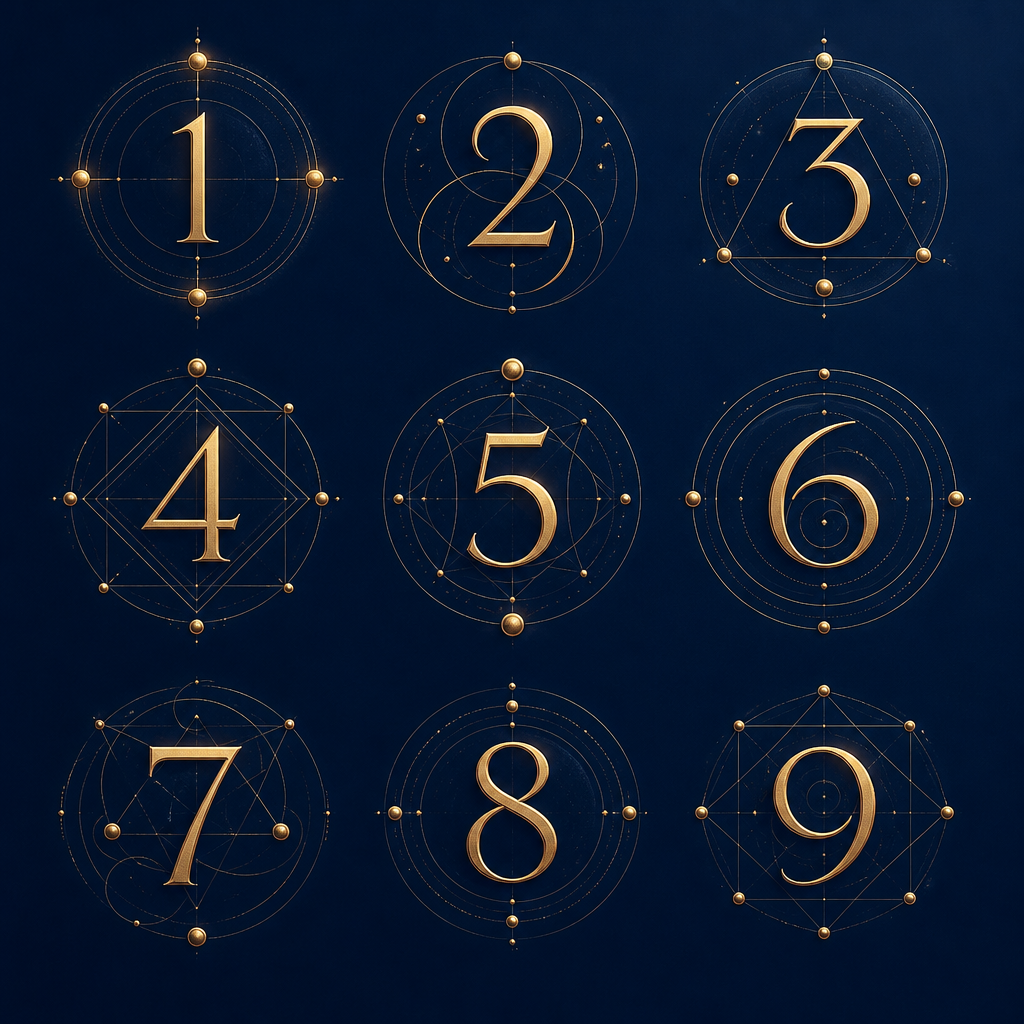
How Numerology Uses Single-Digit Meanings
Many forms of numerology reduce larger values to numbers from 1 to 9, while sometimes preserving master numbers such as 11, 22, and 33. These root numbers carry broad symbolic meanings.
- 1: initiative, independence, beginnings
- 2: cooperation, sensitivity, partnership
- 3: creativity, communication, expression
- 4: structure, discipline, stability
- 5: change, movement, freedom
- 6: responsibility, care, relationships
- 7: reflection, analysis, inner development
- 8: achievement, management, material results
- 9: completion, compassion, release
These meanings often influence angel-number interpretations as well, which is one reason the two systems can appear similar.
How Angel Numbers Use Repetition
Angel numbers often emphasize repeated digits. The repetition is treated as strengthening or highlighting the symbolic quality of a number.
For example:
- 111: often associated with beginnings, focus, intention, or attention to thought patterns
- 222: often associated with balance, patience, cooperation, or trust
- 333: often associated with creativity, communication, growth, or encouragement
- 444: often associated with stability, grounding, support, or structure
- 555: often associated with change, transition, flexibility, or movement
- 777: often associated with introspection, spiritual inquiry, or inner alignment
- 888: often associated with achievement, abundance, power, or practical results
- 999: often associated with completion, closure, compassion, or release
These meanings are not universally standardized. They are broad symbolic conventions rather than rules that can be objectively verified.
Is 11:11 Numerology or an Angel Number?
11:11 can be interpreted in both contexts, but the method is different.
In numerology, 11 is often treated as a master number associated with intuition, inspiration, sensitivity, or heightened awareness. A numerologist may study 11 if it appears through an actual chart calculation.
In angel-number practice, repeatedly seeing 11:11 on a clock may be interpreted as a synchronicity or reminder to become aware of your thoughts, intentions, or direction.
The same number can therefore carry related symbolism while entering the interpretation through different pathways.
Are Master Numbers the Same as Angel Numbers?
No. Master numbers are a numerology concept. The most commonly recognized master numbers are 11, 22, and 33. They are sometimes preserved instead of immediately reducing to 2, 4, and 6.
An angel number is a noticed sequence. It may contain a master number, such as 11:11 or 22:22, but that does not make every master number an angel number.
For example, if a Life Path calculation produces 22, that is a numerology result even if the person has never repeatedly seen 22 in daily life.
Can Angel Numbers Be Reduced Like Numerology Numbers?
Some people reduce angel-number sequences to a root digit, but that is an optional interpretive technique rather than a universal rule.
For example:
444 → 4 + 4 + 4 = 12 → 1 + 2 = 3
A numerologist might note both the strong repetition of 4 and the reduced root of 3. However, many angel-number interpretations focus primarily on the repeated digit itself.
If you combine methods, be clear about what you are doing. Otherwise, it becomes easy to produce multiple meanings and choose whichever interpretation feels most convenient.
Do Angel Numbers Have Personal Calculations?
Usually not in the same way numerology does. Angel-number interpretations are generally based on the sequence that appears rather than a fixed chart derived from your identity.
Some modern practices combine angel numbers with numerology by comparing a repeated sequence with the person’s Life Path, Personal Year, or other chart numbers. This can create an interesting reflective framework, but it is a hybrid approach rather than a traditional requirement.
Does Numerology Require You to See Repeating Numbers?
No. You can calculate a complete numerology chart without ever seeing a repeated number on a clock, receipt, or license plate.
A Life Path Number comes from the birth date. An Expression Number comes from the birth name. A Personal Year comes from a calendar-based formula. None of those calculations depend on synchronicity or repeated observation.
Do Angel Numbers Predict the Future?
Angel numbers should not be treated as reliable predictions of future events. Seeing 555 does not prove that a job change, breakup, move, or financial event will happen. Seeing 888 does not guarantee money or business success.
A more grounded use is to treat the sequence as a prompt. If 555 reminds you of change, you might ask what is already changing in your life and how you can respond intentionally. The number becomes a reflection cue rather than a forecast.
Does Numerology Predict the Future?
Numerology also should not be treated as scientifically validated forecasting. Personal Year and Personal Month cycles are often used to describe symbolic themes, but they do not establish what specific events will occur.
Numerology can help organize reflection around themes such as beginnings, structure, change, relationships, or completion. Practical decisions still depend on evidence, circumstances, preparation, finances, health, law, relationships, and other real-world factors.
Angel Numbers vs. Numerology: Side-by-Side Comparison
- Source of the number: Numerology derives numbers from names, birth dates, and cycles; angel numbers are noticed in everyday life.
- Method: Numerology uses formulas; angel numbers rely on observation and interpretation.
- Consistency: Numerology calculations can usually be repeated; angel-number experiences are personal and situational.
- Structure: Numerology has defined chart positions; angel numbers generally do not.
- Repetition: Repeating digits are central to angel numbers but not required in numerology.
- Master numbers: 11, 22, and 33 are formal concepts in many numerology systems; they may also appear inside angel-number sequences.
- Purpose: Both are often used for reflection, but numerology focuses more on chart patterns while angel numbers focus more on synchronicity and timing of attention.
Where the Two Systems Overlap
The main overlap is symbolic number meaning. Both systems may associate 1 with beginnings, 2 with partnership, 4 with stability, 5 with change, 7 with introspection, 8 with achievement, and 9 with completion.
This overlap does not mean they are identical. Think of the shared number meanings as a common symbolic vocabulary. Numerology organizes that vocabulary through calculations. Angel-number practice applies it to sequences that appear in lived experience.
Can You Use Angel Numbers and Numerology Together?
Yes, if you keep their roles clear. One practical approach is to use numerology as the structured background and angel numbers as occasional reflection prompts.
For example, imagine you are in a Personal Year 5, a numerology cycle traditionally associated with change and flexibility. If you repeatedly notice 444, you might use the contrast as a reflection prompt: change may be active, but where do you also need stronger structure?
This does not prove that the universe sent a specific instruction. It simply creates a structured way to think about two symbolic themes together.
How to Interpret Repeating Numbers Without Overthinking Them
Repeated numbers can become distracting if every clock time, invoice, or phone number is treated as a message. A balanced approach helps prevent confirmation bias from taking over.
Try this process:
- Notice the number without forcing meaning.
- Record the context. What were you thinking about when you saw it?
- Look at the broad symbolic theme.
- Ask a practical reflection question.
- Do not make major decisions solely because of the sequence.
This keeps the practice useful without making everyday coincidences feel controlling.
Common Mistakes When Comparing Angel Numbers and Numerology
Assuming every repeating number is part of your numerology chart
A repeated sequence you notice is not automatically a Life Path, Destiny, Personal Year, or other calculated chart number.
Assuming every numerology number is an angel number
Your Life Path 7 is a numerology result even if you never see 777.
Using social-media meanings as universal rules
Angel-number definitions vary widely. One source may call 444 “protection,” another may call it “stability,” and another may connect it with practical work. Treat meanings as symbolic conventions, not objective facts.
Ignoring context
The same symbolic number can be useful in different ways depending on your situation. A theme of change may relate to work, relationships, routine, beliefs, or something else entirely.
Turning symbolism into certainty
Neither angel numbers nor numerology can establish that a particular event is guaranteed to happen. Use them for reflection rather than certainty.
Which System Is Better for Beginners?
Angel numbers are often easier to start with because there is no chart calculation. You notice a sequence and read about its common symbolic meaning.
Numerology requires more structure but can offer a deeper framework. Learning your Life Path Number, Birthday Number, Expression Number, Personal Year, and Personal Month gives you several layers that can be compared consistently over time.
If you enjoy spontaneous symbolism, angel numbers may feel more intuitive. If you prefer formulas, repeatable calculations, and a structured chart, numerology may be more satisfying.
Frequently Asked Questions
Are angel numbers part of traditional numerology?
Not exactly. They borrow from number symbolism, but modern angel-number practice developed as its own popular spiritual framework rather than as a single standardized branch of classical numerology.
Is 111 a numerology number?
111 can be analyzed numerologically, but repeatedly noticing 111 is usually discussed as an angel-number experience. In numerology, you might also reduce it to 3 because 1 + 1 + 1 = 3.
Is 11 a master number or an angel number?
In numerology, 11 is a master number. If you repeatedly notice 11 or 11:11 in everyday life, people may also interpret that observation through angel-number symbolism.
Can my Life Path Number be an angel number?
Your Life Path Number is a numerology calculation. If you later keep noticing the same digit or sequence, you may choose to interpret that repetition symbolically, but the two concepts remain distinct.
Are angel numbers scientifically proven?
No. There is no scientific evidence that repeating number sequences are supernatural messages. Their value is spiritual, symbolic, or reflective rather than scientifically established.
Is numerology scientifically proven?
No. Numerology is also not a scientifically validated method for predicting personality or future events. It is best understood as a symbolic interpretive tradition.
Final Takeaway
Angel numbers and numerology share a language of number symbolism, but they use that language differently. Numerology calculates numbers from personal data and organizes them into chart positions and cycles. Angel-number practice begins with repeated or striking sequences noticed in everyday life.
If you want a structured system, numerology offers repeatable calculations such as the Life Path, Expression Number, Personal Year, and Personal Month. If you are interested in synchronicity and spontaneous reflection, angel numbers provide a looser, more intuitive framework.
You do not have to choose one over the other. The key is to avoid confusing their methods. Use calculated numerology numbers as chart information, use repeated sequences as reflection prompts if they are meaningful to you, and avoid treating either system as proof of what must happen next.