Name numerology turns letters into numbers so a name can be interpreted as a symbolic pattern. In the most common Western system, each letter is assigned a value from 1 to 9. Those values are then added and reduced to calculate chart positions such as the Expression Number, Soul Urge Number, and Personality Number.
The basic idea is simple: letters are converted into numbers through a fixed chart. The interpretation comes afterward. If two people use the same spelling and the same numerology system, they should arrive at the same numerical total before interpretation begins.
This guide explains exactly how letters become numbers, how to calculate the main name-based numerology numbers, why spelling matters, what master numbers mean, and how to avoid common calculation mistakes.
Quick Answer: How Do Letters Become Numbers in Numerology?
In Pythagorean numerology, the alphabet is assigned numbers from 1 to 9 in repeating order:
- 1: A, J, S
- 2: B, K, T
- 3: C, L, U
- 4: D, M, V
- 5: E, N, W
- 6: F, O, X
- 7: G, P, Y
- 8: H, Q, Z
- 9: I, R
To calculate a name number, convert each letter to its numerical value, add the values, and reduce the total to a single digit unless your method preserves a master number such as 11, 22, or 33.
For example:
ANNA = A(1) + N(5) + N(5) + A(1) = 12 → 1 + 2 = 3
In this simplified example, the name ANNA reduces to the number 3.
What Is Name Numerology?
Name numerology is the branch of numerology that assigns numerical values to letters and interprets the resulting totals. Instead of using a birth date, name numerology works with the letters in a person’s name.
Different traditions use different letter-number systems. The two best-known Western approaches are the Pythagorean system and the Chaldean system. They do not assign the same values, so a calculation should always state which system is being used.
This article focuses on the Pythagorean method because it is the most widely used in modern Western numerology and is relatively easy to calculate consistently.
Numerology is an interpretive spiritual framework rather than a scientifically validated method of measuring personality or predicting events. It is best used for symbolic reflection, not as evidence that a name determines destiny.
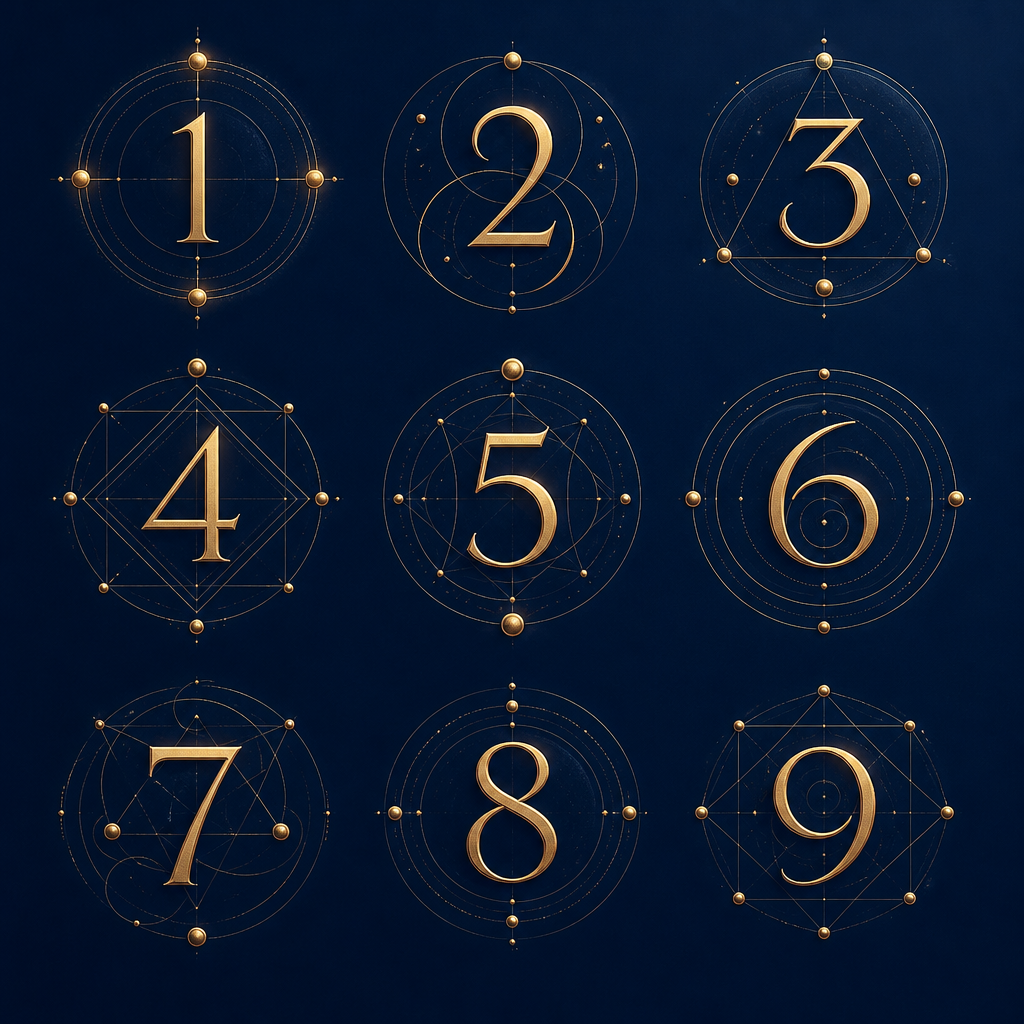
The Pythagorean Letter-to-Number Chart
The Pythagorean chart cycles through the numbers 1 to 9 repeatedly across the English alphabet.
- A = 1
- B = 2
- C = 3
- D = 4
- E = 5
- F = 6
- G = 7
- H = 8
- I = 9
- J = 1
- K = 2
- L = 3
- M = 4
- N = 5
- O = 6
- P = 7
- Q = 8
- R = 9
- S = 1
- T = 2
- U = 3
- V = 4
- W = 5
- X = 6
- Y = 7
- Z = 8
Because the sequence repeats, J returns to 1 after I reaches 9, and the cycle continues through Z.
How to Calculate a Name Number Step by Step
The process is straightforward when you keep the spelling and system consistent.
Step 1: Write the full name exactly as required
For core name numerology, many practitioners use the full birth name as it appears on the original birth record. This is especially common when calculating the Expression or Destiny Number.
Other calculations may use a current name, married name, professional name, nickname, or business name, but those are usually interpreted as additional layers rather than replacements for the birth-name calculation.
Step 2: Convert each letter into a number
Use the Pythagorean chart and write the number below each letter.
Example:
DAVID
D = 4, A = 1, V = 4, I = 9, D = 4
Step 3: Add the values
For DAVID:
4 + 1 + 4 + 9 + 4 = 22
Step 4: Reduce the total if your method requires it
In many numerology systems, 22 is preserved as a master number rather than reduced immediately to 4. The result may therefore be written as 22/4.
If your method does not preserve master numbers, you would calculate:
2 + 2 = 4
The important rule is consistency. Do not preserve 22 in one example and reduce it in another simply because one interpretation seems more appealing.
What Is the Expression or Destiny Number?
The Expression Number, also called the Destiny Number in many modern systems, is calculated from all letters in the full birth name.
It is traditionally interpreted as a symbol of talents, capacities, tendencies, and the ways a person may express potential in the world.
To calculate it:
- Write the full birth name.
- Convert every letter into its Pythagorean numerical value.
- Add all values.
- Reduce the total while following your chosen master-number rule.
Because this calculation uses all letters, both vowels and consonants contribute to the result.
What Is the Soul Urge Number?
The Soul Urge Number, sometimes called the Heart’s Desire Number, is generally calculated from the vowels in the full birth name.
In English-language Pythagorean numerology, the usual vowels are A, E, I, O, and U. The letter Y can be treated differently depending on how it functions phonetically in the name and on the practitioner’s rules.
The Soul Urge Number is traditionally associated with inner motivation, emotional preferences, private desires, and what feels personally meaningful.
For the name DAVID, the vowels are A and I:
A(1) + I(9) = 10 → 1
Under this method, DAVID would have a Soul Urge result of 1 for the first name alone. A full chart would normally use the complete birth name.
What Is the Personality Number?
The Personality Number is usually calculated from the consonants in the full birth name.
It is traditionally interpreted as the outward impression, social presentation, or qualities that others may notice first.
Using DAVID again, the consonants are D, V, and D:
D(4) + V(4) + D(4) = 12 → 3
Again, a full chart would use the entire birth name rather than only one first name.
Expression, Soul Urge, and Personality: How They Fit Together
These three name-based numbers use the same letter-to-number chart but different subsets of the name.
- Expression Number: all letters
- Soul Urge Number: vowels
- Personality Number: consonants
This creates three perspectives from one name. The Expression Number looks at the whole pattern, the Soul Urge focuses on the inward vowel pattern, and the Personality Number focuses on the outward consonant pattern.
They should not be treated as three separate predictions. A more useful approach is to compare them and ask how their symbolic themes reinforce or challenge one another.
What Do the Numbers 1 to 9 Mean in Name Numerology?
The final reduced number is interpreted through the broader symbolic vocabulary of numerology.
- 1: independence, initiative, originality, leadership
- 2: cooperation, sensitivity, diplomacy, partnership
- 3: creativity, expression, communication, sociability
- 4: structure, reliability, discipline, practical effort
- 5: flexibility, movement, curiosity, change
- 6: care, responsibility, harmony, relationships
- 7: analysis, reflection, privacy, inner development
- 8: ambition, organization, authority, material achievement
- 9: compassion, completion, idealism, service
The meaning depends on the chart position. A 5 Expression Number is interpreted differently from a 5 Soul Urge because the position changes the question being asked.
What About Master Numbers 11, 22, and 33?
Many modern numerology systems recognize 11, 22, and 33 as master numbers. When one of these appears as a meaningful final or intermediate result, some practitioners preserve it instead of reducing immediately.
- 11/2: intuition, inspiration, sensitivity, vision
- 22/4: large-scale building, organization, practical manifestation
- 33/6: service, teaching, compassion, responsibility
These interpretations are symbolic traditions, not objective measurements. They are best treated as added layers of meaning rather than evidence that someone is more evolved, gifted, or destined than another person.
Does Spelling Matter in Name Numerology?
Yes. Spelling changes the numerical total. Adding, removing, or changing a letter can change the result because each letter carries a fixed value.
For example, ANN and ANNE are not numerically identical:
ANN = A(1) + N(5) + N(5) = 11
ANNE = A(1) + N(5) + N(5) + E(5) = 16 → 7
That is why a numerology reading should specify which version of a name is being calculated.
Should You Use Your Birth Name or Current Name?
For the main Expression, Soul Urge, and Personality calculations, many practitioners prefer the full birth name because it provides a stable reference point.
A current legal name, married name, nickname, or professional name can also be calculated, but it is often interpreted as a secondary influence connected with how the person currently presents or identifies themselves.
There is no scientifically established rule proving that one version of a name has metaphysical priority. The choice belongs to the numerology tradition you are using. The important thing is to label the calculation clearly.
What About Middle Names and Multiple Surnames?
If you are calculating the full birth-name Expression Number, include the complete name according to the system you have chosen. That generally means first name, middle name or names, and surname or surnames.
Do not silently omit a middle name because it makes the calculation easier. If the method calls for the full birth name, consistency matters more than convenience.
How Is Chaldean Name Numerology Different?
Chaldean numerology uses a different assignment system and traditionally works with numbers 1 through 8 for most letters. The values are not simply the repeating A=1, B=2 sequence used in Pythagorean numerology.
Because the mapping differs, the same name can produce a different total under the Chaldean method.
This is not necessarily a contradiction. It means the two systems are different interpretive frameworks. Problems arise only when values from one system are mixed with reduction rules from another without explanation.
Can You Calculate a Business or Brand Name?
Yes. Modern numerology often applies letter-number calculations to business names, brand names, product names, and project names.
The calculation process is the same: choose a system, convert the letters, total them, and interpret the result. However, a business-name number should not be treated as a guarantee of commercial success.
Real business outcomes depend on product quality, market demand, pricing, customer acquisition, operations, capital, competition, legal conditions, and execution. Numerology can serve as a branding reflection tool, but not as a substitute for business analysis.
Can Changing Your Name Change Your Numerology?
Changing the spelling of a name changes its numerical value, so the calculated current-name pattern can change.
That does not prove that changing one letter will automatically change a person’s fate, income, relationships, or health. A grounded interpretation treats a new name as a new symbolic pattern rather than a guaranteed mechanism for producing specific events.
If you are considering a legal or professional name change, practical factors such as identity, family, culture, documents, branding, and personal comfort matter far more than chasing a numerology total.
Common Mistakes in Name Numerology
Mixing Pythagorean and Chaldean values
Choose one letter-number system for the calculation. Mixing values makes the result internally inconsistent.
Using only a first name for a full Expression Number
A first-name analysis can be interesting, but it is not the same as a full birth-name Expression calculation.
Forgetting vowels and consonants use different subsets
The Soul Urge uses vowels, while the Personality Number uses consonants. The Expression Number uses both.
Reducing too early
Premature reduction can erase meaningful intermediate results, especially if your method recognizes master numbers or compound numbers.
Changing spelling to force a preferred number
You can calculate alternative spellings, but selectively changing a name only to obtain a desirable interpretation can turn the process into confirmation bias.
How to Use Name Numerology Practically
Name numerology is most useful when it prompts reflection rather than certainty. After calculating a number, ask questions such as:
- Which qualities associated with this number do I already express?
- Which qualities feel underdeveloped or exaggerated?
- Does my Soul Urge theme differ from how I present socially?
- Does my Expression Number describe strengths I actually use?
- How does my name-based pattern compare with my Life Path Number?
The goal is not to make the number fit every detail of your life. It is to use the symbolic language as a structured way to notice patterns and ask better questions.
Name Numerology vs. Birth-Date Numerology
Name numerology and birth-date numerology use different source material.
Birth-date numerology calculates numbers such as the Life Path, Birthday Number, Personal Year, and Personal Month from dates.
Name numerology calculates numbers such as the Expression, Soul Urge, and Personality Number from letters.
A complete modern numerology chart often combines both. The Life Path may describe a broad life theme, while the Expression Number adds a symbolic perspective on capacities and expression.
Frequently Asked Questions
What numerology system assigns A=1, B=2, C=3?
The common Western Pythagorean system assigns letters in a repeating 1-to-9 sequence, beginning with A=1, B=2, and C=3.
What number is the letter Z in Pythagorean numerology?
Z is assigned the number 8 because the 1-to-9 cycle repeats through the alphabet.
Does Y count as a vowel in name numerology?
It depends on the method and how Y functions in the specific name. Some practitioners treat Y as a vowel when it produces a vowel sound and as a consonant in other cases. State your rule and use it consistently.
Can two people have the same Expression Number?
Yes. Many different names can reduce to the same final number. The number is a symbolic category, not a unique identifier.
Is the Expression Number the same as the Life Path Number?
No. The Expression Number is calculated from the full birth name, while the Life Path Number is calculated from the full birth date.
Can a name number be 11, 22, or 33?
Yes, in systems that preserve master numbers. The result may be written as 11/2, 22/4, or 33/6 to show both the master number and its reduced root.
Is name numerology scientifically proven?
No. There is no scientific evidence that letter-number calculations objectively determine personality, destiny, or future events. Name numerology is best understood as a symbolic interpretive tradition.
Final Takeaway
Name numerology works by converting letters into numbers through a fixed mapping system and then interpreting the resulting totals. In the Pythagorean method, letters cycle through values 1 to 9, allowing names to be calculated in a repeatable way.
The full birth name is commonly used to calculate the Expression Number. Vowels are used for the Soul Urge Number, and consonants for the Personality Number. Master numbers such as 11, 22, and 33 may be preserved depending on the numerology school.
The calculation itself should be consistent and transparent. The interpretation should remain flexible. Use name numerology as a framework for reflection, not as proof that spelling determines fate or guarantees what will happen next.