Quick answer: The Eight of Swords Tarot card represents feeling restricted, uncertain, or unable to see a clear way forward. Upright, it often points to self-doubt, limiting beliefs, fear of making the wrong choice, or circumstances that seem to leave very little room to move. Reversed, it can show perspective returning, greater personal agency, challenging old assumptions, and beginning to release yourself from a restrictive situation. The central message is not that you are permanently trapped, but that the path forward may become clearer when you separate real constraints from fear-based assumptions.
Eight of Swords Tarot Card Meaning at a Glance
The Eight of Swords belongs to the Suit of Swords, associated with thought, communication, truth, decisions, conflict, and mental patterns. In traditional imagery, a bound and blindfolded figure stands among swords. The image looks restrictive, yet it also suggests that not every barrier is absolute.
- Upright keywords: restriction, self-doubt, fear, limited perspective, overthinking, helplessness, uncertainty, mental blocks
- Reversed keywords: release, empowerment, perspective, freedom, self-awareness, challenging fear, new options, recovery
- Element: Air
- Suit: Swords
- Core question: Which limits are real, and which limits become weaker when you examine them more closely?
What Does the Eight of Swords Mean in Tarot?
At its core, the Eight of Swords describes a situation in which your perceived options feel narrower than they may actually be. You may feel caught between competing responsibilities, worried about consequences, or convinced that every available choice will create another problem.
Some restrictions can be very real. Financial obligations, workplace rules, family responsibilities, contracts, health limitations, or another person’s decisions may genuinely affect what you can do. A grounded Tarot reading should never dismiss those realities by claiming that every obstacle exists only in your mind.
However, the Eight of Swords asks you to examine whether fear is making the situation even smaller. You may be assuming that you have no options when the truth is that the available options are uncomfortable, imperfect, or require help. That distinction matters.
The card encourages careful reality testing. What do you know for certain? What are you predicting? What have you not asked yet? Which boundary is fixed, and which one could potentially be negotiated? When you answer these questions, a situation that initially looked completely closed may reveal one workable next step.
Eight of Swords Upright Meaning
When the Eight of Swords appears upright, you may feel mentally or practically restricted. Perhaps you are waiting for someone else’s decision, afraid to speak honestly, uncertain about changing direction, or overwhelmed by possible consequences.
Self-doubt is a major theme. You may underestimate your ability to handle the outcome of a decision. The mind can become focused on everything that could go wrong while ignoring evidence that you have solved difficult problems before.
Upright, the card can also indicate overthinking. Instead of gathering useful information and making a decision, you may repeatedly analyze the same possibilities. More thinking does not always produce more clarity when the missing ingredient is action, communication, or outside perspective.
The Eight of Swords does not advise reckless escape. It asks for an accurate assessment of your constraints. Identify what cannot currently be changed, then focus attention on what remains within your influence.
Eight of Swords Upright Keywords
Restriction, self-doubt, helplessness, uncertainty, fear, overthinking, limited perspective, mental blocks, hesitation, powerlessness, feeling stuck, lack of confidence.
Eight of Swords Reversed Meaning
Reversed, the Eight of Swords often marks the beginning of release. You may realize that a situation has more flexibility than you assumed, become willing to ask for help, challenge an old belief, or take a step you previously considered impossible.
This reversal is often about reclaiming agency gradually rather than experiencing instant freedom. A difficult situation may still exist, but your relationship to it changes. Instead of asking only, “Why can’t I move?” you begin asking, “What can I do from where I am?”
The reversed card can also represent confronting fear directly. You may recognize that avoiding a decision has become more restrictive than making one. Clarity develops because you are willing to test assumptions rather than treating every anxious prediction as a fact.
In some contexts, reversed Eight of Swords can indicate continued entrapment because a person is resisting available help or returning to familiar limiting patterns. Surrounding cards and real-life circumstances help distinguish release from deeper avoidance.
Eight of Swords Reversed Keywords
Release, empowerment, perspective, freedom, self-awareness, new options, courage, recovery, challenging beliefs, accepting help, taking responsibility.
Eight of Swords Love Meaning
In love readings, the Eight of Swords often appears when fear, uncertainty, or limited communication makes a relationship feel more restrictive than supportive. It may describe difficulty expressing needs, fear of losing the relationship, anxiety about commitment, or feeling unable to make a decision.
If You Are in a Relationship
Upright, you may feel that there is no safe way to discuss an important issue. Perhaps you worry that honesty will create conflict, disappointment, or separation. As a result, the same concern remains unresolved.
The card can also indicate a relationship in which practical constraints are significant. Shared finances, children, housing, distance, family expectations, or other responsibilities can make decisions complicated. Tarot should not reduce these realities to “just change your mindset.” Instead, identify which practical resources, conversations, or professional support could expand your choices.
If the relationship includes coercion, threats, isolation, or abuse, prioritize real-world safety and qualified support rather than relying on Tarot to determine what to do.
Reversed, communication may become easier or you may recognize that you have more agency than you previously believed. You might set a boundary, ask directly for what you need, seek counseling, or make a decision that has been postponed.
If You Are Single
For singles, the Eight of Swords can reflect fear of repeating past relationship patterns. You may want connection while simultaneously expecting disappointment, rejection, or loss of independence.
It can also suggest rigid assumptions such as “I always choose the wrong people” or “healthy relationships are not available to me.” These thoughts can feel convincing, but they are interpretations rather than permanent facts.
Reversed, you may become more open to dating differently. This could mean changing boundaries, communicating expectations earlier, slowing down, or simply allowing new experiences to challenge old conclusions.
Eight of Swords Career Meaning
In career readings, the Eight of Swords often represents feeling trapped in a role, organization, or professional direction. You may believe that leaving is impossible, promotion is unavailable, or changing careers would be too risky.
Some limitations may be concrete. You may need stable income, benefits, visa sponsorship, specific qualifications, or a schedule that supports family responsibilities. Recognizing these constraints helps you build a realistic strategy instead of making impulsive decisions.
At the same time, investigate assumptions. Have you actually researched alternative roles? Could you build a new skill while remaining employed? Is there another department, schedule, employer, or income structure you have not considered?
The card can also describe low confidence at work. You may hesitate to contribute ideas, negotiate, apply for a position, or take ownership because you assume others are more qualified. Gather objective evidence about your performance rather than allowing anxiety to write the entire story.
Reversed, career options may begin opening. You could update your résumé, start networking, ask for clearer responsibilities, seek training, or finally apply elsewhere. Progress often begins with one concrete action rather than a dramatic resignation.
Eight of Swords Money Meaning
Financially, the Eight of Swords can represent feeling squeezed by expenses, debt, limited income, or fear about the future. When money is tight, anxiety can make it difficult to look at the numbers directly.
The practical advice is to replace vague fear with specific information. List obligations, interest rates, deadlines, income, savings, and flexible expenses. Knowing the exact shape of the problem can reveal choices that generalized worry hides.
Avoid interpreting this card as a promise that financial restrictions will disappear through positive thinking. Some situations require negotiation, professional financial advice, additional income, formal assistance, or a longer recovery plan.
Reversed, you may begin taking control of financial decisions. This could involve restructuring debt, cancelling unnecessary expenses, creating a repayment plan, discussing shared finances openly, or asking for qualified help.
Eight of Swords as Advice
As advice, the Eight of Swords asks you to distinguish facts from assumptions. Write down what is genuinely preventing you from moving forward. Then write down what you fear might happen. These lists are often not identical.
Do not force yourself to solve everything at once. Look for the smallest action that creates additional information or flexibility. One phone call, application, conversation, appointment, budget review, or boundary can change the shape of the problem.
Seek perspective from someone who is not inside the same mental loop. A trusted person, mentor, counselor, financial professional, career adviser, or other qualified source may see options that are difficult to recognize when you are overwhelmed.
Reversed as advice, use the freedom you are beginning to recognize. Do not wait until fear disappears completely. Confidence often develops after responsible action, not before it.
Eight of Swords as a Person
As a person, the Eight of Swords can describe someone cautious, self-questioning, mentally overwhelmed, or highly aware of possible consequences. They may struggle to make decisions because they can imagine many ways a situation could go wrong.
This person may be intelligent and perceptive but lack confidence in their own judgment. They can benefit from clearer boundaries, practical information, and experiences that demonstrate their ability to cope with uncertainty.
Reversed, the person may be becoming more assertive, independent, and willing to challenge beliefs that previously kept them stuck.
Eight of Swords as Feelings
As feelings, the Eight of Swords can indicate anxiety, hesitation, uncertainty, or feeling unable to express emotions freely. Someone may feel conflicted about what they want or worried about the consequences of acting on their feelings.
This does not reveal another person’s private thoughts with certainty. It is better used to describe the emotional dynamic suggested by the reading than to claim that Tarot has verified exactly what someone thinks.
Reversed, emotional pressure may begin easing. A person may become more willing to communicate, admit uncertainty, or stop allowing fear to determine every choice.
Eight of Swords Yes or No
For a simple yes-or-no question, the Eight of Swords generally leans toward “not yet” or “not under the current conditions.” There may be restrictions, missing information, or fear preventing a clear decision.
Rather than treating this as a permanent no, ask what condition would need to change. Reversed, the answer can become more favorable as limitations are addressed and options become clearer.
Eight of Swords Symbolism
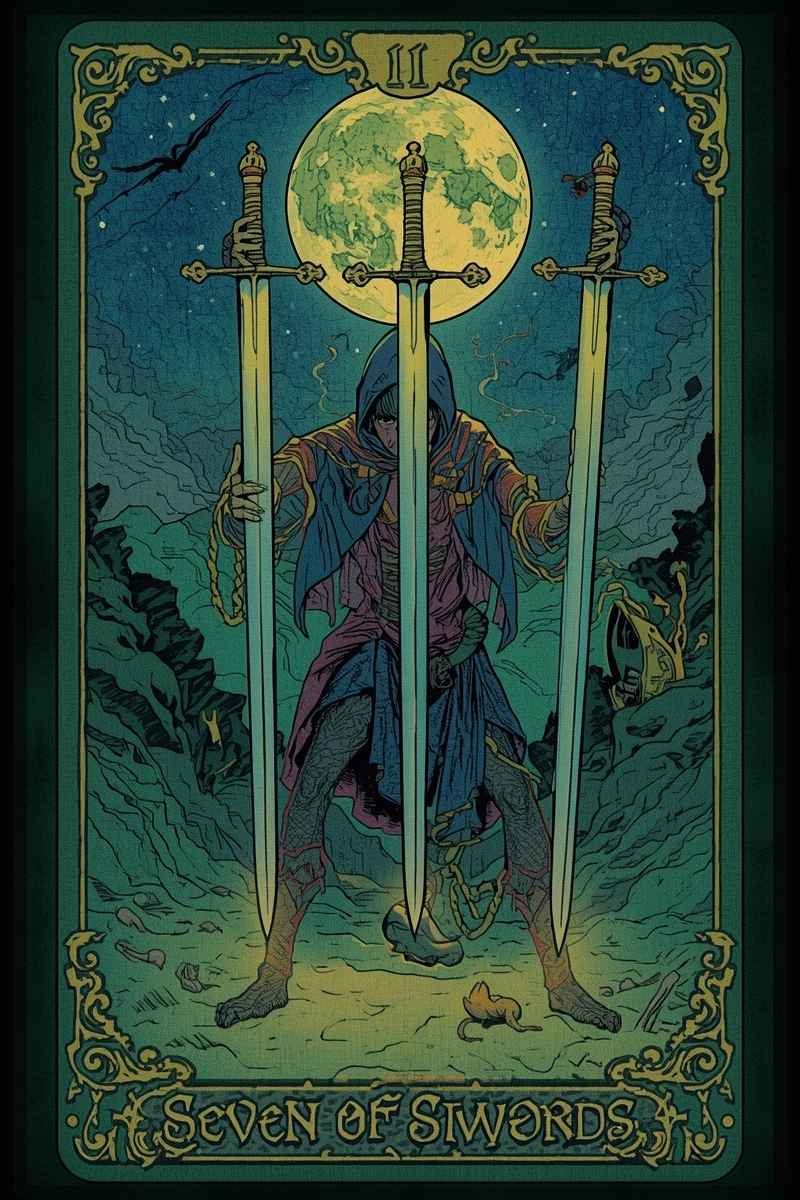
Traditional Eight of Swords imagery typically shows a blindfolded and loosely bound figure surrounded by swords. The blindfold symbolizes limited perspective: the person cannot currently see the entire situation.
The bindings suggest restriction, but they often appear less absolute than they first seem. This supports the card’s central tension between genuine constraints and perceived helplessness.
The surrounding swords can resemble a barrier, yet the enclosure may not be completely sealed. Symbolically, this suggests that escape may require awareness, assistance, careful movement, or a change in perspective rather than brute force.
The distant landscape can represent a wider world beyond the immediate problem. When attention is consumed by fear, it is easy to forget that the present situation is not necessarily the entire future.
Eight of Swords in a Tarot Spread
Context determines how the Eight of Swords should be interpreted. With supportive Pentacles, practical resources, budgeting, work, or stability may be central. Cups can emphasize emotional fear and relationship dynamics. Wands may point toward confidence, initiative, or the tension between wanting action and feeling unable to move. Other Swords can intensify overthinking, communication issues, or difficult decisions.
In a past position, the card may describe a period of restriction or a belief formed during a difficult experience. In the present, it highlights current constraints and perceptions. In a future position, it can warn against allowing fear or incomplete information to narrow your options unnecessarily.
Eight of Swords vs. Nine of Swords
The Eight of Swords focuses on restriction and perceived lack of options. The Nine of Swords emphasizes worry, guilt, mental distress, and repetitive anxious thinking. The Eight asks, “Where can I move?” while the Nine often asks, “How do I stop my mind from repeating the worst possibilities?”
When both appear, practical limitations and anxiety may be reinforcing each other. Separate the solvable external problem from the mental stress surrounding it, then address each appropriately.
Eight of Swords vs. The Devil
Both cards can describe feeling trapped, but their emphasis differs. The Eight of Swords often highlights fear, limited perspective, and uncertainty about available choices. The Devil may emphasize attachment, compulsion, unhealthy patterns, temptation, dependency, or power dynamics.
Together, they can suggest that a restrictive pattern deserves serious examination. Avoid fatalistic interpretations. Instead, identify concrete behaviors, incentives, dependencies, and support systems that maintain the pattern.
Is the Eight of Swords Always About Being Trapped?
No. Feeling trapped is a central theme, but the card is more nuanced than permanent imprisonment. It often describes a moment when options are difficult to see or feel unsafe to pursue.
The Eight of Swords can therefore be a card of potential agency. Its value lies in asking whether every apparent barrier is equally solid. Some constraints may require acceptance or careful planning; others may weaken once you gain information, ask for help, or challenge an assumption.
Practical Questions to Ask When You Draw the Eight of Swords
- What is objectively limiting me right now?
- Which part of the situation is based on an assumption?
- What information would make the next decision easier?
- Who could provide useful outside perspective?
- Am I waiting to feel completely confident before acting?
- What is one low-risk step that would create more options?
- What support would make this situation safer or more manageable?
Eight of Swords Tarot Card FAQ
Is the Eight of Swords a negative Tarot card?
It is challenging because it highlights restriction, fear, and self-doubt, but it also contains an important message about perspective and agency. It can reveal where a problem needs to be examined more accurately.
What does the Eight of Swords mean in love?
It can represent feeling unable to express needs, fear of making a relationship decision, anxiety about losing someone, or practical circumstances that complicate the relationship. Reversed, communication and personal agency may improve.
Does the Eight of Swords mean a relationship is over?
No. The card alone does not predict a breakup. It describes restriction, uncertainty, fear, or limited choices. The real relationship context and actions of the people involved matter more than a single card.
What does the Eight of Swords reversed mean?
Reversed, it often represents release, a broader perspective, challenging limiting beliefs, accepting help, and taking practical steps toward greater freedom. In some contexts, it can also show difficulty letting go of a restrictive pattern.
What does the Eight of Swords mean for career?
It may show feeling trapped in a job or career path, lacking confidence, or believing there are fewer options than actually exist. Research, skill development, networking, and realistic planning can help clarify alternatives.
What is the Eight of Swords advice?
Separate facts from fears, identify the constraints that are genuinely fixed, and look for one manageable action that increases information or choice. Ask for appropriate support when needed.
Is the Eight of Swords yes or no?
It usually leans toward “not yet” or “not under current conditions.” The situation may need more information, flexibility, confidence, or a change in circumstances before a clear yes becomes realistic.
Final Meaning of the Eight of Swords
The Eight of Swords is a Tarot card about restriction, perspective, self-doubt, and the complicated experience of feeling unable to move. Upright, it asks you to recognize both the real limitations around you and the assumptions that may be making those limitations feel even stronger.
Reversed, it often marks a shift toward agency. You may not have complete freedom, but you can begin seeing alternatives, asking for help, challenging an old belief, or taking one responsible step that expands your choices.
In love, career, money, and personal growth, the Eight of Swords offers a grounded question: what changes when you stop treating every fear as a fact? The answer does not require denying real obstacles. It requires seeing them clearly enough to know where acceptance is necessary, where support is available, and where movement is still possible.