
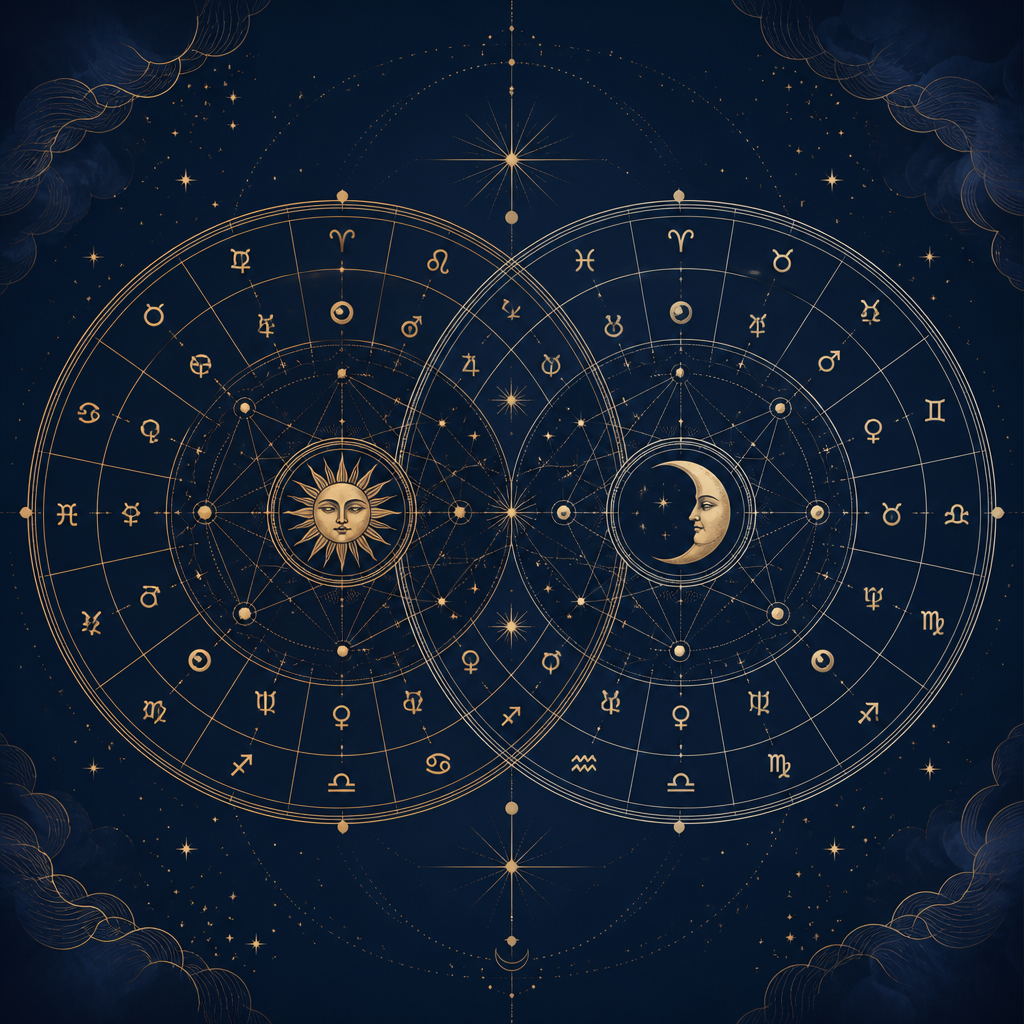
Astrology compatibility is often reduced to a single question: “What is your Sun sign?” That can be a fun place to start, but it is rarely enough to describe how two people actually relate. A birth chart contains many layers, and relationship astrology becomes much more useful when we look beyond Sun-sign matching.
The Sun can describe identity, purpose, confidence, and the way a person wants to express themselves. But relationships also involve emotional needs, communication, attraction, desire, habits, timing, boundaries, and practical expectations. Those areas are represented by other parts of the chart.
A better compatibility reading does not ask whether two signs are destined to succeed or fail. It asks how two people’s patterns interact, where connection comes easily, where translation may be needed, and how those patterns are expressed in real life.
Why Sun Signs Are Only the Beginning
Sun signs are popular because they are easy to identify from a birth date. If you were born during a certain period of the year, you can usually know your Sun sign immediately. That simplicity makes Sun-sign compatibility accessible, but it also creates a major limitation.
Two people with traditionally “compatible” Sun signs may have very different emotional or communication styles. Conversely, two people with supposedly difficult Sun signs may have strong supportive connections elsewhere in their charts.
This is why a complete birth chart adds important context.
The Moon: Emotional Needs
The Moon is one of the most important placements in close relationships. It is associated with emotional security, instinctive reactions, comfort, vulnerability, and the private self.
Moon compatibility can help explain what each person needs when stressed or emotionally exposed. One person may need immediate reassurance. Another may need solitude. One may process feelings through conversation, while another prefers to understand emotions internally before speaking.
These differences are often more important in everyday relationships than whether two Sun signs share the same element.
Mercury: Communication Style
Mercury describes thinking, language, learning, and communication. In compatibility, it can show how two people exchange information and make sense of disagreement.
A couple may have strong attraction but still struggle if their communication styles are very different. One person may speak directly and quickly; another may need more context and time. One may enjoy debate; another may experience debate as conflict.
Mercury compatibility can reveal both natural understanding and areas where communication skills need to be developed consciously.
Venus: Attraction, Affection, and Values
Venus is traditionally associated with attraction, pleasure, beauty, affection, and values. It can describe what feels romantic and how a person tends to express appreciation.
One person may show love through practical support, while another values verbal affection or shared adventure. Without translation, both may care deeply and still feel that something is missing.
Venus also reflects values, so it can point toward differences in lifestyle, spending, aesthetics, social priorities, and what each person considers worthwhile.
Mars: Desire, Action, and Conflict
Mars describes drive, assertion, pursuit, physical energy, and frustration. In relationship astrology, it is often associated with chemistry and sexual attraction, but it is equally useful for understanding conflict style.
How quickly does each person act? Who initiates? How does each respond when angry? Does one want immediate resolution while the other needs time to cool down?
Strong Mars connections can create excitement, but they can also create friction. The quality of the relationship depends on how that energy is handled.
The Ascendant: First Impressions and Social Rhythm
The Ascendant, or Rising sign, describes the style through which a person approaches the world. It can influence first impressions, social behavior, body language, and the way someone enters new situations.
Two Ascendants that work easily together may create an immediate sense of familiarity. Contrasting Ascendants can create curiosity or misunderstanding. Because the Ascendant depends heavily on exact birth time, accurate data matters here.
Synastry: Comparing Two Birth Charts
The traditional technique for comparing two natal charts is called synastry. Instead of looking at isolated signs, synastry examines how one person’s planets relate to the other person’s planets and angles.
For example, one person’s Moon may form a harmonious aspect to the other person’s Venus, which can symbolize emotional warmth and affection. Mercury contacts may emphasize communication. Saturn contacts may bring commitment, responsibility, pressure, or lessons about boundaries depending on the wider context.
No single aspect should be interpreted in isolation. A relationship is represented by a pattern of interactions, not one symbolic connection.
What Aspects Mean in Compatibility
Aspects are geometric relationships between planets. Common aspects include conjunctions, sextiles, squares, trines, and oppositions.
Trines and sextiles are often described as easier or more flowing. Squares and oppositions are often described as more challenging or dynamic. Conjunctions intensify the planets involved and can be supportive or difficult depending on the combination.
It is important not to assume that “easy” means good and “challenging” means bad. Too much ease can sometimes lead to complacency, while constructive tension can create growth, attraction, or motivation. The real question is how the people involved experience and manage the pattern.
Element Compatibility Still Has Value
Sun-sign element compatibility is not useless. Fire, earth, air, and water provide a helpful shorthand for broad temperament.
Fire signs often emphasize enthusiasm and action. Earth signs may value stability and practicality. Air signs may prioritize communication and ideas. Water signs may emphasize emotion and intuition.
But every birth chart contains multiple elements. Someone with a fire Sun may have several planets in water or earth, making their overall style more complex than the Sun sign suggests.
Houses Add Context
In synastry, one person’s planets can fall into different houses of the other person’s chart. This can show where the relationship feels especially active.
For example, planets falling in the seventh house may emphasize partnership themes. Fifth-house overlays can highlight romance, creativity, or pleasure. Fourth-house connections may bring attention to home, family, and emotional roots.
House overlays depend on accurate birth time, so uncertainty should be acknowledged when the data is incomplete.
Compatibility Is Not the Same as Relationship Quality
A chart cannot tell you whether someone is kind, honest, emotionally available, or willing to communicate. Astrology can describe symbolic patterns, but real relationship quality comes from behavior.
Two charts may contain many traditionally harmonious aspects, yet the relationship can still be unhealthy. Another pair may have several challenging aspects and build a strong relationship through self-awareness and mutual effort.
Compatibility should therefore be treated as information, not judgment.
Questions for a Better Compatibility Reading
- How do our Moon signs describe emotional needs?
- How do our Mercury placements communicate?
- What do our Venus signs value in love?
- How do our Mars signs handle desire and conflict?
- Which synastry aspects feel supportive or activating?
- Where do we naturally understand each other?
- Where do we need more conscious communication?
What If You Do Not Know the Birth Time?
You can still compare many planetary placements without an exact birth time. The Sun, Mercury, Venus, and Mars can often be identified from the date, although the Moon may change signs on certain days.
What becomes less reliable without birth time is the Ascendant and house system. Rather than guessing, use the information that can be calculated confidently and clearly label what remains uncertain.
A Healthier Way to Use Astrology Compatibility
The most useful compatibility reading should increase understanding, not anxiety. It should help people recognize patterns and ask better questions rather than telling them that a relationship is guaranteed or doomed.
If a chart suggests different communication styles, the practical question is how the couple can communicate better. If it suggests different emotional needs, the question is whether both people can make room for those needs. If it shows strong chemistry, the question is whether that chemistry is supported by trust and compatibility in everyday life.
Related Compatibility Guides
- Birth Chart Compatibility and Synastry
- Zodiac Compatibility Explained
- Moon Sign Compatibility
- Venus Sign Compatibility
- Mars Sign Compatibility
Frequently Asked Questions
Why is compatibility more than Sun signs?
Relationship astrology also considers the Moon, Venus, Mars, Mercury, Rising signs, planetary aspects, and how two full birth charts interact.
Can one difficult aspect define a relationship?
No. A single aspect should be interpreted within the wider synastry pattern and alongside the real behavior, values, and circumstances of the people involved.
Final Reflection
Sun signs are a doorway into astrology, not the whole building. Real compatibility is more layered because people are more layered.
Looking at the Moon, Mercury, Venus, Mars, the Ascendant, aspects, and houses creates a richer picture of how two people connect. It also reminds us that no single placement should carry the weight of an entire relationship.
The best use of astrology compatibility is not to search for certainty. It is to understand difference, recognize strengths, identify recurring patterns, and support better choices. The chart can offer a map of tendencies, but the relationship itself is created through communication, respect, boundaries, and the decisions two people make together.
1 thought on “Astrology Compatibility Beyond Sun Signs: A Better Way to Compare Charts”
Comments are closed.