Your Personal Year Number is a core numerology cycle used to describe the symbolic theme of a calendar year. Unlike your Life Path Number, which stays the same throughout life, the Personal Year changes annually. Numerologists use it as a framework for understanding shifting themes such as beginnings, cooperation, creativity, structure, change, responsibility, reflection, ambition, and completion.
This guide explains how to calculate your Personal Year Number step by step, what each number from 1 to 9 traditionally means, how master numbers may be handled, and how to use the cycle as a reflective planning tool rather than a fixed prediction.
Quick Answer: How Do You Calculate a Personal Year Number?
Add your birth month, your birth day, and the digits of the calendar year you want to study. Then reduce the total to a single digit, unless your numerology system preserves a master number such as 11, 22, or 33.
Formula:
Birth Month + Birth Day + Calendar Year = Personal Year Number
Example: for a birthday on July 24 in 2026:
- July = 7
- 24 → 2 + 4 = 6
- 2026 → 2 + 0 + 2 + 6 = 10 → 1 + 0 = 1
- Total: 7 + 6 + 1 = 14 → 1 + 4 = 5
The Personal Year Number for 2026 is 5.
What Is a Personal Year Number?
In numerology, a Personal Year Number represents a symbolic annual cycle. It is often interpreted as the background theme influencing the kinds of lessons, priorities, opportunities, and challenges that may receive more attention during a particular year.
A Personal Year does not replace your Life Path or other core chart numbers. Instead, it adds a time-based layer. Your Life Path may describe a broad lifelong pattern, while your Personal Year describes the changing annual context in which that pattern is expressed.
Numerology is not a scientifically established forecasting system. Personal Year interpretations are best treated as symbolic prompts for reflection, planning, and self-inquiry rather than guarantees about what will happen.
Step 1: Reduce Your Birth Month
Start with the month you were born. January through September are already single digits, so they remain 1 through 9.
- October = 10 → 1
- November = 11 → may remain 11 in master-number systems
- December = 12 → 1 + 2 = 3
For a July birthday, the birth month value is 7.
Step 2: Reduce Your Birth Day
Next reduce the day of your birth by adding its digits if necessary.
For day 24:
2 + 4 = 6
For day 29:
2 + 9 = 11
If your method preserves master numbers, you may keep 11 rather than reducing it immediately to 2. The key is to use one consistent reduction rule across the whole calculation.
Step 3: Reduce the Calendar Year
Add the digits of the year you want to analyze.
For 2026:
2 + 0 + 2 + 6 = 10 → 1 + 0 = 1
For 2027:
2 + 0 + 2 + 7 = 11
Depending on your system, 11 may remain a master number or be reduced to 2.
Step 4: Add the Three Values
Now add the reduced birth month, reduced birth day, and reduced calendar year.
Using July 24 and the year 2026:
- Birth month = 7
- Birth day = 6
- Calendar year = 1
- 7 + 6 + 1 = 14
- 1 + 4 = 5
The result is a Personal Year 5.
When Does a Personal Year Begin?
In the most common modern method, the Personal Year begins on January 1 and runs through December 31. This makes it easy to calculate because the Personal Year aligns with the calendar year.
Some numerology traditions use the birthday as a transition point instead. Under that approach, one cycle may be considered active until your birthday and the next one begins after it. Because schools differ, always check which method a source is using before comparing interpretations.
Personal Year 1 Meaning: New Beginnings
A Personal Year 1 is traditionally associated with initiative, independence, new direction, and fresh starts. It often symbolizes the opening of a new nine-year cycle.
This can be a useful year for beginning projects, redefining goals, making independent choices, or stepping into a more self-directed role. The challenge is impatience. Starting something is important, but long-term success still requires follow-through.
Personal Year 2 Meaning: Patience and Partnership
Personal Year 2 emphasizes cooperation, relationships, diplomacy, patience, and gradual development. After the push of Year 1, Year 2 is often interpreted as a period of refinement rather than rapid expansion.
Partnerships may require more attention. Listening, negotiation, trust, and emotional sensitivity can become more important. The challenge is passivity or overdependence on other people’s approval.
Personal Year 3 Meaning: Creativity and Expression
A Personal Year 3 is associated with communication, creativity, social connection, optimism, and self-expression. It can support writing, speaking, artistic work, networking, learning, and sharing ideas.
The challenge is scattered attention. A strong flow of ideas can be useful, but without discipline it may lead to unfinished projects. The constructive expression of Year 3 combines creativity with enough structure to produce something meaningful.
Personal Year 4 Meaning: Structure and Foundations
Personal Year 4 traditionally emphasizes discipline, organization, responsibility, routine, and long-term foundations. This is often considered a building year.
You may be drawn toward practical work: improving finances, strengthening systems, organizing your home or business, developing healthier routines, or creating stable processes. The challenge is rigidity or feeling trapped by responsibility.
Personal Year 5 Meaning: Change and Freedom
A Personal Year 5 is linked with movement, change, experimentation, variety, flexibility, and new experiences. It is often interpreted as a period of adjustment after the structured energy of Year 4.
Travel, career changes, new relationships, new environments, or shifts in priorities may receive more attention. The constructive side is adaptability. The challenge is impulsiveness or creating disruption simply because routine feels uncomfortable.
Personal Year 6 Meaning: Responsibility and Relationships
Personal Year 6 emphasizes care, home, family, commitments, service, harmony, and responsibility. It may bring more attention to relationships, domestic life, caregiving, or community obligations.
This can be a constructive period for strengthening important bonds and creating stability. The challenge is over-responsibility. Supporting others is different from trying to manage everyone’s life.
Personal Year 7 Meaning: Reflection and Inner Growth
A Personal Year 7 is associated with introspection, study, analysis, spiritual inquiry, research, and deeper understanding. External momentum may become less important than gaining clarity.
This can be a valuable year for learning, journaling, therapy, research, skill development, or reconsidering assumptions. The challenge is isolation or overthinking. Reflection works best when it eventually leads to greater understanding.
Personal Year 8 Meaning: Achievement and Material Results
Personal Year 8 traditionally emphasizes ambition, career, money, management, authority, power, and tangible results. Practical performance may come into sharper focus.
This can be a useful year for business decisions, negotiations, leadership, financial organization, and measuring progress. The challenge is excessive control, pressure, or defining success only through status and material outcomes.
Personal Year 9 Meaning: Completion and Release
A Personal Year 9 is associated with endings, closure, integration, compassion, forgiveness, and letting go. It marks the final stage of the nine-year cycle before a new Personal Year 1 begins.
This year may highlight what has run its course. Projects can be completed, habits reconsidered, relationships reevaluated, and unnecessary burdens released. The challenge is holding on to situations that no longer fit simply because they are familiar.
How the Nine-Year Personal Year Cycle Works
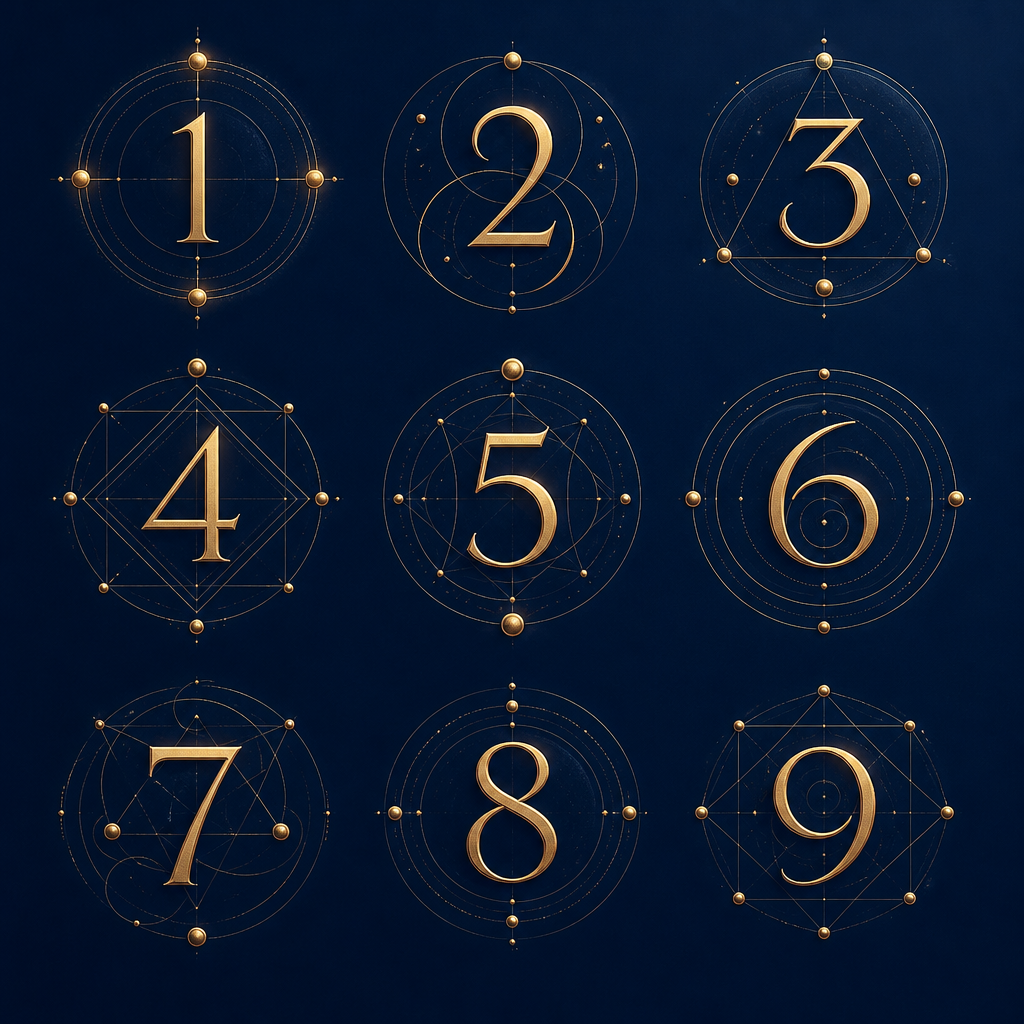
Personal Years generally move forward in sequence from 1 to 9 and then begin again at 1. The sequence creates a repeating symbolic rhythm:
- 1: begin
- 2: cooperate
- 3: express
- 4: build
- 5: change
- 6: commit
- 7: reflect
- 8: achieve
- 9: complete
These keywords are not rigid rules. They are broad symbolic themes that may appear differently depending on your circumstances, choices, and other numbers in your numerology chart.
What About Master Numbers 11, 22, and 33?
Some numerology systems preserve master numbers when they appear during Personal Year calculations. Others reduce all annual cycles to 1 through 9.
If you use master numbers, 11 may be interpreted as heightened intuition and inspiration, 22 as large-scale practical building, and 33 as service and compassionate responsibility. However, there is no universal agreement on whether these should be retained in Personal Year work.
The best practice is consistency. If you choose one method, use it across all years rather than changing rules when a particular result seems more appealing.
Personal Year vs. Life Path Number
Your Life Path Number is calculated from your full birth date and remains the same throughout life. Your Personal Year Number changes every calendar year.
Think of the Life Path as a long-term symbolic theme and the Personal Year as the current annual chapter. The Personal Year can highlight which themes may deserve more attention now without replacing your broader Life Path pattern.
Personal Year vs. Personal Month
The Personal Year is the larger annual cycle. The Personal Month is a shorter cycle calculated by adding the calendar month to the Personal Year.
For example, someone in a Personal Year 5 may experience a Personal Month 6 in January, 7 in February, 8 in March, and so on. Reading the month inside the yearly context produces a more layered interpretation than using either number alone.
Can You Use Personal Year Numbers for Planning?
Many numerology practitioners use Personal Years as a symbolic planning framework. A Year 1 may encourage beginning, a Year 4 may emphasize structure, a Year 8 may focus attention on practical achievement, and a Year 9 may favor completion.
That does not mean important events should be scheduled solely according to numerology. Real decisions depend on finances, health, legal obligations, relationships, preparation, opportunity, and many other practical conditions. Numerology can provide an additional reflective lens, but it should not replace evidence-based judgment.
How to Use Your Personal Year Practically
Instead of asking, “What will happen to me this year?” use the number as a question:
- 1: What am I ready to begin?
- 2: Where do I need patience or cooperation?
- 3: What needs to be expressed?
- 4: What foundation needs strengthening?
- 5: Where do I need greater flexibility?
- 6: What responsibility or relationship needs care?
- 7: What deserves deeper study or reflection?
- 8: What tangible result am I working toward?
- 9: What is ready to be completed or released?
This approach keeps numerology practical and reflective rather than fatalistic.
Common Personal Year Calculation Mistakes
Using the birth year instead of the current calendar year
The Personal Year uses your birth month and day, but the year portion comes from the calendar year you want to study.
Using the Life Path Number directly
The Personal Year is not calculated by simply adding the current year to your Life Path. It has its own formula based on birth month, birth day, and calendar year.
Mixing reduction methods
If you preserve master numbers in one step but reduce them in another without a consistent rule, your results may vary unnecessarily.
Treating the number as a guaranteed forecast
A Personal Year interpretation is symbolic, not deterministic. It should not be used as the sole basis for financial, medical, legal, career, or relationship decisions.
Frequently Asked Questions
Does my Personal Year Number change every year?
Yes. In the standard calendar-based method, it changes each January because the calendar year in the formula changes.
Is a Personal Year 9 negative?
No. Year 9 is associated with completion and release, but successful completion, forgiveness, graduation, decluttering, and finishing long-term work are also positive expressions of the cycle.
Can two people have the same Personal Year?
Yes. Many people share the same Personal Year, but they may experience it differently because their Life Path Numbers, circumstances, choices, and broader numerology charts differ.
Can I calculate future Personal Years?
Yes. Replace the calendar year in the formula with any future year and follow the same reduction method.
Which is more important, Life Path or Personal Year?
They serve different purposes. Life Path is a stable core number, while Personal Year is a changing annual cycle. A fuller interpretation considers both together.
Final Takeaway
Your Personal Year Number offers a simple way to explore annual numerology cycles. The calculation is straightforward: reduce your birth month, reduce your birth day, reduce the calendar year, add the values, and reduce the final total consistently.
The most useful question is not, “What is guaranteed to happen this year?” but, “What theme may be worth paying more attention to?” Used in that way, the Personal Year becomes a structured reflection tool for reviewing priorities, planning intentionally, and understanding how one year differs symbolically from the next.