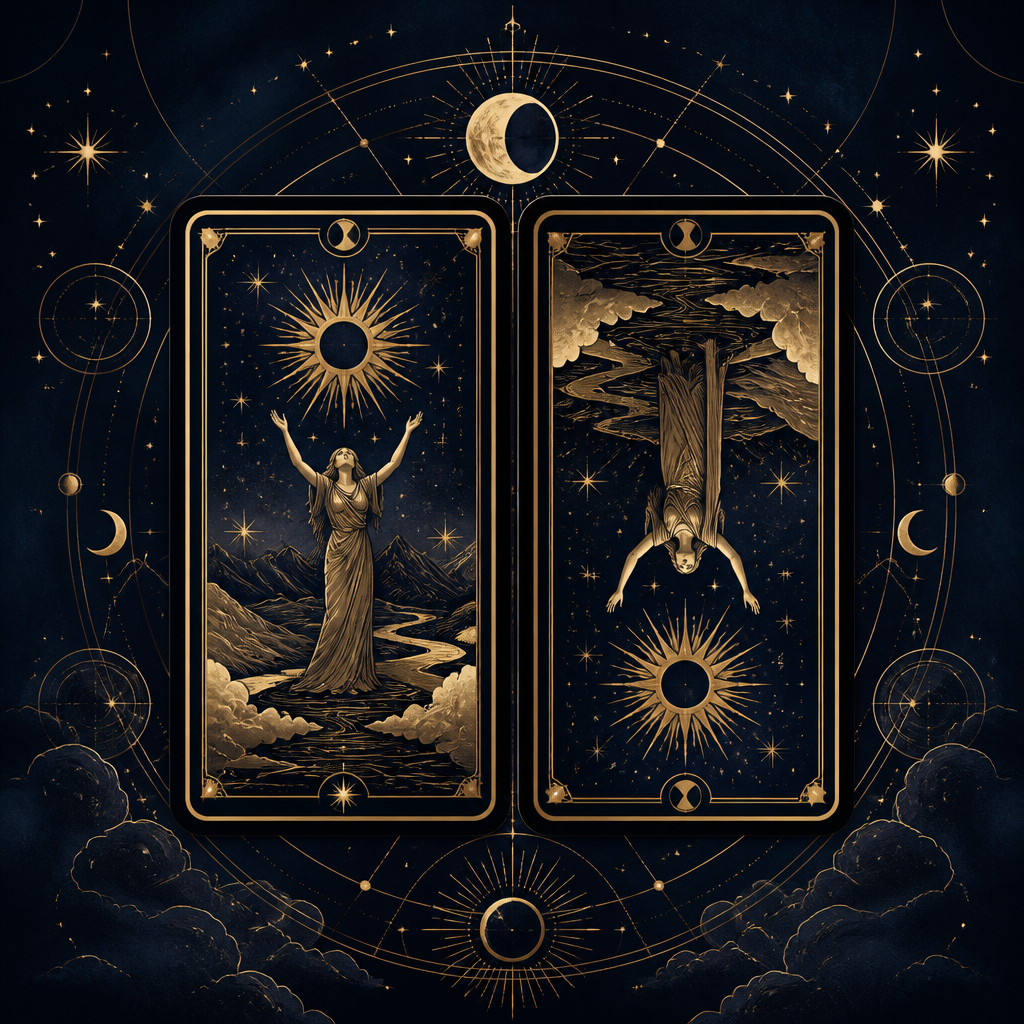
Tarot cards are traditionally read in two orientations: upright and reversed. For beginners, this can seem like a simple technical distinction, but in practice it changes the way a reader explores the card’s symbolism. An upright card often expresses a theme in a direct, visible, or active way, while a reversed card may suggest that the same energy is blocked, internalized, delayed, excessive, or asking for closer reflection.
That does not mean upright cards are automatically “good” and reversed cards are “bad.” Tarot is much more useful when each card is understood as a spectrum of possible meanings rather than as a fixed prediction.
What an Upright Tarot Card Usually Means
When a card appears upright, readers often begin with the card’s most recognizable themes. The upright orientation can suggest that the qualities associated with the card are active, conscious, available, or easier to notice.
For example, The Magician upright may point toward initiative, skill, focus, and the ability to use available resources. The Hermit upright may highlight introspection, solitude, and the search for inner wisdom. The Sun upright may emphasize clarity, confidence, optimism, or greater visibility.
These are not guaranteed events. They are symbolic patterns that can help you think about what is happening in a situation.
What a Reversed Tarot Card Can Mean
A reversed card turns the visual image upside down, but its interpretation is not simply the opposite of the upright meaning. Reversals can be read in several ways depending on the question, the spread, surrounding cards, and the reader’s method.
One common approach is to see a reversal as blocked energy. The card’s theme may be present, but something prevents it from being expressed clearly. Another approach is to view the energy as internalized. Instead of appearing outwardly, the issue may be happening privately, emotionally, or psychologically.
A reversal can also suggest delay, resistance, imbalance, exaggeration, or the need to reconsider how the card’s energy is being used.
Example: The Magician Upright and Reversed
The Magician upright often represents focused action, creativity, confidence, and the ability to work with the tools available. In a career reading, it might invite you to recognize your skills and act intentionally.
The Magician reversed could indicate scattered attention, unused talent, poor planning, self-doubt, or manipulation. It may ask whether your abilities are being directed effectively or whether you are relying too heavily on appearance rather than substance.
The reversed meaning does not erase the upright meaning. It modifies it.
Example: The Lovers Upright and Reversed
The Lovers upright is often associated with connection, alignment, values, choices, and meaningful relationships. In a relationship reading, it may invite reflection on mutual understanding and shared values.
The Lovers reversed might suggest misalignment, conflicting values, poor communication, or a difficult choice. It can also point to an internal conflict between what you want and what you believe is right.
Again, the reversal is not automatically negative. It may simply make the underlying tension more visible.
Example: The Tower Upright and Reversed
The Tower upright is commonly associated with disruption, sudden realization, instability, or the breakdown of something that can no longer continue in its current form.
The Tower reversed can be read as resisting necessary change, experiencing upheaval internally, avoiding an uncomfortable truth, or slowly rebuilding after disruption. In some readings, the reversal may indicate that a crisis is less external and more psychological.
Four Useful Ways to Read Reversals
1. Blocked energy
The card’s qualities are present but difficult to access. Strength reversed, for example, may point toward self-doubt or difficulty trusting your own resilience.
2. Internal energy
The card describes an inward process rather than an external event. The Hermit reversed might indicate isolation, private reflection, or difficulty reconnecting with others.
3. Excess or imbalance
The card’s energy may be overused. The Emperor reversed could reflect excessive control, rigidity, or difficulty adapting.
4. Delay or resistance
The theme may be unfolding slowly or encountering hesitation. The Chariot reversed may suggest unclear direction, competing priorities, or difficulty committing to a path.
Do You Have to Use Reversed Cards?
No. Many experienced tarot readers choose not to read reversals at all. They interpret the full range of a card’s meaning from its upright position and use the question, spread position, and neighboring cards to decide which part of the spectrum is most relevant.
Other readers prefer reversals because they add another layer of nuance. Neither method is more authentic. Consistency matters more than complexity.
If you are a beginner, you may find it easier to learn the upright meanings first. Once the cards feel familiar, you can experiment with reversals and decide whether they improve your readings.
How to Practice Upright and Reversed Meanings
Choose one card and write its main upright themes. Then ask how those themes might look if they were blocked, hidden, delayed, excessive, or turned inward. This creates a more flexible understanding than memorizing two separate definitions.
For example, if the upright Eight of Pentacles represents practice, craftsmanship, and steady improvement, a reversal might suggest distraction, perfectionism, repetitive work without growth, or a need to improve technique.
This exercise teaches you to think symbolically instead of relying on rigid keywords.
Use the Question as Context
The same reversed card may mean something different in a career reading than in a relationship reading. Context helps narrow the interpretation.
Suppose the Two of Swords appears reversed. In a decision-making question, it may suggest that avoidance is becoming difficult and a choice must be made. In a relationship question, it could point toward unspoken tension or a conversation that can no longer be postponed.
The card does not change, but the area of life changes how the symbolism is applied.
Avoid Treating Reversals as Warnings
One of the most common beginner mistakes is assuming that every reversed card predicts something negative. This can make tarot readings unnecessarily alarming.
A reversal may simply reveal an internal process, a lesson still developing, or an area that needs attention. Sometimes it can even soften an intense upright meaning. A difficult card reversed might describe recovery, reduced intensity, or a growing awareness of the issue.
Look at the Whole Spread
Tarot cards work best as part of a larger pattern. If several cards are reversed, that may suggest a reading focused more on internal states, hesitation, or unresolved themes. If one reversed card appears among several upright cards, it may identify the specific area where momentum is slower or more complicated.
Pay attention to repeated suits, Major Arcana cards, elements, numbers, and themes. Orientation is one factor among many.
Upright and Reversed Cards as a Spectrum
A useful modern approach is to imagine every card as a spectrum. One end shows the card’s constructive expression, while the other shows its shadow, excess, absence, or challenge. Upright and reversed orientations help you decide where on that spectrum the reading may be focused.
This approach avoids rigid good-versus-bad interpretations and encourages more thoughtful reflection.
Related Tarot Guides
- What Is Tarot?
- Major Arcana Explained
- Minor Arcana Explained
- How to Ask Better Tarot Questions
- Three-Card Tarot Spreads
Frequently Asked Questions
Are reversed Tarot cards always negative?
No. A reversal can suggest blocked, internalized, delayed, excessive, or altered expression of the card’s core theme.
Do I have to read reversals?
No. Many experienced readers use upright cards only. Consistency in the chosen method matters more than using reversals.
Final Thoughts
Upright and reversed tarot cards are two ways of exploring the same symbolic energy. Upright cards often express a theme directly, while reversed cards may show that theme as blocked, internal, delayed, exaggerated, or in need of adjustment.
You do not need reversals to read tarot well. What matters is having a consistent method, understanding the card’s core symbolism, and interpreting it in relation to the question and the rest of the spread.
Used carefully, reversals can add depth without turning tarot into a system of fixed predictions. They are best treated as another perspective—a way to ask what is visible, what is hidden, and what may need a different approach.
1 thought on “Upright and Reversed Tarot Cards: What’s the Difference?”
Comments are closed.