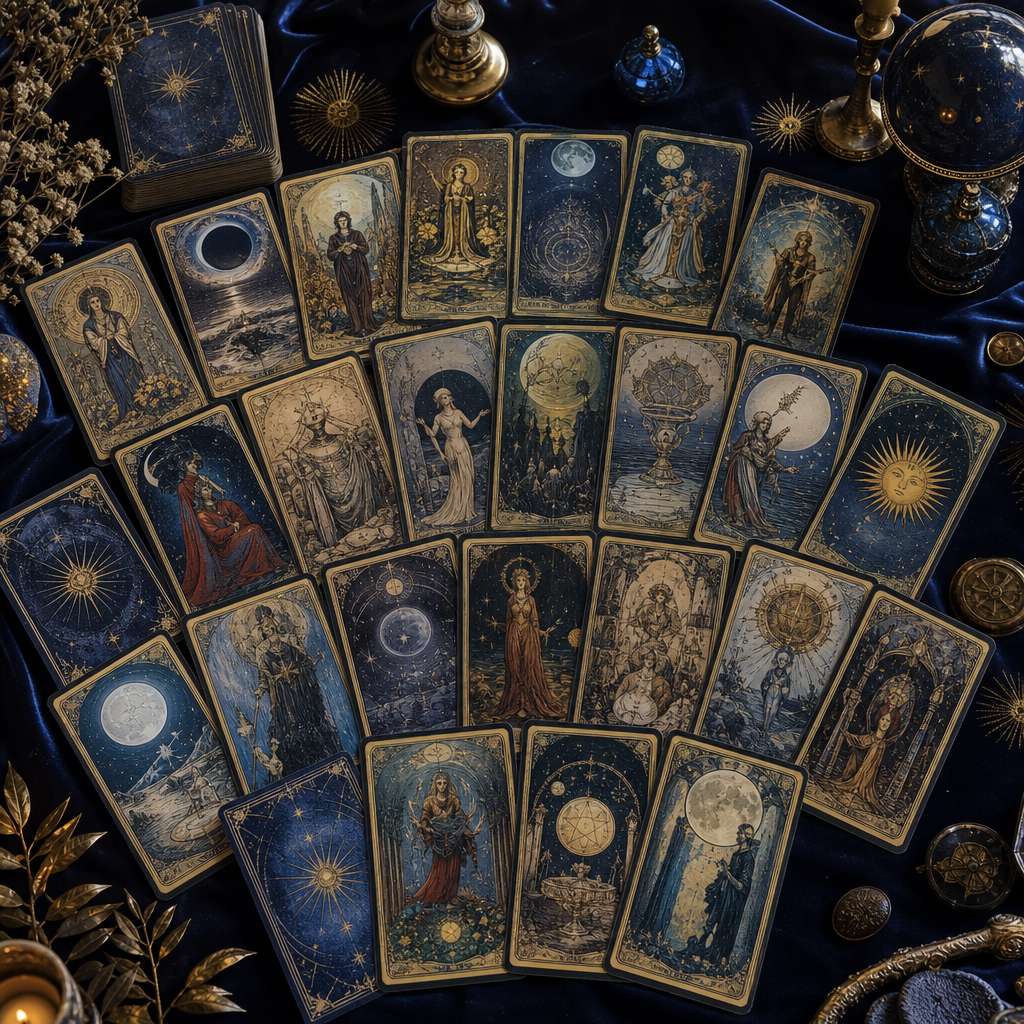
Tarot is a 78-card symbolic system used for reflection, storytelling, spiritual practice, and divination. A standard deck is divided into 22 Major Arcana cards and 56 Minor Arcana cards. Each card contains traditional themes, imagery, numbers, and relationships that readers interpret in the context of a question or spread.
Tarot is often presented as a way to predict the future, but it can be used more responsibly as a structured reflection tool. A card can highlight a pattern, tension, possibility, or question without claiming that a specific event must happen.
Where Tarot Comes From
Tarot cards developed in Europe as playing cards before becoming closely associated with esoteric and divinatory traditions. Over time, readers connected the cards with systems such as astrology, numerology, Kabbalah, elemental symbolism, and archetypal psychology.
Modern tarot includes many schools and deck styles. The Rider-Waite-Smith tradition is especially influential because its illustrated Minor Arcana made narrative interpretation easier for beginners.
The Structure of a Tarot Deck
A standard tarot deck has 78 cards. The 22 Major Arcana represent large archetypal themes and major developmental experiences. The 56 Minor Arcana are divided into four suits and tend to describe everyday situations, emotions, thoughts, actions, relationships, work, and practical life.
The Major Arcana
The Major Arcana begins with The Fool, commonly numbered 0, and continues through cards such as The Magician, The High Priestess, The Empress, The Emperor, The Lovers, The Chariot, Strength, The Hermit, Wheel of Fortune, Justice, The Hanged Man, Death, Temperance, The Devil, The Tower, The Star, The Moon, The Sun, Judgement, and The World.
Many readers see these cards as stages in an archetypal journey. They often carry more symbolic weight in a spread than everyday Minor Arcana cards, though context always matters.
The Minor Arcana
The Minor Arcana consists of four suits: Wands, Cups, Swords, and Pentacles. Each suit contains Ace through Ten plus four court cards: Page, Knight, Queen, and King.
The suits create a practical vocabulary that can be combined with numerical and visual symbolism.
Wands
Wands are commonly associated with fire, action, inspiration, creativity, ambition, confidence, and movement. They often appear in readings about projects, motivation, competition, or personal initiative.
Too much Wands energy can suggest impatience, burnout, conflict, or acting before planning.
Cups
Cups are associated with water, emotion, relationships, intuition, imagination, connection, and the inner life. They often appear in questions about love, friendship, emotional needs, creativity, or belonging.
Challenging Cups cards can point toward emotional overwhelm, idealization, disappointment, or difficulty with boundaries.
Swords
Swords are associated with air, thought, communication, decisions, truth, conflict, perspective, and mental patterns. They can describe both intellectual clarity and the stress created by overthinking.
Swords are sometimes viewed as a “negative” suit because several cards contain difficult imagery, but their deeper theme is the power and consequences of thought and communication.
Pentacles
Pentacles are associated with earth, work, money, health routines, resources, skill, stability, and practical results. They often appear in readings about careers, finances, home, long-term projects, or physical routines.
The suit emphasizes what can be built, maintained, measured, or sustained.
The Aces
Aces usually represent beginnings, potential, or the pure form of a suit. Ace of Wands can suggest new inspiration, Ace of Cups emotional opening, Ace of Swords mental clarity, and Ace of Pentacles a practical opportunity or foundation.
An Ace is not a guaranteed outcome. It often represents something available to be developed.
Numbers Two Through Ten
Numbered cards add another symbolic layer. Twos often involve polarity, choice, or balance. Threes can indicate development and expression. Fours suggest structure or stabilization. Fives often bring disruption or adjustment. Sixes can relate to harmony or transition. Sevens frequently involve testing or evaluation. Eights can emphasize movement, work, or consolidation. Nines suggest maturity or nearing completion. Tens often represent culmination and transition to a new cycle.
These themes change according to the suit and imagery.
The Court Cards
Pages, Knights, Queens, and Kings can represent people, roles, developmental stages, approaches, or qualities. A Page may symbolize learning or a message, a Knight action and pursuit, a Queen mastery expressed internally or relationally, and a King mastery expressed through direction or responsibility.
Readers differ on whether court cards should be treated as literal people. Context is the safest guide.
What Is a Tarot Spread?
A spread is the arrangement of cards used for a reading. Each position can have a specific purpose. A three-card spread might represent past, present, and future; situation, challenge, and advice; or mind, body, and spirit.
The spread position gives context to the card. The same card in an “obstacle” position may be reflected on differently than in an “advice” position.
One-Card Readings
A single-card draw is a good way to learn tarot. Ask a clear, open question, draw one card, and write what you notice before looking up the traditional meaning.
One-card readings reduce complexity and help beginners build a direct relationship with the deck.
Three-Card Readings
Three-card spreads are flexible and easy to compare. You can use past-present-future, situation-action-outcome, or what to keep-what to release-what to develop.
The value comes from the relationship between the three cards, not only their individual definitions.
Upright Cards
When a card appears upright, many readers begin with its most direct or visible themes. The energy may be active, available, conscious, or outwardly expressed.
Upright does not mean positive. The Tower upright can be challenging, while the Five of Pentacles may describe hardship or insecurity.
Reversed Cards
Some readers interpret cards that appear upside down as reversals. A reversed card may suggest blocked, internalized, delayed, exaggerated, or imbalanced expression of the same core theme.
Other experienced readers do not use reversals at all. Neither method is inherently more correct. Consistency matters.
Do You Need to Memorize Every Card?
No. Start with the structure: Major vs. Minor Arcana, suit meanings, numbers, and court roles. Then learn the individual cards gradually.
Pay attention to imagery. Ask what is happening in the scene, where figures are looking, what objects repeat, and how the picture feels. Visual observation makes memorization easier.
How to Ask Better Tarot Questions
Open questions usually create better readings than rigid yes-or-no questions. Instead of “Will I get the job?” ask “What should I understand about this opportunity?” Instead of “Does this person love me?” ask “What relationship dynamic should I pay attention to?”
Questions focused on your choices are generally more useful than questions that attempt to read another person’s private thoughts.
Tarot and Prediction
Some traditions read tarot predictively, but cards cannot responsibly guarantee exact future events. A reading may describe patterns or likely consequences if current conditions continue.
Your choices and circumstances can change. Treat the reading as a snapshot of possibilities rather than a fixed timeline.
How to Read a Card
Use four layers: traditional meaning, visual symbolism, spread position, and question context. Then look at neighboring cards.
For example, the Eight of Pentacles traditionally emphasizes practice and skill. In a career reading, it may suggest deliberate improvement. In a relationship reading, it could prompt reflection on the work required to maintain connection.
Reading Cards Together
Cards influence one another. Repeated suits can emphasize a theme. Several Major Arcana cards can suggest that the question involves broader developmental issues. Repeated numbers may create another pattern.
Try to tell one coherent story rather than producing disconnected card definitions.
Tarot Journaling
Keep a record of the date, question, cards, orientations, positions, your first interpretation, and what happened later. Journaling helps you learn your deck and notice when you are reshaping a reading after the fact.
It also provides a personal reference library over time.
Choosing a Tarot Deck
Beginners often benefit from a deck based on Rider-Waite-Smith imagery because many books and learning resources use that structure. However, the best deck is one whose visual language you can understand and enjoy working with.
Check that the deck contains all 78 cards and that the imagery matches the reading tradition you want to study.
Responsible Tarot Practice
Do not use tarot as a substitute for medical, legal, financial, or mental-health advice. Avoid fear-based claims about death, curses, illness, or guaranteed disasters.
If readings make you anxious or dependent, take a break. A reflective tool should increase agency, not reduce it.
Related Tarot Guides
- Major Arcana Explained
- Minor Arcana Explained
- Upright and Reversed Tarot Cards
- How to Ask Better Tarot Questions
- Three-Card Tarot Spreads
Frequently Asked Questions
Do you need psychic ability to read Tarot?
No. Tarot can be learned as a symbolic system through card structure, imagery, traditional meanings, spread positions, and reflective practice.
Should beginners use reversals?
Not necessarily. Many readers learn upright meanings first and add reversals later. Consistency matters more than using every possible technique from the beginning.
What is the easiest Tarot spread to start with?
A one-card draw or a simple three-card spread is usually easiest because it limits complexity while still teaching position, context, and card relationships.
Final Thoughts
Tarot is a 78-card symbolic system built from the Major Arcana, four Minor Arcana suits, numbers, court cards, imagery, orientation, and spread positions. Its richness comes from combining these layers in relation to a meaningful question.
You do not need to predict the future to use tarot well. Begin with observation, learn the structure, ask open questions, keep a journal, and treat the cards as prompts that help you think more carefully about choices, patterns, and possibilities.
7 thoughts on “What Is Tarot? A Beginner’s Guide to the 78-Card Deck”
Comments are closed.