
Planetary degrees are the precise coordinates that show where each planet sits inside a zodiac sign. In a birth chart, every zodiac sign spans 30 degrees, from 0°00′ to 29°59′. A planet’s sign describes the style in which its energy is expressed, while its exact degree helps astrologers judge precision, aspects, timing, and how closely different chart factors interact.
This is why two people can both have Venus in Leo, for example, yet experience Venus very differently. One may have Venus at 2° Leo and another at 27° Leo. The sign is the same, but the degree changes the planet’s geometric relationship to the rest of the chart.
What Are Degrees in a Birth Chart?
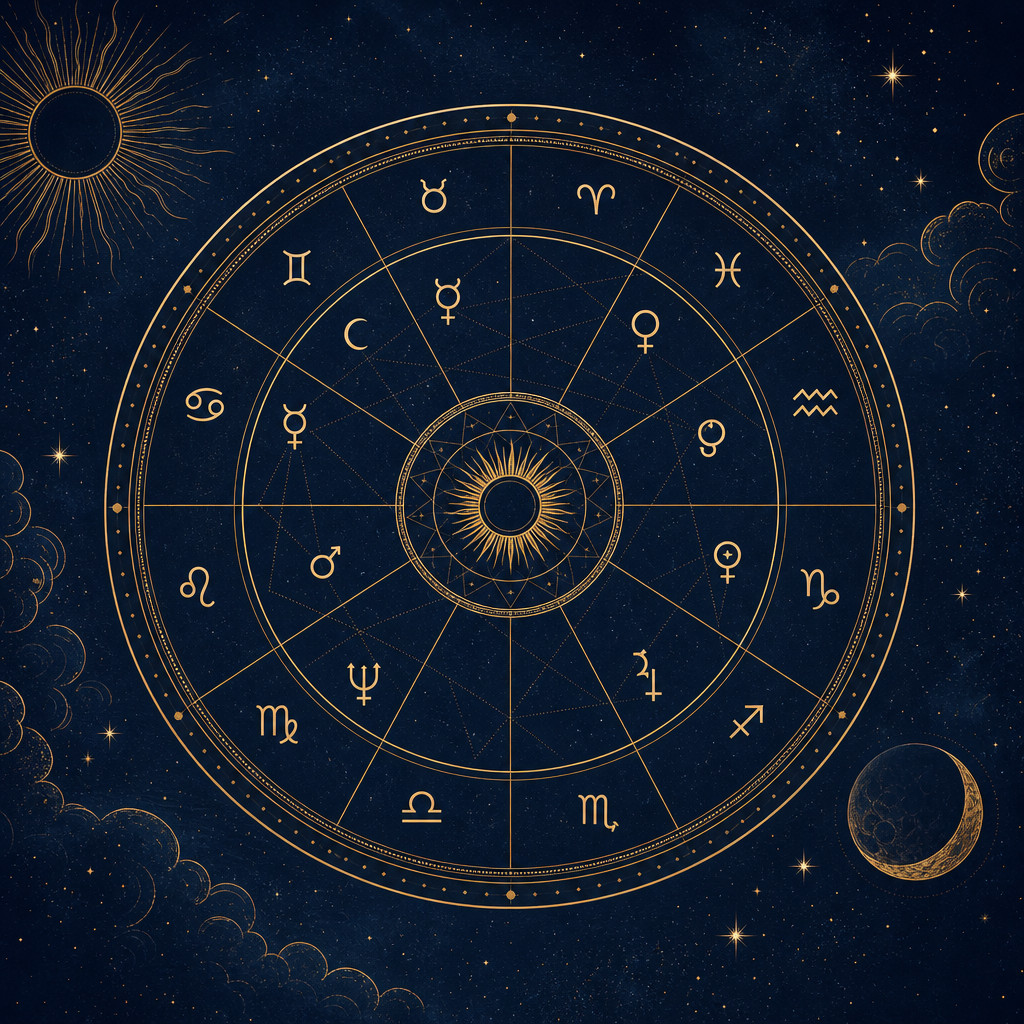
A natal chart is a 360-degree circle divided into twelve zodiac signs. Each sign occupies exactly 30 degrees. Aries covers 0° through 29°59′ of its sign, Taurus does the same, and so on through Pisces. When an astrology chart says “Sun 18° Gemini,” it means the Sun was positioned eighteen degrees into Gemini at the recorded birth time and location.
Degrees therefore are not separate zodiac signs or additional planets. They are measurements. Think of the zodiac sign as a neighborhood and the degree as a street address. “Mars in Capricorn” tells you the general territory; “Mars at 14°32′ Capricorn” tells you where Mars is located within that territory.
This precision matters because astrology is fundamentally geometric. Conjunctions, oppositions, trines, squares, sextiles, and other aspects are calculated from angular distance. Degrees tell us whether two planets are actually close enough to form an aspect and how exact that aspect is.
Why Every Zodiac Sign Has 30 Degrees
The zodiac circle contains 360 degrees. Dividing that circle into twelve equal signs gives 30 degrees per sign. This simple structure creates the coordinate system used in natal astrology.
Astrologers usually write a planetary position using degrees and minutes, such as 22°15′ Libra. There are 60 arc minutes in one degree, and each minute can be divided into 60 arc seconds. Most everyday natal interpretations do not need second-by-second precision, but accurate birth data becomes especially important when calculating fast-moving chart points such as the Ascendant and house cusps.
The degree shown next to a planet should therefore be read together with its sign. A Moon at 29° Taurus is not “the 29th degree of the whole zodiac.” It is twenty-nine degrees into Taurus. In absolute zodiac longitude, that position is much farther around the 360-degree circle.
What Planetary Degrees Actually Tell You
Planetary degrees become most useful when they answer a specific interpretive question. They can show how exact an aspect is, whether a planet is near a sign boundary, whether several planets cluster tightly together, and whether a transit is approaching an important natal position.
Suppose your natal Mercury is at 10° Virgo and Jupiter is at 11° Taurus. The signs already suggest a harmonious earth-sign relationship. The degrees show that the planets are roughly one degree away from an exact trine. That closeness can make the aspect more prominent than a much wider Mercury–Jupiter trine.
Degrees also allow astrologers to distinguish between planets that merely occupy compatible signs and planets that are geometrically connected. This distinction is crucial. Sign-based interpretation provides context; degree-based calculation provides precision.
Degrees and Aspects: Why the Exact Number Matters
An aspect is an angular relationship between two chart factors. A conjunction centers on 0°, a sextile on 60°, a square on 90°, a trine on 120°, and an opposition on 180°. In real charts, planets rarely sit at perfectly exact mathematical distances, so astrologers use an orb—an allowed range around the exact aspect.
For example, if the Sun is at 15° Cancer and Saturn is at 16° Aries, their positions are close to a 90-degree square. The one-degree difference from exactness helps describe the aspect’s tightness. Different astrologers and traditions use different orb rules, so there is no single universal orb that must be applied to every planet and every technique.
A practical rule is to avoid interpreting a degree in isolation. Ask first: what sign is the planet in, what house does it occupy, what does it rule, and what aspects does its degree create? The degree refines the chart rather than replacing these larger layers.
What Do 0 Degrees and 29 Degrees Mean?
Degrees near the beginning or end of a sign naturally attract attention because the planet is close to a sign boundary.
0°: The Beginning of a Sign
A planet near 0° has recently entered a sign in zodiacal longitude. Some modern astrologers interpret this symbolically as a fresh or concentrated expression of that sign. That can be a useful interpretive lens, but it should not be treated as a universal law that overrides the rest of the chart.
More concretely, a planet at 0° matters because its aspects may connect it closely with planets at late degrees of other signs. The exact geometry should always be checked rather than assuming that an early degree automatically has a special destiny.
29°: The Final Degree
The 29th degree is often called the anaretic degree in modern astrological discussion. It is frequently associated with culmination, urgency, transition, or an intensified encounter with the themes of the sign.
However, responsible interpretation requires context. A planet at 29° is not automatically unlucky, doomed, or more powerful than every other planet. Its house, aspects, dignity, rulership, and role in the whole chart remain essential. The most objective fact is simply that the planet is at the end of a sign and therefore close to entering the next one by zodiacal longitude.
Are Some Birth Chart Degrees More Powerful Than Others?
You may encounter lists claiming that certain degrees are “fame degrees,” “wealth degrees,” “death degrees,” or degrees belonging to specific zodiac signs. These systems can come from particular astrological schools, symbolic degree traditions, or modern internet astrology. They should not be confused with the basic astronomical meaning of a degree.
The strongest starting point is always the chart’s actual structure. A planet can become especially significant because it is angular, rules important houses, forms multiple tight aspects, belongs to a major configuration, or is emphasized through traditional dignity. Its degree helps reveal those relationships.
So rather than asking, “Is 17° a lucky degree?” a more useful question is, “What does the planet at 17° connect with in this chart?” That shift turns degree interpretation from a list of isolated meanings into genuine chart analysis.
Degrees and House Cusps
Degrees are equally important for the houses. The Ascendant, Midheaven, Descendant, Imum Coeli, and other house cusps are calculated at specific zodiac degrees. If your Ascendant is 12° Scorpio, a planet at 13° Scorpio may be extremely close to the Ascendant, depending on the chart and interpretive method.
This is one reason accurate birth time matters. The planets move at different speeds, but the angles and house cusps can shift significantly as Earth rotates. An uncertain birth time may change the Ascendant degree and sometimes the rising sign itself.
When reading a chart, do not assume that a planet is strongly connected to an angle merely because it occupies the same sign. Compare the actual degrees. A planet one degree from the Midheaven is geometrically much closer than a planet twenty degrees away in the same sign.
Degrees in Transits and Predictive Astrology
Degrees become especially practical when studying transits. A transit occurs when a moving planet reaches an angular relationship with a natal planet or point. If your natal Sun is 8° Aquarius, an astrologer tracking Saturn, Jupiter, Uranus, Neptune, Pluto, or a faster planet will watch the degrees around that natal position and the degrees that form major aspects to it.
This explains why a transit through a zodiac sign does not affect every person with placements in that sign at exactly the same time. A planet moving through early Gemini reaches a natal planet at 3° Gemini before it reaches another at 25° Gemini.
Degree-based timing therefore adds specificity to broad sign forecasts. A general forecast might say that a planet is transiting Cancer for a period of time. A personalized reading asks when that planet approaches the exact degree of your natal Moon, Ascendant, Venus, or another relevant point.
What About Decans?
Degrees can also divide each zodiac sign into smaller symbolic sections. One widely used division is the decan. Each 30-degree sign contains three decans of ten degrees each: approximately 0°–9°59′, 10°–19°59′, and 20°–29°59′.
Different astrological traditions assign different planetary or sign associations to decans. Because these systems vary, it is useful to identify which tradition an interpretation is using rather than combining every decan system as though they were identical.
Decans can add nuance, but they are a secondary interpretive layer. If you are learning astrology, first become comfortable with planets, signs, houses, aspects, and chart rulers. Once those foundations are clear, decans and other degree-based subdivisions become easier to evaluate.
Critical Degrees and Degree Symbolism
Traditional and modern astrology contain several systems of so-called critical degrees. There are also symbolic systems that assign an image or phrase to each zodiac degree. These techniques can be meaningful within their own interpretive frameworks, but they are not interchangeable.
This distinction matters for clear astrology education. The mathematical degree of a planet is observable within the chart calculation. The symbolic meaning assigned to that degree depends on the astrological method being used. Keeping those two layers separate helps prevent an interpretation from sounding more certain than its method supports.
How to Read a Planetary Degree Step by Step
When you see a placement such as Venus at 24° Libra, begin with Venus: relationships, attraction, values, pleasure, aesthetics, and ways of relating. Next consider Libra as the sign modifying Venus’s expression. Then identify the house, because the house describes the life area in which Venus is emphasized.
Only after those foundations should you use 24° to inspect exact aspects, proximity to angles or cusps, decan placement, and any degree technique you deliberately choose to apply. This sequence keeps the interpretation anchored in the full chart.
A useful workflow is: planet → sign → house → degree/aspects → rulership → larger chart patterns. No single number should be asked to carry the entire interpretation.
Common Mistakes When Interpreting Birth Chart Degrees
One common mistake is treating every degree as a standalone personality label. Another is assuming that planets at the same numerical degree are automatically conjunct even when they occupy different signs. A third is applying dramatic labels such as “karmic,” “fatal,” or “millionaire degree” without examining the rest of the chart.
It is also easy to confuse degree symbolism with aspect geometry. A degree may have a symbolic interpretation in a particular school, but the same number simultaneously serves as a precise coordinate used to calculate aspects. These are different functions.
Finally, remember that chart accuracy depends on input accuracy. If the recorded birth time is approximate, the Ascendant and house cusps may be uncertain. Interpret precise angle degrees cautiously when the source birth time is not reliable.
Frequently Asked Questions About Planetary Degrees
Does every degree have a meaning in astrology?
Every degree has a mathematical function because it identifies an exact zodiac position. Some astrological traditions also assign symbolic meanings to individual degrees, but those meanings depend on the system being used.
Is 29° always bad?
No. The final degree of a sign can be emphasized in some interpretive traditions, but it does not automatically predict misfortune. Evaluate the planet, sign, house, aspects, rulership, and complete natal context.
Is 0° especially powerful?
Some astrologers read 0° as a concentrated or initiating expression of a sign. Its clearest technical significance is that the planet is at the very beginning of that sign and may form close aspects to other early- or late-degree placements.
Can two planets be in aspect if their degree numbers are different?
Yes. Aspect calculation uses angular separation around the entire zodiac, not matching degree numbers alone. For example, planets in different signs can form a trine, square, opposition, sextile, or other aspect depending on their exact positions.
Why are degrees important for transits?
Degrees help identify when a moving planet approaches an exact natal position or aspect. This makes personalized transit timing more precise than sign-only forecasts.
Final Takeaway
Planetary degrees are best understood as the precision layer of a birth chart. Signs tell you the zodiacal style of a placement; houses describe where its themes operate; planets describe what is acting; and degrees show exactly where those factors sit and how they connect geometrically.
Special-degree traditions can add symbolic nuance, but they work best after the chart’s fundamentals are understood. Instead of searching for a single “lucky” or “dangerous” degree, use degrees to see relationships: which planets form tight aspects, which placements sit near important angles, and when transiting planets activate natal positions.
That approach makes planetary degrees more useful, more coherent, and more faithful to the birth chart as a complete system rather than a collection of isolated numbers.