
Quick answer: The Seven of Swords Tarot card represents strategy, independence, discretion, indirect action, and the need to think carefully about what is being revealed or withheld. Upright, it can point to planning, working independently, protecting information, avoiding confrontation, or taking a route that others do not fully understand. In more challenging contexts, it can warn of secrecy, evasion, dishonesty, or trying to escape consequences. Reversed, it often brings hidden matters toward the surface and can represent confession, accountability, self-deception, a failed strategy, or the decision to stop avoiding an issue.
Seven of Swords Tarot Card Meaning at a Glance
The Seven of Swords belongs to the Suit of Swords, which is associated with thought, communication, truth, decisions, boundaries, and conflict. Unlike cards that emphasize direct confrontation, the Seven asks what happens when a person chooses an indirect path.
That indirect path is not automatically wrong. Privacy, strategic timing, independent work, and careful planning can all be wise. The problem begins when strategy becomes deception, discretion becomes concealment, or avoidance replaces a conversation that genuinely needs to happen.
- Upright keywords: strategy, independence, discretion, secrecy, planning, avoidance, resourcefulness, indirect action, self-interest
- Reversed keywords: confession, accountability, exposure, self-deception, failed strategy, coming clean, reconsideration, truth emerging
- Element: Air
- Suit: Swords
- Core question: Are you being strategically private, or are you avoiding a truth that needs to be addressed?
What Does the Seven of Swords Mean in Tarot?
At its core, the Seven of Swords is about strategy and the consequences of acting outside the obvious path. It can describe someone choosing to work alone, keeping plans private until they are ready, finding an unconventional solution, or avoiding unnecessary confrontation.
However, the same qualities can become problematic. A person may withhold important information, manipulate a situation, tell only part of the truth, or avoid responsibility. This is why context matters so much with the Seven of Swords.
The card should not automatically be translated as “cheating” or “betrayal.” Those are possible interpretations in a relevant spread, but the card by itself does not prove them. A grounded reading asks what information is missing, why someone might be acting indirectly, and whether greater transparency would improve the situation.
The Seven of Swords also asks you to examine your own strategy. Are you being clever or simply postponing an uncomfortable problem? Are you protecting legitimate privacy or using secrecy to avoid accountability? Are you following your own path because it is right for you, or because you do not want your choices questioned?
Seven of Swords Upright Meaning
When the Seven of Swords appears upright, careful strategy may be necessary. You may need to think several steps ahead, protect a developing plan, work independently, or avoid revealing information before the timing is appropriate.
This can be especially constructive in competitive environments. Not every idea needs to be announced before it is ready. Not every disagreement deserves immediate confrontation. Sometimes the smartest move is to observe, gather information, and act when you understand the situation more clearly.
Yet the card carries an ethical test. If your strategy depends on misleading others, hiding information they genuinely need, or escaping responsibilities that belong to you, the short-term advantage may create a larger long-term cost.
Upright, the Seven of Swords can also describe avoidance. You may be taking a complicated route around a conversation, decision, or responsibility because direct engagement feels uncomfortable. Ask whether the indirect approach is truly safer or simply delaying the inevitable.
Seven of Swords Upright Keywords
Strategy, planning, independence, discretion, secrecy, avoidance, resourcefulness, stealth, unconventional approach, self-interest, incomplete information, calculated action.
Seven of Swords Reversed Meaning
Reversed, the Seven of Swords often suggests that secrecy becomes harder to maintain. Information can emerge, a weak strategy may stop working, or someone may decide that honesty is less exhausting than continued avoidance.
It can represent confession, accountability, correcting misinformation, returning something that was taken, or admitting that a plan was not handled well. In this sense, the reversal can be constructive because it creates an opportunity to repair trust.
Another interpretation is self-deception. You may have created a convincing explanation for why you are avoiding a problem, but part of you already knows the explanation is incomplete. The reversed Seven of Swords asks for internal honesty before external circumstances force the issue.
Sometimes it indicates a strategy that needs revision rather than a moral problem. A plan may have too many weaknesses, assumptions may be wrong, or circumstances may have changed. Reassess instead of continuing simply because you have already invested time in the original approach.
Seven of Swords Reversed Keywords
Confession, truth emerging, accountability, exposure, self-deception, failed strategy, reconsideration, coming clean, returning, changing tactics.
Seven of Swords Love Meaning
In love readings, the Seven of Swords frequently raises questions about openness, privacy, avoidance, and trust. It does not automatically prove infidelity. Instead, it suggests examining whether both people have access to the information they reasonably need to make informed decisions about the relationship.
If You Are in a Relationship
Upright, one or both partners may be avoiding a difficult conversation. Someone might minimize concerns, keep plans private, or withdraw rather than explain what they need. This can create uncertainty even when there is no deliberate betrayal.
The card can also reflect healthy independence. Partners do not need to share every thought, password, or private moment. The distinction is whether privacy respects the relationship or whether secrecy removes the other person’s ability to understand something that directly affects them.
If trust has already been damaged, avoid using Tarot as proof of wrongdoing. Look for verifiable behavior, communicate directly, and decide what boundaries are necessary based on reality rather than fear.
Reversed, hidden concerns may finally be discussed. A partner could admit something, correct a misunderstanding, or acknowledge an avoidance pattern. Repair is possible when honesty is followed by consistent behavior rather than promises alone.
If You Are Single
For singles, the Seven of Swords may suggest caution around unclear intentions, inconsistent communication, or people who reveal very little while expecting significant access to you. Take time to observe whether words and actions match.
It can also describe your own desire to remain private after difficult experiences. That can be healthy while you rebuild trust. Just be careful that self-protection does not become a permanent strategy that prevents genuine connection.
Reversed, you may become more willing to acknowledge what you truly want from dating. Instead of pretending to be comfortable with an arrangement that does not meet your needs, you can communicate more clearly.
Seven of Swords Career Meaning
In career readings, the Seven of Swords is strongly associated with strategy. You may be developing a project quietly, preparing for a job change, protecting intellectual property, navigating workplace politics, or finding a more efficient way to complete a task.
Upright, discretion can be useful. If you are considering leaving a job, for example, you may reasonably keep the search private until plans are secure. If you are building a new proposal, sharing it only with relevant stakeholders may protect the work from unnecessary interference.
At the same time, the card warns against unethical shortcuts. Taking credit for another person’s work, hiding important mistakes, manipulating data, or withholding information that colleagues need may create serious consequences even if the tactic seems effective initially.
For entrepreneurs, the Seven of Swords can favor competitive research, lean experimentation, and unconventional strategy. Protect confidential information, but make sure contracts, claims, and business practices remain transparent where transparency is required.
Reversed, a workplace issue may come into the open. A hidden mistake, unclear responsibility, or ineffective strategy may need correction. If you made an error, addressing it early is often easier than maintaining a complicated explanation.
Seven of Swords Money Meaning
Financially, the Seven of Swords encourages careful review. Check contracts, recurring charges, taxes, account security, shared expenses, and any arrangement where important details could be overlooked.
It can also represent a private financial strategy: quietly building savings, reducing debt, negotiating, or planning a purchase before announcing it. Privacy around money can be reasonable as long as it does not violate agreements or responsibilities to people directly affected.
In challenging contexts, the card warns against schemes that sound unusually easy, hidden fees, misleading promises, or financial decisions based on incomplete information. Verify details independently rather than relying only on persuasion.
Reversed, a financial oversight may be discovered or an unsustainable strategy may need correction. This can be an opportunity to organize records, disclose relevant information, renegotiate, or rebuild a plan on more realistic assumptions.
Seven of Swords as Advice
As advice, the Seven of Swords says to be strategic without becoming deceptive. Think ahead. Protect information that genuinely needs privacy. Choose timing carefully. Do not reveal a developing plan simply because other people are curious.
At the same time, examine what you are avoiding. If an issue directly affects another person, secrecy may create more damage than the conversation you are trying to escape. If you made a mistake, hiding it usually increases the number of problems you eventually have to solve.
Use intelligence to simplify the situation, not to create a maze of explanations. The strongest strategy is often one that can survive scrutiny.
Reversed as advice, reconsider your approach. Correct inaccurate information, acknowledge what is not working, and stop investing energy in maintaining an unnecessary secret. If honesty is required, choose a responsible way to deliver it.
Seven of Swords as a Person
As a person, the Seven of Swords can describe someone strategic, independent, observant, private, resourceful, and difficult to read. They may prefer working alone and dislike explaining plans before they are fully formed.
In a challenging expression, the person may be evasive, overly self-interested, inconsistent, or skilled at telling people only what they want them to know. Context and repeated behavior matter more than a single Tarot card.
Reversed, this person may be reconsidering their behavior, feeling guilty, becoming more transparent, or discovering that their previous strategy is no longer sustainable.
Seven of Swords as Feelings
As feelings, the Seven of Swords can indicate caution, guardedness, uncertainty, or a desire to keep emotions private. Someone may be thinking carefully before revealing what they feel.
It can also reflect avoidance. A person may have feelings but prefer not to deal with the consequences of discussing them. That is different from proving what those feelings are.
Reversed, someone may feel pressure to become more honest or may be tired of hiding what is going on internally. However, Tarot cannot verify another person’s private thoughts. Direct communication and observable behavior provide stronger evidence.
Seven of Swords Yes or No
In a simple yes-or-no reading, the Seven of Swords is usually closer to “not without more information.” Something about the situation may be incomplete, indirect, or strategically hidden.
If the question involves signing an agreement, trusting a claim, or making a major commitment, verify details before proceeding. Reversed, the answer may become clearer as missing information emerges or an unrealistic strategy is corrected.
Seven of Swords Symbolism
Traditional imagery often shows a figure carrying swords away while looking over their shoulder. The scene creates ambiguity. Is the person stealing, escaping, acting strategically, or simply taking an unconventional route? That uncertainty is central to the card.
The swords represent thought, communication, decisions, and strategy. Carrying several while leaving others behind suggests selective action: choosing what to take, what to reveal, and what to leave.
The backward glance can symbolize awareness of consequences. Even when someone believes they have avoided direct confrontation, they may still be watching to see whether their actions are noticed.
Seven of Swords in a Tarot Spread
Surrounding cards help determine whether the Seven of Swords is primarily constructive strategy or problematic secrecy. Supportive Pentacles may emphasize practical planning, business, or protecting resources. Wands can point toward entrepreneurial tactics, ambition, or independent action. Cups may bring relationship trust and emotional avoidance into focus. Other Swords can intensify themes of communication, truth, conflict, or mental strategy.
In a past position, the card may describe a previous secret, avoidance pattern, or strategic decision affecting the present. In the present, it asks you to examine what is happening indirectly. In a future position, it can advise planning carefully and verifying information before making commitments.
Seven of Swords vs. Five of Swords
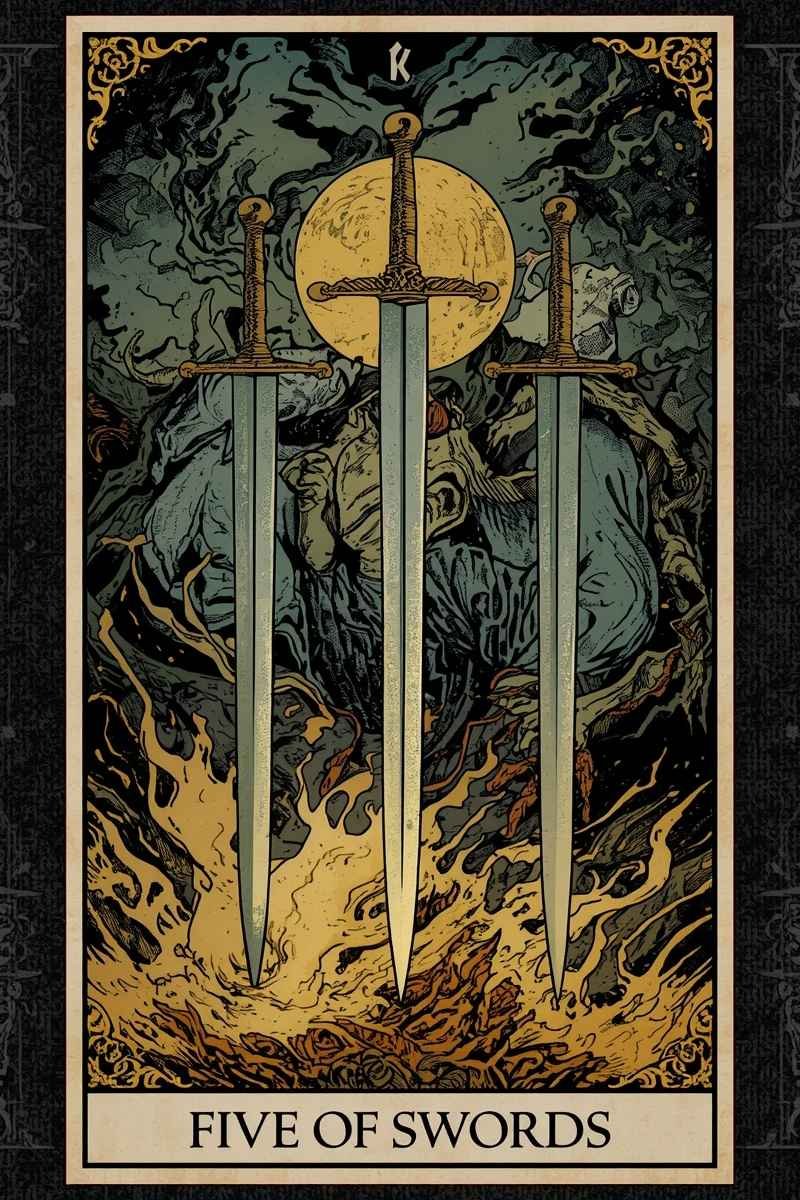
The Five of Swords centers on direct conflict, competition, and the consequences of trying to win. The Seven of Swords is more indirect. Instead of confronting the situation openly, someone may maneuver around it, work independently, or keep part of the strategy hidden.
When both cards appear, examine whether conflict is pushing people toward increasingly defensive or strategic behavior. The solution may require clearer boundaries, better information, and a decision about whether continued engagement is worthwhile.
Seven of Swords vs. The Moon
Both cards can create uncertainty, but they operate differently. The Moon often concerns ambiguity, intuition, fear, projection, and difficulty seeing a situation clearly. The Seven of Swords is more closely tied to deliberate strategy, selective disclosure, or avoidance.
Together, they can indicate that information is incomplete and assumptions are risky. Rather than jumping to the most dramatic interpretation, gather facts and separate what you know from what you fear.
Is the Seven of Swords Always About Cheating?
No. This is one of the most common oversimplifications of the card. In relationship readings, the Seven of Swords can sometimes appear when there is deception, including infidelity, but it can also describe avoiding confrontation, protecting privacy, making independent plans, withholding feelings, or simply behaving cautiously.
A Tarot card cannot prove that a partner is cheating. If you have concerns, base important decisions on communication, observable behavior, evidence, and your boundaries. The card is more useful as a prompt to examine transparency than as an accusation.
Practical Questions to Ask When You Draw the Seven of Swords
- What information is currently missing?
- Am I protecting legitimate privacy or avoiding accountability?
- Would direct communication actually simplify this situation?
- What part of my plan should remain private until it is ready?
- Have I verified the assumptions behind my strategy?
- Is a short-term advantage creating a long-term trust problem?
- What would I change if my actions were completely visible?
Seven of Swords Tarot Card FAQ
Is the Seven of Swords a negative Tarot card?
It can be challenging because it raises questions about secrecy, avoidance, and incomplete information, but it also represents intelligence, independence, discretion, and strategic planning. The surrounding context determines which qualities are most relevant.
Does the Seven of Swords mean lying?
It can indicate dishonesty or selective truth, but not always. It may instead show privacy, avoidance, careful planning, or an unconventional approach. Look for evidence before assuming deception.
Does the Seven of Swords mean cheating in love?
Not automatically. Infidelity is one possible interpretation in a relevant context, but the card alone cannot confirm it. It more broadly highlights trust, secrecy, independence, avoidance, and the need for clearer information.
What does the Seven of Swords reversed mean in love?
It can represent confession, greater transparency, hidden issues emerging, or a decision to stop avoiding a relationship problem. It can also show self-deception becoming harder to maintain.
What is the Seven of Swords advice for career?
Plan carefully, protect genuinely confidential information, verify details, and avoid unethical shortcuts. A strong strategy should improve your position without creating unnecessary integrity or trust problems.
Can the Seven of Swords be positive?
Yes. It can represent resourcefulness, strategic independence, intelligent timing, privacy, and finding a solution outside the obvious path. Its positive expression uses discretion without exploiting other people.
What should I do when the Seven of Swords appears?
Check the facts, review your strategy, and notice what is being handled indirectly. Decide what legitimately requires privacy and what would benefit from honest communication. If a plan depends on deception, consider the long-term consequences before proceeding.
Final Meaning of the Seven of Swords
The Seven of Swords is a card of strategy, discretion, independence, and the complicated boundary between privacy and secrecy. Upright, it asks you to think ahead, protect what genuinely needs protection, and recognize when an indirect approach is useful. It also warns that cleverness becomes costly when it depends on deception, avoidance, or escaping legitimate responsibility.
Reversed, the card often turns attention toward accountability. Hidden information may emerge, a strategy may need revision, or you may decide that maintaining secrecy is more exhausting than dealing honestly with the underlying issue.
In love, career, money, and personal development, the Seven of Swords offers a practical test: would your strategy still make sense if all relevant facts were visible? If the answer is yes, discretion may be wise. If the plan only works while someone else remains uninformed about something that directly affects them, greater transparency may be the more sustainable path.