Quick answer: The Six of Swords Tarot card represents transition, gradual recovery, moving away from difficulty, and choosing a calmer direction even when the journey is not emotionally simple. Upright, it often suggests progress, distance from conflict, relocation, healing, or a necessary passage from one phase of life to another. Reversed, it can point to resistance to change, unfinished business, delays, returning to an old situation, or discovering that physical distance alone does not resolve what still needs to be processed.
Six of Swords Tarot Card Meaning at a Glance
The Six of Swords belongs to the Suit of Swords, associated with thought, communication, truth, decisions, boundaries, and mental challenges. After the Five of Swords highlights conflict and the cost of fighting, the Six suggests movement away from that turbulence. The battle may not be completely forgotten, but continuing to remain inside it is no longer useful.
This is often called a card of transition. Yet transition does not always feel exciting. Sometimes moving forward means leaving something familiar because staying has become more difficult than changing. The destination may not be perfectly clear, but the direction is calmer and more sustainable.
- Upright keywords: transition, moving forward, recovery, travel, relocation, distance, healing, passage, calmer waters, necessary change
- Reversed keywords: resistance, delays, unfinished business, emotional baggage, returning, difficulty moving on, blocked transition
- Element: Air
- Suit: Swords
- Core question: What do you need to leave behind so that a healthier next chapter can begin?
What Does the Six of Swords Mean in Tarot?
At its core, the Six of Swords describes movement from a more difficult state toward one that offers greater stability or perspective. This can be literal movement, such as travel or relocation, but it is equally often psychological: changing your mindset, reducing contact with conflict, leaving an exhausting environment, or accepting that a chapter has reached its natural conclusion.
The card does not promise that every problem disappears immediately. In traditional imagery, the swords often travel with the figures in the boat. Symbolically, this suggests that memories, lessons, concerns, and unresolved thoughts can accompany us even when circumstances change. Progress can therefore be real without being instant or emotionally effortless.
The Six of Swords encourages practical movement. Instead of repeatedly analyzing the same conflict, ask what action creates greater safety, clarity, or peace. Sometimes the most intelligent response is not to win another argument but to stop giving the argument control over your direction.
Six of Swords Upright Meaning
When the Six of Swords appears upright, a transition is underway or becoming possible. You may be leaving a stressful period, recovering after conflict, changing environments, or creating enough distance to think more clearly.
The card often indicates gradual improvement rather than dramatic transformation. You may not feel completely healed, certain, or enthusiastic yet. That does not mean the movement is wrong. Some of the most important transitions begin quietly, through small decisions that reduce chaos and create space for something healthier.
Upright, the Six of Swords can also represent travel, moving house, changing jobs, ending an unhealthy pattern, or stepping back from relationships and situations that continually drain your energy. Context determines whether the movement is physical, emotional, professional, or mental.
A key message is to take useful lessons with you without carrying the entire conflict forward. Reflection helps; constant replay does not. The goal is not to erase the past but to prevent it from becoming the permanent blueprint for the future.
Six of Swords Upright Keywords
Transition, movement, recovery, travel, relocation, healing, progress, leaving difficulty, distance, acceptance, passage, calmer conditions.
Six of Swords Reversed Meaning
The reversed Six of Swords often appears when moving forward feels more complicated than expected. You may know that change is necessary while still feeling emotionally attached to the old situation. Plans can be delayed, travel may become complicated, or circumstances may repeatedly pull attention back toward unfinished business.
Sometimes the reversal describes resistance. Familiar discomfort can feel safer than an uncertain future. You might continue revisiting an argument, relationship, workplace, or decision because part of you hopes a different ending can be created without making a deeper change.
In other cases, the reversed card suggests that you have changed the external situation but not yet processed its internal impact. Moving cities does not automatically remove anxiety. Ending a relationship does not instantly resolve grief. Leaving a stressful job does not necessarily reset habits built during burnout.
The constructive message is not to force yourself to “move on” faster. Instead, identify what remains unfinished. Do you need information, closure, a practical plan, stronger boundaries, professional support, or simply more time? Progress becomes easier when the real obstacle is named.
Six of Swords Reversed Keywords
Resistance to change, delays, unfinished business, difficulty moving on, emotional baggage, returning, stalled progress, unresolved issues, complicated transition.
Six of Swords Love Meaning
In love readings, the Six of Swords often describes a relationship moving away from turbulence. This can mean repairing communication after a difficult period, creating healthier boundaries, taking space, relocating together, or deciding that separation is the calmer path. The card itself does not automatically predict a breakup.
If You Are in a Relationship
Upright, the Six of Swords may indicate that a couple is emerging from conflict and entering a quieter phase. Previous arguments may still matter, but both people can become more willing to focus on solutions rather than repeatedly proving who was right.
For some couples, it can represent a literal move, long-distance travel, or an environmental change that affects the relationship. For others, the movement is emotional: leaving behind a destructive communication pattern or establishing boundaries with outside pressures.
If the relationship has become consistently unhealthy, the card can also reflect choosing distance. Whether that distance is temporary or permanent depends on the actual situation and surrounding cards. Tarot should not replace evidence about safety, respect, or compatibility.
Reversed, old arguments may keep returning. One or both partners might say they want to move forward while continuing to reopen the same wound. The useful question is what has not actually been repaired. Avoid demanding instant closure when trust or communication still needs concrete work.
If You Are Single
For singles, the upright Six of Swords can represent moving beyond a painful relationship history and becoming more emotionally available for a different experience. Healing does not require forgetting the past. It means the past gradually stops controlling every new decision.
The card may also indicate travel, relocation, or meeting people outside your usual environment. However, it is better understood as openness to a new chapter than as a guaranteed prediction about where or when you will meet someone.
Reversed, you may still be mentally returning to a former relationship or comparing new people with someone from the past. Give yourself room to understand what remains unresolved before forcing a new beginning.
Six of Swords Career Meaning
In career readings, the Six of Swords commonly represents professional transition. You may be leaving a difficult workplace, changing teams, transferring locations, learning a new role, or moving toward work that offers better long-term stability.
Upright, this is often a positive sign for moving away from workplace conflict or chronic stress. The next stage may still require adjustment, but the overall direction can be more manageable. If you have been debating whether to change your professional environment, the card asks you to compare the real cost of staying with the realistic challenges of moving.
For job seekers, it can suggest broadening your search, considering remote work, relocation, a different industry, or skills that allow greater mobility. Rather than waiting for perfect certainty, create a practical transition plan.
For entrepreneurs, the Six of Swords may represent simplifying operations, leaving an unproductive strategy, changing markets, or gradually moving resources toward a more sustainable model.
Reversed, a career transition may be delayed or emotionally difficult. You could remain attached to a familiar role even when it no longer fits, or encounter practical obstacles such as timing, contracts, finances, or incomplete qualifications. Break the transition into smaller steps instead of treating delay as permanent failure.
Six of Swords Money Meaning
Financially, the Six of Swords favors movement toward greater stability through practical adjustments. This might involve reducing unnecessary expenses, restructuring debt, leaving an expensive arrangement, changing income strategies, or creating a clearer financial plan after a stressful period.
The card is generally more about steady improvement than sudden wealth. It encourages realistic progress: understanding where money is going, reducing avoidable pressure, and making choices that improve your position over time.
Travel or relocation costs can also be relevant. If a move is being considered, calculate the full transition cost rather than focusing only on the potential benefits.
Reversed, financial recovery may feel slower than expected. Old obligations, debt, unexpected costs, or reluctance to change spending patterns can make progress difficult. Identify which part of the plan is genuinely blocked and which part simply needs patience and consistency.
Six of Swords as Advice
As advice, the Six of Swords says: move toward the environment, mindset, or decision that creates greater clarity and stability. You do not need perfect certainty before taking the next reasonable step.
Leave unnecessary conflict behind. This does not mean ignoring injustice or abandoning important responsibilities. It means recognizing when continued engagement no longer produces a useful outcome. Distance can be strategic.
Take the lessons, not the entire burden. Review what happened, identify what you would do differently, and allow that knowledge to guide the next chapter. Do not make permanent residence inside an old problem.
Reversed as advice, slow down and identify what is preventing movement. If the obstacle is practical, build a plan. If it is emotional, give it appropriate attention. If you are returning to an old situation, be clear about what has actually changed before assuming the outcome will be different.
Six of Swords as a Person
As a person, the Six of Swords can describe someone thoughtful, adaptable, private, and focused on finding a calmer way forward. They may have experienced difficulty and learned to value peace, perspective, and strategic distance.
This person may not be highly expressive while processing change. They can appear quiet because they are mentally reorganizing priorities or deciding what belongs in the next phase of life.
Reversed, the person may struggle to release old situations or repeatedly return to familiar patterns. They may want change intellectually while emotionally resisting the uncertainty that comes with it.
Six of Swords as Feelings
As feelings, the Six of Swords can indicate a desire for peace, emotional distance, recovery, or a calmer connection. Someone may care but feel that tension needs to decrease before closeness can grow.
It can also reflect mixed emotions: sadness about what is being left behind combined with relief that a difficult phase is ending. Transition often contains both grief and hope.
Reversed, feelings may remain tied to the past. Someone might find it difficult to let go, continue replaying events, or feel uncertain about whether to leave or return. Tarot cannot verify another person’s private thoughts, so observable communication and behavior remain more reliable than assumptions.
Six of Swords Yes or No
In a simple yes-or-no reading, the Six of Swords generally leans toward “yes, if you are willing to move forward or change the current conditions.” The answer is less about staying exactly where you are and more about accepting transition.
Reversed, the answer is closer to “not yet.” Delays, resistance, unfinished details, or unresolved emotions may need attention first.
Six of Swords Symbolism
Traditional imagery often shows figures traveling by boat across water, with swords carried alongside them. The water may appear rougher behind and calmer ahead, emphasizing passage from turbulence toward greater stability.
The boat symbolizes transition and the practical means of getting from one condition to another. The swords suggest that thoughts, memories, lessons, and concerns come with us. We do not become a completely different person simply because our surroundings change.
The card therefore presents healing realistically. Moving forward is not the same as pretending nothing happened. It is choosing a direction in which what happened no longer controls every future choice.
Six of Swords in a Tarot Spread
Surrounding cards clarify what kind of transition is taking place. With Cups, the movement may be primarily emotional or relational. With Pentacles, work, money, housing, or material stability may be central. With Wands, the card can emphasize travel, ambition, or a change of direction. With other Swords, communication, decisions, mental recovery, and boundaries may dominate.
In a past position, the Six of Swords may describe a previous transition that shaped your current circumstances. In the present, it suggests that movement or recovery is happening now. In a future position, it can indicate that current difficulties are likely to require a change of environment, strategy, or perspective rather than endless engagement with the same problem.
Six of Swords vs. Five of Swords
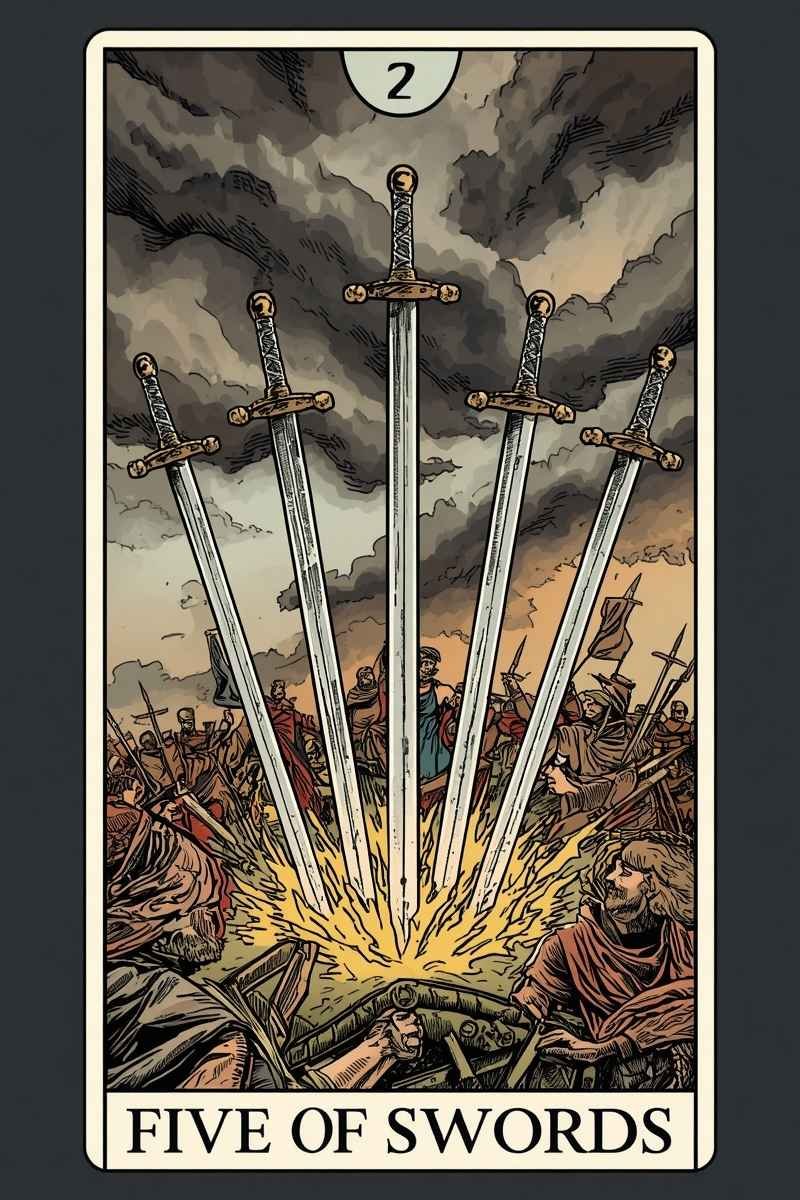
The Five of Swords focuses on conflict, competition, difficult victories, and the cost of how disagreement is handled. The Six of Swords represents what can happen afterward: stepping away, processing the lesson, and moving toward calmer conditions.
Together, the cards can tell a clear story. A conflict may have reached the point where further fighting offers diminishing returns. The next useful action is not necessarily another confrontation but a thoughtful transition. That might mean changing communication, establishing distance, leaving an environment, or simply refusing to repeat the same argument.
Six of Swords vs. Eight of Cups
Both cards can involve leaving something behind, but their emphasis differs. The Eight of Cups is strongly emotional and often concerns walking away because something no longer provides meaningful fulfillment. The Six of Swords is more closely associated with mental clarity, practical transition, recovery, and moving away from turbulence.
When both appear, a departure may involve both emotional recognition and a practical plan. Rather than treating the combination as a guaranteed ending, examine what is being left, why the change is necessary, and what healthier direction is becoming possible.
Questions to Ask When You Draw the Six of Swords
- What situation has become too costly to keep repeating?
- What would “calmer waters” look like in practical terms?
- Which lesson should I take with me, and which burden can I release?
- Am I waiting for perfect certainty before making a reasonable change?
- What practical step would make this transition safer or easier?
- Is physical distance enough, or is there emotional work that still needs attention?
- What am I afraid will happen if I genuinely move forward?
Six of Swords Tarot Card FAQ
Is the Six of Swords a positive Tarot card?
It is generally constructive because it points toward movement away from difficulty and toward greater stability. However, it can still carry sadness, uncertainty, or adjustment. Improvement does not always feel immediately comfortable.
Does the Six of Swords mean travel?
It can. Travel, relocation, commuting, or moving house are traditional possibilities, but the transition can also be emotional, mental, professional, or relational. Context matters.
Does the Six of Swords mean a breakup?
Not automatically. In love readings, it can show creating distance, leaving conflict behind, repairing a relationship, relocating, or choosing separation. Actual relationship behavior and surrounding cards provide more context.
What does the Six of Swords reversed mean in love?
It can indicate difficulty moving beyond old arguments, emotional baggage, returning to a previous relationship pattern, or a transition that has stalled. It may also suggest that external change occurred without enough internal repair.
What is the main advice of the Six of Swords?
Move toward greater peace and stability. Take useful lessons from the past, make a practical transition plan, and avoid repeatedly investing energy in conflicts that no longer lead anywhere constructive.
Does the Six of Swords mean someone is coming back?
Reversed, the card can sometimes symbolize returning or revisiting an old situation, but it does not guarantee that a specific person will return. Use real communication and evidence rather than treating a Tarot card as proof of another person’s future actions.
What does the Six of Swords mean for healing?
It often represents gradual recovery. Healing may involve distance from a stressful environment, a change in perspective, support, time, and practical steps that reduce repeated exposure to the same source of distress.
Final Meaning of the Six of Swords
The Six of Swords is a card of transition, recovery, and deliberate movement toward calmer conditions. Upright, it suggests that progress becomes possible when you stop giving old conflict unlimited access to your attention and begin taking practical steps toward a more stable chapter. Reversed, it highlights resistance, delays, unfinished business, or the realization that changing external circumstances is only part of moving forward.
In love, career, money, and personal development, the message is grounded: you do not need to erase the past before beginning the next phase. Carry the lessons that make you wiser, address the responsibilities that still matter, and release what only keeps you trapped in repetition.
The Six of Swords does not promise an effortless journey. It offers something more useful: direction. When the old environment repeatedly produces the same turbulence, progress may begin with a simple decision to stop circling the conflict and start moving toward calmer water.