
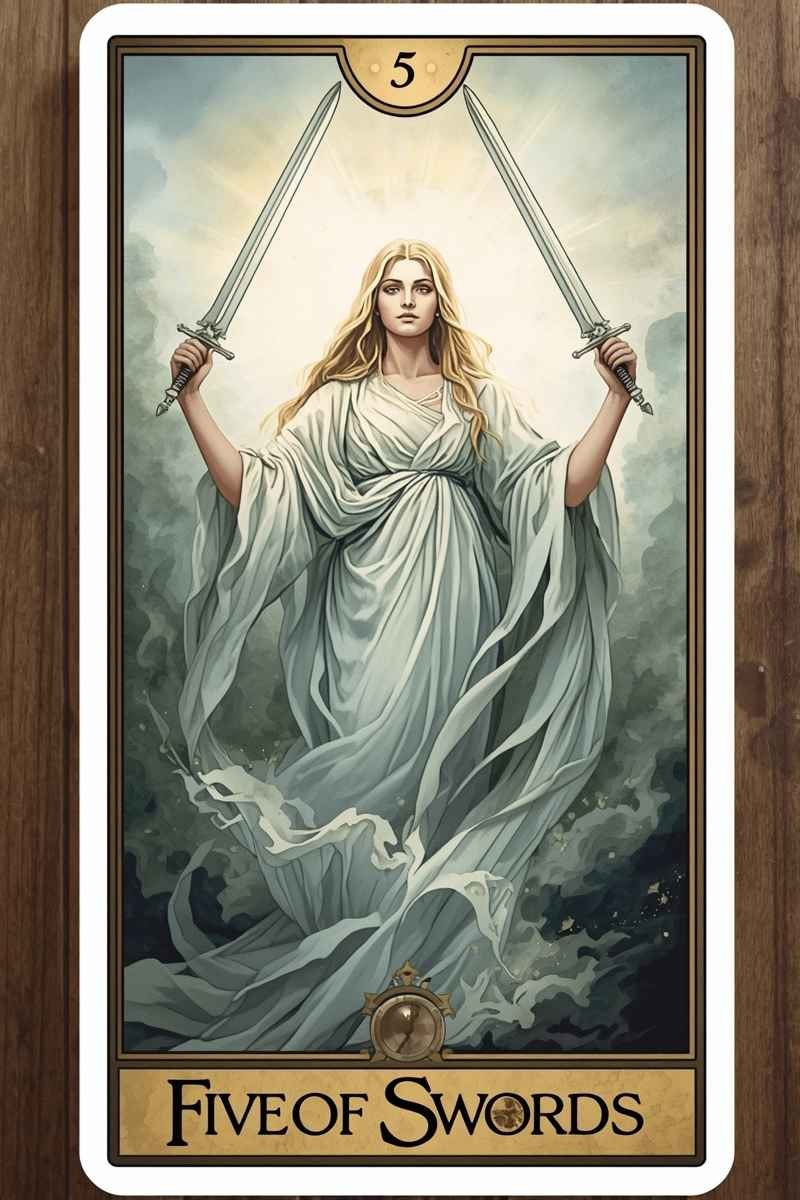
Quick answer: The Five of Swords Tarot card represents conflict, tension, competition, difficult victories, and the consequences of how we choose to fight. Upright, it can point to arguments, ego clashes, winning at too high a cost, or realizing that being technically right does not always create a useful outcome. Reversed, it often highlights reconciliation, accountability, letting go of resentment, unresolved hostility, or the need to stop repeating an unproductive conflict.
Five of Swords Tarot Card Meaning at a Glance
The Five of Swords belongs to the Suit of Swords, which is associated with thought, communication, truth, decisions, boundaries, and conflict. After the Four of Swords creates a pause for rest and reflection, the Five brings us back into a more difficult social landscape: what happens when different priorities, beliefs, or egos collide?
This card is often described as a card of conflict, but its deeper meaning is about the price of conflict. A victory can still leave relationships damaged. A sharp comment can prove a point while destroying trust. Walking away can sometimes be wiser than continuing a battle simply because you do not want to lose.
- Upright keywords: conflict, tension, competition, ego, disagreement, difficult victory, hostility, consequences, self-interest
- Reversed keywords: reconciliation, making amends, accountability, lingering resentment, conflict avoidance, forgiveness, de-escalation
- Element: Air
- Suit: Swords
- Core question: What are you trying to win, and what might that victory cost?
What Does the Five of Swords Mean in Tarot?
At its core, the Five of Swords asks you to examine how you respond when interests clash. It may describe an obvious argument, a competitive environment, passive aggression, office politics, a disagreement between partners, or an internal battle in which your need to be right is competing with your need for peace.
The card does not automatically mean that someone is malicious or that betrayal is inevitable. Sometimes it simply shows that communication has become defensive. People may be protecting their pride, reacting from fear, or treating a complex problem as if one side must completely defeat the other.
The Five of Swords can also appear when you have technically achieved what you wanted but the result feels strangely unsatisfying. That discomfort is useful information. It may be asking whether your methods were aligned with your values, whether the conflict was worth the energy, or whether there is a more constructive way to protect your interests.
Five of Swords Upright Meaning
When the Five of Swords appears upright, tension is usually difficult to ignore. You may be dealing with disagreement, competition, criticism, defensiveness, or a situation in which everyone is focused on protecting their own position. Communication can become more about winning than understanding.
Upright, the card can warn against unnecessary escalation. A disagreement does not have to become a war. Before responding, consider whether the issue actually requires confrontation, whether your goal is clear, and whether the way you communicate will move the situation closer to resolution.
In some readings, the Five of Swords describes a hollow victory. You may win an argument, outperform a rival, or secure an advantage, yet lose goodwill, trust, cooperation, or peace of mind. The card does not say that you should never compete or defend yourself. It asks you to distinguish healthy self-protection from conflict driven primarily by pride.
It can also represent the experience of being on the receiving end of unfair tactics. If so, the message is not to blame yourself. Instead, focus on what you can control: clear boundaries, accurate documentation, calm communication, and knowing when disengagement is more effective than continuing the fight.
Five of Swords Upright Keywords
Conflict, disagreement, competition, hostility, tension, ego, self-interest, argument, difficult victory, consequences, defensiveness, power struggle.
Five of Swords Reversed Meaning
The reversed Five of Swords often appears when the desire for conflict is beginning to weaken. Someone may be ready to apologize, compromise, admit a mistake, or stop investing energy in a battle that no longer serves a meaningful purpose.
This can be a constructive reversal. It may indicate reconciliation after an argument, a willingness to listen, or recognition that preserving dignity does not require defeating another person. Forgiveness is possible, although forgiveness does not necessarily mean restoring a relationship to exactly what it was before.
However, reversed cards can also expose what has been pushed underground. The visible argument may have stopped while resentment remains. People may avoid the subject because they fear another confrontation. In that case, apparent peace is not the same as resolution.
The reversed Five of Swords therefore asks whether a conflict has actually been processed. If trust was damaged, what would repair require? If you made a mistake, can you take responsibility without turning the apology into another debate? If someone crossed your boundaries, can you move forward without pretending it never happened?
Five of Swords Reversed Keywords
Reconciliation, apology, accountability, compromise, forgiveness, de-escalation, unresolved resentment, conflict avoidance, regret, making amends.
Five of Swords Love Meaning
In love readings, the Five of Swords often points to communication patterns that turn intimacy into competition. Couples may keep score, revisit old arguments, use sarcasm, withdraw affection, or focus so strongly on proving a point that the relationship itself becomes secondary.
If You Are in a Relationship
Upright, the Five of Swords can describe recurring arguments or a specific disagreement that has become more damaging than the original issue. One partner may feel unheard while the other feels constantly criticized. Both may believe they are defending themselves, yet the interaction creates more distance.
The card encourages a shift from “Who is right?” to “What outcome would actually help us?” That does not mean tolerating disrespect or abandoning legitimate needs. Healthy conflict includes boundaries, honesty, and accountability. But it also leaves room for listening and repair.
Reversed, the Five of Swords may show an opportunity to reconcile. A cooling-off period can make a more honest conversation possible. An apology may be offered, or both people may become tired of repeating the same argument. If resentment remains, however, simply declaring the issue finished may not be enough.
If You Are Single
For singles, the upright Five of Swords can suggest carrying a defensive mindset from previous relationship experiences. You may expect dating to involve games, competition, rejection, or hidden motives. Caution can be useful, but excessive defensiveness can make genuine connection harder to recognize.
The card can also advise against pursuing someone primarily because winning their attention has become a challenge. Ask whether you genuinely value the person and the connection, or whether competition is making the situation feel more important than it really is.
Reversed, you may be releasing old resentment and becoming more willing to approach relationships without assuming the next person will repeat the past. The goal is not naive trust; it is learning from experience without allowing old conflict to dictate every new interaction.
Five of Swords Career Meaning
In career readings, the Five of Swords commonly reflects competition, workplace tension, difficult negotiations, office politics, conflicting priorities, or communication that has become adversarial.
Upright, be careful about winning a short-term professional battle at the expense of long-term credibility. Publicly embarrassing a colleague, escalating every disagreement, or taking credit unfairly may create consequences even if it produces an immediate advantage.
If you are dealing with an unfair environment, the card supports strategic self-protection. Keep records of important decisions, clarify expectations in writing, distinguish facts from assumptions, and choose carefully which issues deserve escalation. Professional boundaries can be firm without becoming unnecessarily combative.
For job seekers or entrepreneurs, the Five of Swords may reflect a competitive market. Competition itself is not a negative sign. The practical message is to avoid letting comparison distort your strategy. Focus on what differentiates your skills or offer instead of becoming consumed by what competitors are doing.
Reversed, workplace tension may begin to settle. Mediation, a direct conversation, clearer roles, or a willingness to compromise can help. Alternatively, unresolved politics may simply become less visible. Pay attention to whether behavior has actually changed rather than assuming silence means the problem has disappeared.
Five of Swords Money Meaning
Financially, the Five of Swords advises caution around disputes, competitive pressure, and decisions driven by the need to prove something. Avoid spending simply to match another person’s lifestyle or taking financial risks because losing feels emotionally unacceptable.
The card can also appear around disagreements involving shared expenses, contracts, debts, inheritances, business arrangements, or negotiations. Keep the discussion specific. Use clear numbers and written terms rather than allowing pride to turn a practical financial issue into a personal battle.
Reversed, a financial disagreement may become easier to resolve. A payment plan, renegotiation, compromise, or clearer communication can reduce tension. If money has become connected to resentment or control, separating the emotional issue from the financial facts can help everyone make better decisions.
Five of Swords as Advice
As advice, the Five of Swords asks you to choose your battles carefully. Before reacting, identify what you actually want. Is your goal safety, fairness, clarity, respect, compensation, cooperation, or simply the satisfaction of proving someone wrong?
If the issue matters, communicate directly and protect your boundaries. If the battle is mostly about ego, consider whether disengagement would preserve more energy and dignity. Walking away from an unproductive argument is not necessarily losing.
The card also encourages you to examine your own tactics. Are you listening only for weaknesses in the other person’s argument? Are you using information to clarify or to wound? Are you escalating because the issue requires it, or because backing down feels uncomfortable?
Reversed as advice, prioritize repair where repair is appropriate. A sincere apology should acknowledge impact rather than merely explain intention. If reconciliation is unsafe or unrealistic, closure may instead mean accepting what happened, strengthening boundaries, and deciding not to continue the cycle.
Five of Swords as a Person
As a person, the Five of Swords can describe someone competitive, sharp-minded, defensive, strategic, or highly sensitive to losing. They may be skilled at debate but sometimes prioritize being right over maintaining connection.
This does not automatically mean the person is dishonest or cruel. They may have learned to approach life as a contest because they expect others to take advantage of weakness. In a healthier expression, their strategic thinking can become excellent boundary-setting, negotiation, and problem solving.
Reversed, the person may regret previous conflict and want to make amends. Alternatively, they may avoid confrontation outwardly while still carrying significant resentment.
Five of Swords as Feelings
As feelings, the Five of Swords can indicate defensiveness, frustration, resentment, competitiveness, or emotional tension. Someone may feel that they need to protect themselves or may be replaying a disagreement mentally.
It can also show mixed feelings after a conflict: relief that an argument is over combined with discomfort about how it happened. Reversed, the person may want peace, regret what was said, or feel ready to reconnect after tension.
Tarot cannot confirm another person’s private thoughts with certainty. Use the card as a prompt to observe actual communication and behavior rather than as proof of hidden motives.
Five of Swords Yes or No
In a simple yes-or-no reading, the Five of Swords generally leans toward “no” or “not under the current conditions.” The situation may involve too much conflict, ego, competition, or hidden cost to produce a clean result.
Reversed, the answer may improve if the underlying conflict is addressed. Cooperation, clearer boundaries, or a willingness to compromise can change the conditions surrounding the question.
Five of Swords Symbolism
Traditional Five of Swords imagery often shows a figure holding swords while other people move away. The scene suggests that someone has gained an advantage, yet the emotional atmosphere does not feel celebratory. Separation and tension remain after the contest.
The swords symbolize intellect, language, decisions, and conflict. Their presence emphasizes how words and strategies can become tools for either clarity or harm. The card’s visual tension asks an important question: what does victory mean if nobody feels whole afterward?
Five of Swords in a Tarot Spread
Surrounding cards help clarify the source and likely expression of the conflict. With other Swords cards, the issue may center on communication, decisions, criticism, or mental pressure. With Cups, emotional wounds and relationship dynamics may be central. With Pentacles, the disagreement may involve work, money, property, or resources. With Wands, ambition and competition can become especially important.
Position matters as well. In the past, the Five of Swords may describe a conflict that still influences present choices. In the present, it asks you to examine how disagreement is being handled now. In a future position, it can function as advance notice to establish clearer boundaries and communication before tension escalates.
Five of Swords vs. Three of Swords
The Five of Swords and Three of Swords can both appear in painful readings, but their emphasis differs. The Three of Swords focuses more directly on heartbreak, grief, painful truth, and emotional hurt. The Five of Swords focuses on conflict, competition, interpersonal strategy, and the consequences of how disagreement is handled.
Together, they may suggest that conflict has created emotional pain or that unresolved hurt is feeding further arguments. Rather than assuming a dramatic prediction, use the combination to identify the actual communication pattern that needs attention.
Questions to Ask When You Draw the Five of Swords
- What am I actually trying to achieve in this conflict?
- Would winning this argument improve the larger situation?
- Which boundary genuinely needs to be defended?
- Am I responding to the present problem or to an older wound?
- What would a fair resolution look like?
- Is there a way to communicate firmly without escalating unnecessarily?
- What can I learn from the consequences of previous conflicts?
Five of Swords Tarot Card FAQ
Is the Five of Swords a negative Tarot card?
It is challenging, but not simply negative. The card exposes conflict and its consequences so that you can make more conscious choices about boundaries, communication, competition, and repair.
Does the Five of Swords mean betrayal?
Not automatically. It can sometimes appear around unfair behavior or self-interest, but it more broadly represents conflict, difficult tactics, and the cost of winning. Surrounding cards and real-world evidence are necessary before making stronger conclusions.
Does the Five of Swords mean a breakup?
No. In love readings it can show damaging arguments, defensiveness, or unresolved resentment, but it does not guarantee separation. The relationship’s actual behavior and willingness to repair matter more than one card.
What does the Five of Swords reversed mean in love?
It often points toward reconciliation, apology, de-escalation, or a desire to stop fighting. It can also indicate conflict that has gone quiet without being genuinely resolved.
What is the main advice of the Five of Swords?
Choose your battles carefully. Protect what matters, but do not confuse proving a point with creating a good outcome. Consider the long-term cost of the way you handle disagreement.
What does the Five of Swords mean for communication?
It suggests communication may be defensive, competitive, or overly focused on winning. Slow the exchange down, clarify the real issue, avoid personal attacks, and decide what resolution would actually be useful.
Final Meaning of the Five of Swords
The Five of Swords is a card about conflict and consequences. Upright, it asks whether competition, defensiveness, or the desire to win is creating a greater cost than the original disagreement. Reversed, it highlights the possibility of reconciliation, accountability, and release while also warning that hidden resentment may still need attention.
In love, career, money, and personal growth, its message is practical: not every battle deserves your energy, and not every victory is worth its price. Strong boundaries and honest communication matter, but so does knowing when to stop fighting. The most useful question the Five of Swords leaves you with is not simply “Who wins?” but “What outcome can I live with after the conflict is over?”