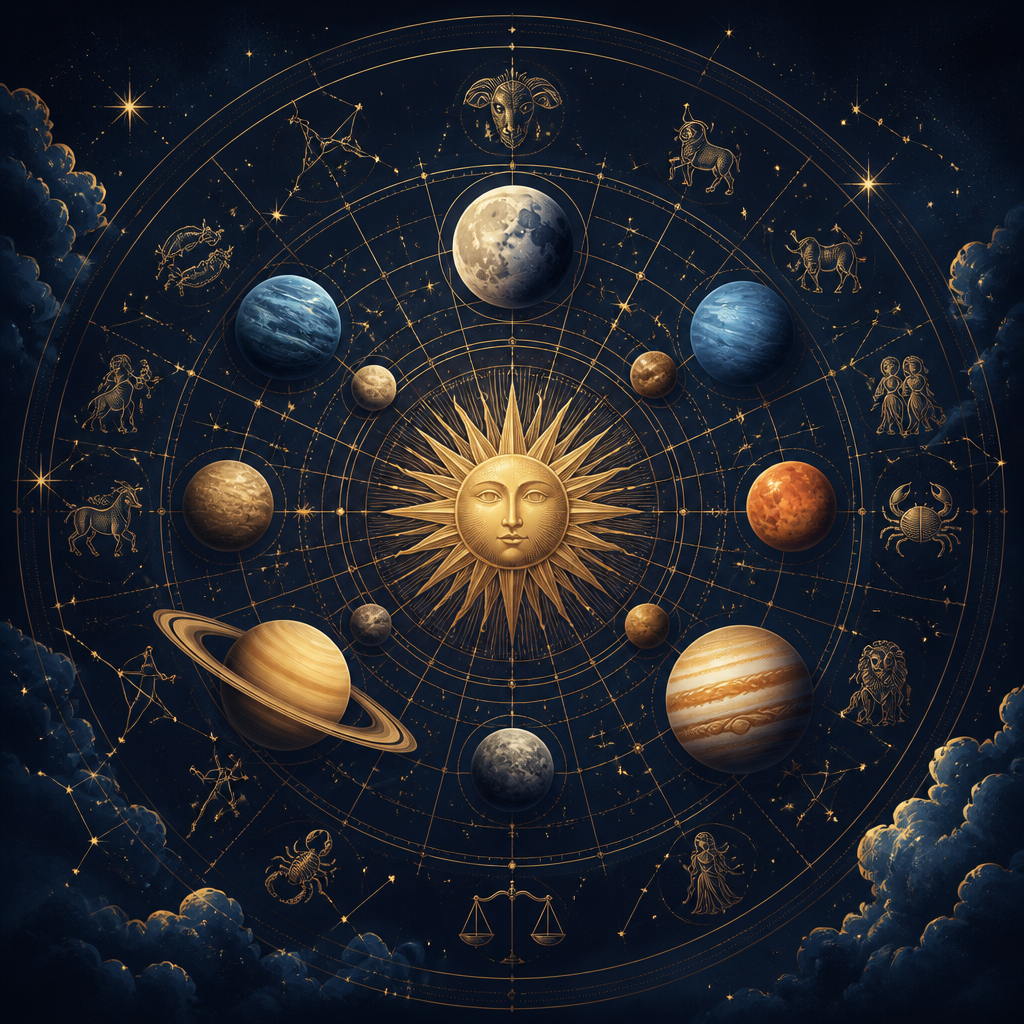
Astrology transits describe the current movement of the planets and how those moving positions relate to a birth chart. They are one of the most common techniques used in predictive and timing-oriented astrology, but the word “predictive” can be misleading. A transit does not guarantee a specific event. It describes a symbolic period in which certain themes may become more noticeable, active, or relevant.
Understanding transits begins with a simple distinction: your natal chart is fixed, while the planets continue moving. A transit compares the moving sky with that fixed birth chart.
What Is an Astrology Transit?
A transit occurs when a current planet reaches a particular zodiac position. Astrologers then compare that position with the planets, angles, and houses in a natal chart.
If transiting Saturn forms a square to your natal Sun, for example, an astrologer may explore themes involving responsibility, limits, effort, confidence, or long-term structure. The interpretation depends on the natal Sun’s sign, house, and aspects as well as the house through which Saturn is moving.
General Transits vs. Personal Transits
General transits describe the sky for everyone. A Mercury retrograde or a Mars-Jupiter aspect is a collective transit because everyone experiences the same planetary geometry.
Personal transits compare those moving planets with your natal chart. These tend to be more specific because the same transit interacts differently with each person’s birth placements.
Fast-Moving Planets
The Moon, Mercury, Venus, and Mars move relatively quickly. Their transits often describe shorter periods.
The Moon can change emotional tone within hours or days. Mercury transits may highlight communication, paperwork, learning, or decisions. Venus can emphasize relationships, values, pleasure, and social connection. Mars can bring energy, motivation, conflict, or urgency.
Slow-Moving Planets
Jupiter, Saturn, Uranus, Neptune, and Pluto move much more slowly, so their transits can last weeks, months, or longer.
These slower transits are often treated as larger developmental cycles. Jupiter may coincide symbolically with expansion or opportunity, Saturn with responsibility and consolidation, Uranus with disruption and independence, Neptune with ideals and uncertainty, and Pluto with deep transformation.
Transiting Planets Through Houses
A planet’s transit through a natal house can describe which area of life receives more symbolic emphasis. Jupiter moving through the tenth house, for example, might draw attention to career, public role, or long-term goals.
Saturn through the fourth house could emphasize home, family obligations, boundaries, or private foundations. The exact expression varies by person and circumstance.
Transits to the Sun
Transits to the natal Sun can highlight identity, confidence, visibility, vitality, and direction. A supportive Jupiter-Sun transit may be interpreted as a period for growth or broader opportunity, while a Saturn-Sun transit may emphasize responsibility, limits, or disciplined development.
Neither transit guarantees a specific external event.
Transits to the Moon
The Moon symbolizes emotions, habits, family patterns, security, and instinctive responses. Slow-planet transits to the natal Moon can correspond with periods of emotional development, changing needs, or shifts in home and family dynamics.
Fast lunar transits are shorter and often used in daily astrology.
Transits to Mercury
Mercury transits can emphasize communication, learning, contracts, travel, information, and decision-making. A Saturn-Mercury transit may encourage careful thinking or disciplined study; Uranus-Mercury can correspond symbolically with new ideas or a desire for mental freedom.
Transits to Venus
Venus relates to relationships, attraction, values, pleasure, and aesthetics. Transits to natal Venus may bring these topics into focus.
A Jupiter-Venus transit may be interpreted as socially or creatively expansive, while Saturn-Venus can highlight commitment, boundaries, finances, or a need to evaluate what is truly valuable.
Transits to Mars
Mars symbolizes drive, action, desire, assertion, and conflict. Transits to Mars can affect the way energy is used.
Uranus-Mars may feel restless or unpredictable, while Saturn-Mars can emphasize controlled effort, frustration, or the need for strategic pacing.
Conjunctions
A conjunction occurs when a transiting planet occupies the same or nearly the same degree as a natal planet. Conjunctions tend to intensify the relationship between the two planetary themes.
The effect depends on which planets are involved. A Venus conjunction is very different from a Pluto conjunction.
Squares
A square is an angle of roughly 90 degrees. Squares are often interpreted as friction, pressure, or a need for adjustment.
They are not automatically negative. A square can create enough discomfort to motivate change or action.
Oppositions
An opposition is roughly 180 degrees and often highlights polarity, awareness, or a tension between two areas of life.
Oppositions may become visible through relationships or external circumstances because they emphasize contrast.
Trines and Sextiles
Trines, roughly 120 degrees, are often associated with easier flow or natural cooperation. Sextiles, roughly 60 degrees, can represent opportunities that are available but may require participation.
Easy aspects are not guarantees of success. They describe symbolic ease, not automatic results.
What Is an Orb?
An orb is the allowable distance from an exact aspect. Astrologers use different orb sizes depending on the planets and technique.
Many readers consider a transit strongest near exactitude. Slow planets can remain within orb for a long time and may cross the same natal degree several times because of retrograde motion.
Why Some Transits Repeat
When a planet turns retrograde, it can pass over the same natal point more than once. A transit may therefore have an initial pass, a retrograde pass, and a final direct pass.
This can create a longer process in which the same theme is introduced, reconsidered, and integrated over time.
Transits to the Angles
The Ascendant, Descendant, Midheaven, and IC are sensitive chart points. Slow-planet transits to these angles are often considered significant because they can correspond with changes in identity, relationships, public role, or home foundations.
Accurate birth time is especially important when interpreting angle transits.
How to Read Transits Without Becoming Anxious
Do not assume that every difficult transit predicts a crisis. Start with the symbolic theme, then ask where it actually appears in your life.
A Saturn transit might simply correspond with a period of increased workload, stronger boundaries, or a need for patience. A Pluto transit may describe an internal change rather than an external dramatic event.
Prioritize Slow Transits
If you are a beginner, start with Jupiter through Pluto because slower transits create longer, easier-to-observe cycles. Then add faster planets for timing and daily detail.
This prevents the chart from becoming overloaded with dozens of temporary aspects.
Keep a Transit Journal
Record the transit, the exact dates, the interpretation you expected, and what actually happened. This helps you learn the symbolism and reduces the temptation to reinterpret vague statements after the fact.
Over time, you may notice which transits feel most relevant to your chart.
Related Astrology Guides
- What Is a Birth Chart?
- How to Read a Birth Chart
- Retrogrades Explained
- Astrology Aspects Explained
- The Planets in Astrology
Frequently Asked Questions
What is an astrology transit?
A transit compares current planetary positions with a birth chart to explore timing, changing conditions, and symbolic themes.
Do transits guarantee events?
No. Transits are best treated as timing and reflection frameworks rather than fixed predictions of specific outcomes.
Final Thoughts
Astrology transits compare the moving planets with a fixed natal chart. Fast planets can describe short-term rhythms, while slow planets are often associated with longer developmental cycles. Aspects show how the transit interacts with natal placements, and houses identify the life areas involved.
The most responsible way to use transits is as a timing and reflection framework rather than a guarantee of events. Observe the symbolism, compare it with reality, and keep your choices grounded in practical information.
How to Prioritize Several Transits at Once
A natal chart can receive many transits on the same day, but they do not all deserve equal attention. Start with the slowest planets making the tightest aspects to the Sun, Moon, Ascendant, Midheaven, Mercury, Venus, or Mars. Then add the house being activated and any faster planet that may trigger the same degree.
This hierarchy prevents daily astrology from becoming a wall of conflicting messages. A short lunar aspect may describe a passing mood, while a close Saturn or Pluto transit can represent a much longer developmental theme. Looking at duration, exactness, and repetition gives the chart a clearer sense of scale.
When several transits repeat the same topic, that repeated theme is often more useful than any single interpretation.
1 thought on “Astrology Transits Explained: How Planetary Movements Affect Your Life”
Comments are closed.