
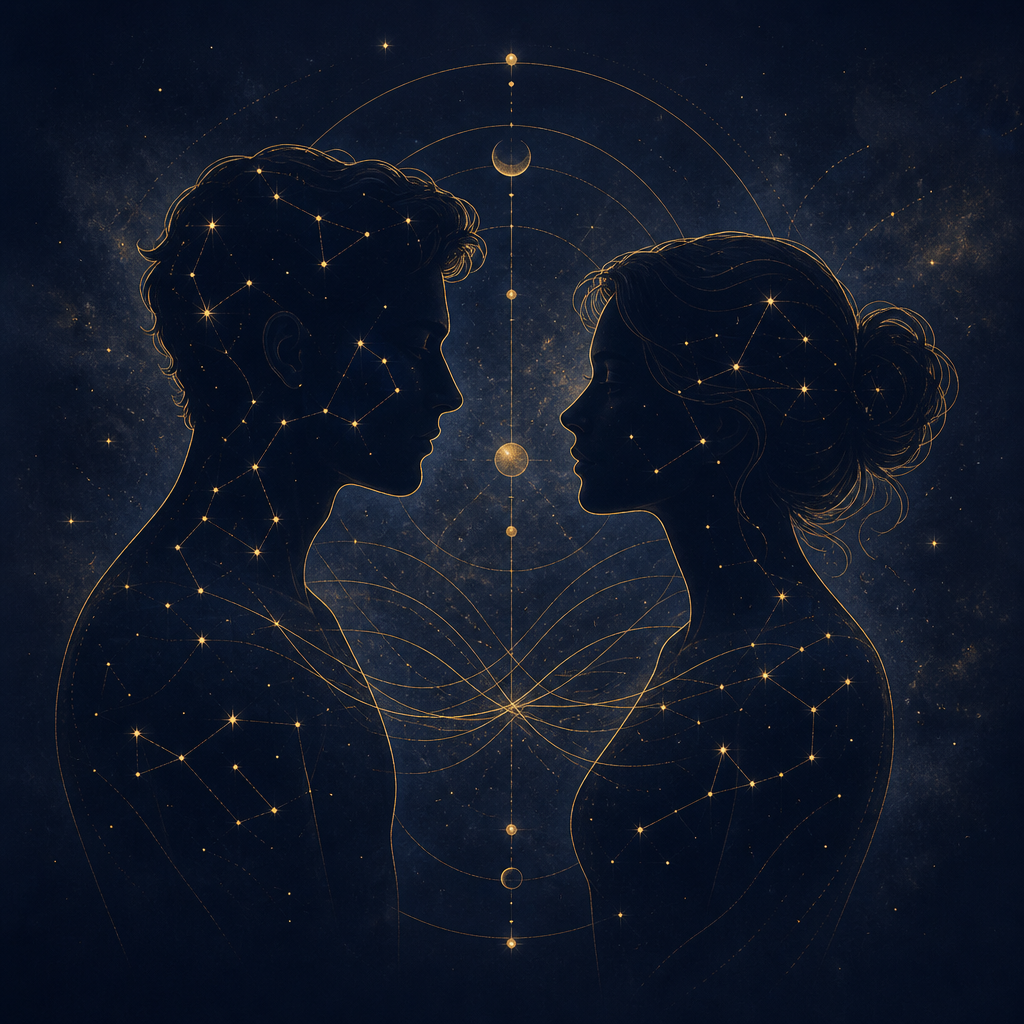
Birth chart compatibility, often called synastry, compares two natal charts to explore how two people’s planetary patterns interact. Unlike simple Sun-sign matching, synastry considers the Moon, Mercury, Venus, Mars, the Ascendant, houses, and aspects between the charts.
The purpose is not to decide whether a relationship is “meant to be.” A compatibility chart is better used to identify areas of natural understanding, attraction, tension, communication differences, and growth. Real relationship outcomes still depend on behavior, values, trust, boundaries, timing, and mutual effort.
What Is Synastry?
Synastry places the planets from one person’s chart in relation to the planets and houses of another person’s chart. Astrologers examine the aspects formed between the two sets of planets.
For example, one person’s Moon may form a trine to the other person’s Venus, suggesting emotional and affectionate styles that cooperate easily. A Mercury-Mars square may indicate stimulating but potentially sharp communication.
Why Sun Signs Are Only the Beginning
The Sun is important for identity and self-expression, but relationships involve much more than identity. Emotional needs are often described by the Moon, communication by Mercury, attraction and values by Venus, drive and conflict by Mars, and partnership patterns by the seventh house.
Two people with supposedly incompatible Sun signs may have highly supportive Moon or Venus connections. Two people with matching Sun signs may still struggle if communication or emotional needs differ strongly.
Moon Compatibility
The Moon is one of the most important placements in close relationships because it is associated with emotional security, habits, instinctive reactions, and comfort.
Compatible Moon signs or supportive Moon aspects can make emotional understanding feel easier. Challenging Moon contacts do not doom a relationship, but they may require more conscious translation of needs.
Mercury Compatibility
Mercury describes communication and thought. Synastry involving Mercury can reveal how easily two people exchange ideas and resolve misunderstandings.
Mercury-Mercury trines or sextiles may support easy conversation. Squares or oppositions can create different reasoning styles that are stimulating but occasionally frustrating. Mercury-Saturn contacts can add seriousness or caution, while Mercury-Uranus can create quick, unconventional mental connection.
Venus Compatibility
Venus symbolizes attraction, affection, values, pleasure, and relationship preferences. Venus contacts are often important for romantic chemistry and shared tastes.
Venus-Moon aspects can support affection and emotional warmth. Venus-Saturn can suggest seriousness, commitment, or feelings of restriction depending on how the relationship functions. Venus-Uranus may bring excitement and a strong need for freedom.
Mars Compatibility
Mars represents desire, drive, assertion, and conflict style. Mars contacts can create attraction and momentum but may also intensify disagreements.
Mars-Venus aspects are often associated with chemistry. Mars-Mars aspects can show whether two people naturally match each other’s pace or compete for direction. Mars-Saturn contacts may create disciplined teamwork or frustration around timing and control.
Sun-Moon Connections
Connections between one person’s Sun and the other person’s Moon are traditionally considered significant because they link conscious identity with emotional needs.
A trine or conjunction may feel naturally supportive, while a square or opposition can create strong attraction alongside differences that require awareness.
The Ascendant in Compatibility
The Ascendant describes approach and first impression. Planets from one chart making close aspects to another person’s Ascendant can feel immediately noticeable.
Venus near another person’s Ascendant may create attraction or appreciation. Mars may create energy and chemistry. Saturn may add seriousness or caution.
House Overlays
In synastry, astrologers also examine where one person’s planets fall in the other person’s houses. These are called house overlays.
If someone’s Venus falls in your seventh house, relationship and partnership themes may be emphasized. Their Sun in your tenth house may connect with career, ambition, or public role. Their Moon in your fourth house may activate home, family, or emotional-foundation themes.
The Seventh House
The seventh house is traditionally associated with one-to-one partnership, including marriage and committed relationships. The sign on the Descendant, planets in the seventh house, and the house ruler can all provide context about relationship patterns.
In synastry, another person’s planets activating this house can feel significant, but no one overlay guarantees partnership.
The Fifth House
The fifth house is associated with romance, pleasure, creativity, play, and attraction. Strong fifth-house overlays can feel fun, expressive, or romantically stimulating.
The fifth house is not the same as the seventh: fifth-house energy can describe attraction and enjoyment without necessarily describing long-term commitment.
The Eighth House
The eighth house is associated with intimacy, trust, vulnerability, shared resources, and transformation. Planetary overlays here can create intense or psychologically revealing dynamics.
Because eighth-house contacts can feel powerful, they should be interpreted carefully rather than automatically labeled “soulmate” connections.
Saturn in Synastry
Saturn often receives special attention because it relates to commitment, responsibility, boundaries, and endurance. Supportive Saturn contacts can help a relationship develop structure and reliability.
Challenging Saturn contacts can feel limiting, critical, or heavy if handled poorly. Yet they can also motivate maturity and clearer boundaries.
Jupiter in Synastry
Jupiter can bring optimism, generosity, growth, learning, and a broader perspective. Jupiter contacts may make people feel encouraged or supported.
The potential challenge is excess. A relationship can encourage overconfidence or unrealistic expectations as easily as positive expansion.
Uranus, Neptune, and Pluto in Synastry
Uranus can bring excitement, freedom, unpredictability, and unconventional connection. Neptune can bring idealization, compassion, creativity, or confusion. Pluto can bring intensity, power dynamics, transformation, or deep psychological involvement.
These planets move slowly, so their aspects become more personally relevant when they are close and involve personal planets or angles.
Composite Charts
A composite chart is different from synastry. Instead of comparing two separate charts, it calculates midpoint positions to create one symbolic chart for the relationship itself.
Some astrologers use both methods: synastry to understand how the two individuals interact and the composite chart to describe the relationship dynamic as a separate entity.
Challenging Aspects Are Not Deal-Breakers
Squares and oppositions can create friction, but they can also create attraction, awareness, and motivation. A relationship with only easy aspects would not automatically be healthy.
The actual behavior of the people involved matters more than the aspect label.
Easy Aspects Are Not Guarantees
Trines and sextiles can support comfort and cooperation, but they do not create communication skills or ethical behavior automatically. A chart full of harmonious aspects cannot compensate for dishonesty, disrespect, or incompatible life goals.
What to Look for First
When comparing charts, begin with the Sun, Moon, Mercury, Venus, and Mars. Then look at the Ascendant and major aspects. After that, consider house overlays and slower planets.
Prioritize repeated themes rather than one dramatic connection.
Compatibility Questions Worth Asking
- How do we express emotional needs?
- How do we communicate under stress?
- What makes each person feel appreciated?
- How do we handle conflict and boundaries?
- Where do we naturally support each other?
- Where do our expectations differ?
What Synastry Cannot Tell You
Synastry cannot guarantee marriage, fidelity, longevity, happiness, or failure. It cannot responsibly prove that someone is a soulmate or that a relationship must end.
It can describe symbolic patterns, but the relationship is lived through choices and behavior.
Related Compatibility Guides
- Zodiac Compatibility Explained
- Moon Sign Compatibility
- Venus Sign Compatibility
- Mars Sign Compatibility
- Astrology Compatibility Beyond Sun Signs
Frequently Asked Questions
What is synastry?
Synastry compares two birth charts to examine how planets, signs, houses, and aspects interact symbolically between two people.
Can birth chart compatibility predict whether a relationship will last?
No. Synastry can organize symbolic relationship themes, but real outcomes depend on communication, behavior, values, boundaries, consent, and circumstances.
Final Thoughts
Birth chart compatibility goes far beyond Sun signs. Moon contacts describe emotional patterns, Mercury communication, Venus affection, Mars desire and assertion, Saturn commitment and boundaries, and house overlays show where another person’s planets activate your life.
The most useful compatibility reading identifies both ease and friction without turning either into destiny. Use synastry as a language for understanding differences and starting better conversations, not as a verdict on whether two people should be together.
6 thoughts on “Birth Chart Compatibility: Synastry, Aspects, and Relationship Patterns”
Comments are closed.