
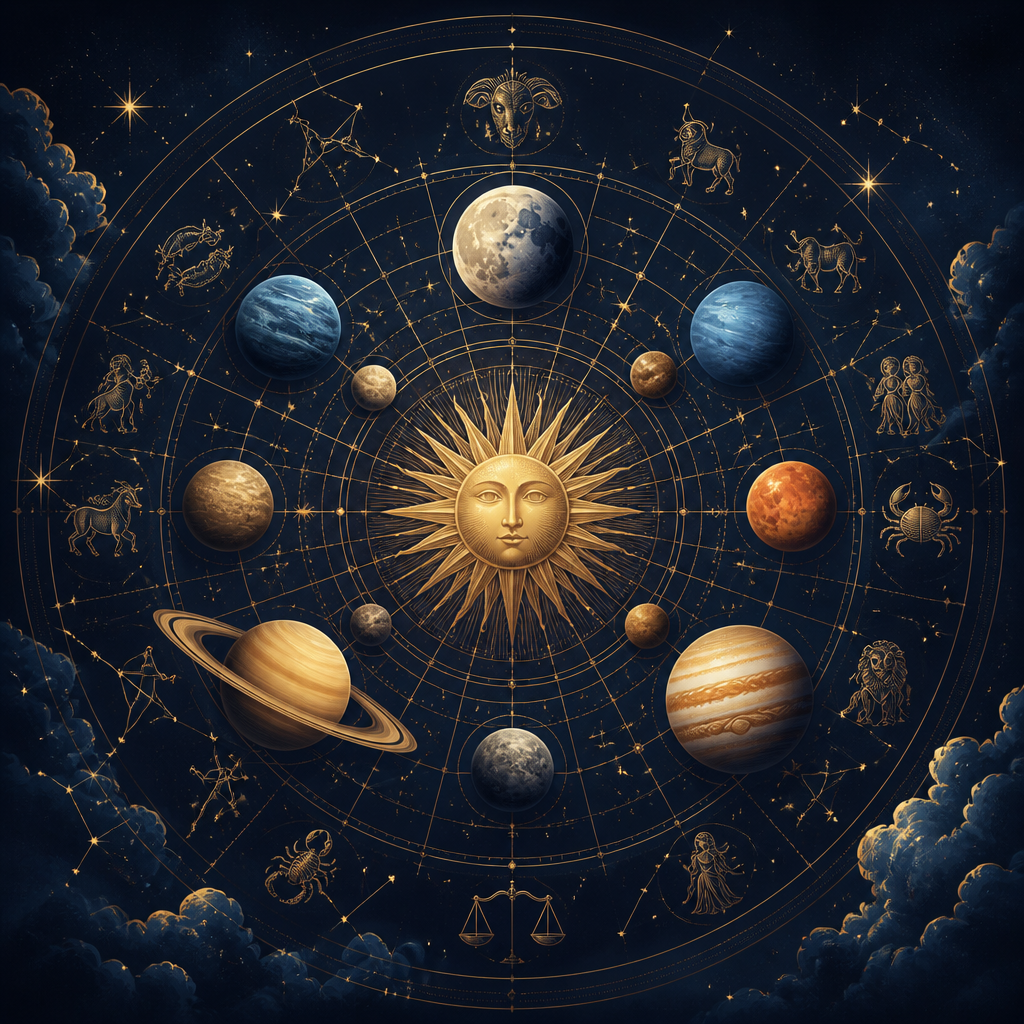
Astrology and astronomy both look toward the sky, but they are not the same discipline. Astronomy is a natural science that studies stars, planets, galaxies, space, and the physical universe through observation, mathematics, and testable evidence. Astrology is an interpretive tradition that uses the positions of the Sun, Moon, planets, and other celestial points as symbolic frameworks for exploring personality, timing, relationships, and life themes.
The two fields share ancient historical roots, which is one reason people still confuse them. Over centuries, however, they separated into very different systems with different goals, methods, standards of evidence, and ways of interpreting the heavens.
Astrology vs. Astronomy: The Difference in One Sentence
Astronomy asks how the universe physically works; astrology asks what celestial patterns may symbolically mean within an astrological system.
An astronomer may calculate the orbit of Mars, analyze the atmosphere of an exoplanet, or measure the age of a distant star. An astrologer may examine Mars in a birth chart to interpret themes associated with motivation, assertion, conflict, or desire. The astronomical position is a physical measurement. The astrological interpretation is symbolic.
What Is Astronomy?
Astronomy is the scientific study of celestial objects, space, and the universe as a whole. It relies on observation, measurement, mathematical models, physics, chemistry, computation, and evidence that can be tested and evaluated by other researchers.
Astronomers study subjects such as the formation and evolution of stars, planetary systems, black holes, galaxies, cosmology, gravitational interactions, asteroids, comets, and the possibility of planets around other stars. Modern astronomy uses instruments ranging from ground-based optical telescopes and radio arrays to space telescopes, satellites, spectrographs, and computer simulations.
What questions does astronomy ask?
Typical astronomical questions include: How old is the universe? How do stars form? What is a planet made of? How far away is a galaxy? What happens near a black hole? Does a distant planet have an atmosphere? Why do planetary orbits behave as they do?
These questions are investigated through evidence. Scientific explanations are expected to make predictions, fit observations, and remain open to revision when better data becomes available.
What Is Astrology?
Astrology is a symbolic and interpretive tradition built around relationships between celestial positions and human or earthly themes. Depending on the astrological tradition, a chart may include the Sun, Moon, planets, zodiac signs, houses, angles, aspects, lunar nodes, and other calculated points.
In natal astrology, for example, an astrologer constructs a birth chart for a particular date, time, and location. The chart becomes a symbolic map used to discuss themes such as identity, emotional patterns, communication, relationships, ambition, challenges, and personal development.
Astrology is practiced in several traditions, including modern Western astrology, Hellenistic astrology, Vedic or Jyotish traditions, and Chinese astrological systems. Their techniques and philosophical assumptions differ substantially, so “astrology” is not one universally standardized method.
Importantly, astrology is not considered a scientifically validated predictive system by the modern scientific community. Its interpretations are better understood as belonging to a symbolic, cultural, spiritual, or divinatory framework rather than the empirical framework used by astronomy.
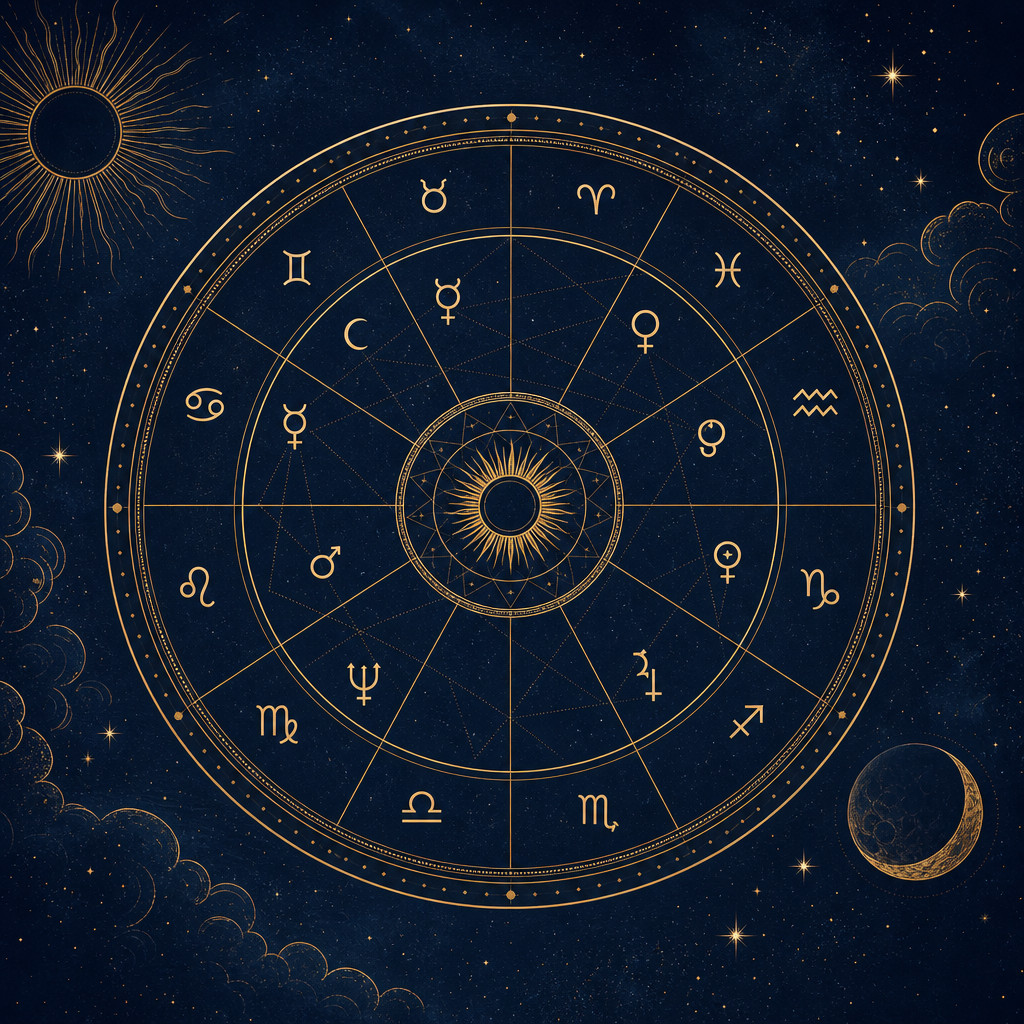
Astrology and Astronomy Compared
| Area | Astronomy | Astrology |
|---|---|---|
| Primary purpose | Understand the physical universe | Interpret symbolic meanings associated with celestial patterns |
| Field | Natural science | Symbolic/divinatory tradition |
| Methods | Observation, mathematics, physics, experiments, models | Charts, signs, houses, aspects, traditional interpretive rules |
| Evidence standard | Empirical, testable, reproducible evidence | Interpretive traditions and symbolic correspondences |
| Typical practitioner | Astronomer, astrophysicist, planetary scientist | Astrologer |
| Example question | What is Mars physically made of? | What might Mars symbolize in a birth chart? |
Why Are Astrology and Astronomy So Often Confused?
The confusion is understandable because both disciplines use many of the same celestial names: Sun, Moon, Mercury, Venus, Mars, Jupiter, Saturn, zodiac, constellations, and planetary positions. They also share a long historical background.
For much of ancient and medieval history, systematic observation of the sky, calendar making, celestial prediction, philosophy, religion, and astrology were not separated in the way modern academic disciplines are. People who tracked planetary movements could use the same observations for calendars, navigation, political omens, religious timing, or astrological judgments.
The modern distinction developed gradually as scientific methods became more formalized and astronomy increasingly focused on physical explanations that could be mathematically modeled and empirically tested.
Did Astrology and Astronomy Once Belong Together?
Historically, their boundaries were much less clear than they are today. Accurate observations of planetary movements were useful to astrologers, while the demand for calendars and celestial predictions encouraged increasingly sophisticated astronomical calculations.
That shared history does not mean modern astronomy endorses astrology. It means that the historical study of the heavens developed within cultures where scientific, philosophical, religious, and symbolic questions often overlapped.
Understanding this history helps avoid two opposite mistakes: claiming astrology and astronomy have always been completely unrelated, or claiming that their historical connection makes them equivalent today. Neither description is accurate.
Do Astronomy and Astrology Use the Same Zodiac?
Not exactly. This is one of the most important distinctions.
In astronomy, a constellation is a defined region of the sky. The zodiac constellations lie along the apparent path of the Sun through the sky, known as the ecliptic. Their actual sizes are unequal, and the Sun does not spend an equal amount of time in each astronomical constellation.
In most Western tropical astrology, the zodiac signs are twelve equal 30-degree divisions of the ecliptic. Aries begins at the March equinox, followed by Taurus, Gemini, and the remaining signs. These signs function as sections of an astrological coordinate system and should not be treated as identical to the modern astronomical constellation boundaries carrying the same names.
What About the “13th Zodiac Sign” Ophiuchus?
Ophiuchus frequently appears in headlines claiming that astronomy has discovered a thirteenth zodiac sign and therefore changed everyone’s astrological sign. This mixes two different frameworks.
The Sun passes through the astronomical constellation Ophiuchus along the ecliptic. But the tropical astrological zodiac is defined as twelve equal signs, not as a list of all modern constellations intersecting the ecliptic. Therefore, the existence of Ophiuchus as a constellation does not automatically add a thirteenth sign to the tropical zodiac.
Whether someone accepts astrology is a separate question. The key point is definitional: astronomical constellations and astrological signs are not interchangeable categories.
What Is Precession, and Why Does It Matter?
Earth’s rotational axis slowly changes orientation over a cycle of roughly 26,000 years, a phenomenon called axial precession. As a result, the relationship between the equinoxes and the background stars gradually shifts over long periods.
This matters because Western tropical astrology anchors its zodiac to the seasonal equinoxes and solstices, while sidereal astrological systems attempt to align zodiac divisions more closely with stellar reference points using an offset often called an ayanamsha.
Astronomy describes and measures precession as a physical phenomenon. Different astrological traditions decide how that phenomenon relates to their coordinate systems. Again, the measurement and the symbolic framework are separate layers.
Do Astrologers Use Real Astronomical Data?
Yes, modern astrological chart calculations can use accurate astronomical data for planetary positions. Software can calculate where the Sun, Moon, and planets appeared from a particular place and time with considerable precision.
But accurate input data does not make the resulting interpretation an astronomical conclusion. For example, astronomy can determine the apparent position of Saturn at a given moment. The claim that Saturn symbolizes responsibility, boundaries, maturity, or long-term lessons comes from astrological tradition, not from astronomical measurement.
This distinction is useful whenever evaluating astrology: the celestial position can be objectively calculated while the meaning assigned to that position remains interpretive.
Is Astrology a Science?
Under the standards used by contemporary science, astrology is not generally classified as a science. Scientific theories are expected to produce testable claims, withstand controlled evaluation, generate reproducible results, and change when evidence contradicts them. Astrology has not established reliable predictive validity under these standards sufficient for acceptance as a scientific theory.
That does not prevent people from engaging with astrology for cultural, spiritual, reflective, entertainment, or symbolic purposes. It does mean readers should distinguish personal usefulness or resonance from scientific evidence.
Can You Be Interested in Both Astronomy and Astrology?
Yes. Interest in one does not require hostility toward the other, as long as their roles are represented accurately.
You might study astronomy to understand how stars evolve, why eclipses happen, how planets orbit, or how galaxies form. You might study astrology to understand the history of zodiac symbolism or to use a birth chart as a structured tool for reflection. The important part is knowing when a statement is scientific and when it is symbolic or interpretive.
How to Tell Whether You Are Reading Astronomy or Astrology
Ask what kind of claim the source is making. If the discussion concerns physical measurements, orbital mechanics, stellar composition, gravity, planetary geology, cosmology, or observational data, it is likely astronomy. If it assigns meanings such as personality traits, relationship patterns, life themes, or symbolic timing to planetary placements, it is astrology.
Also examine the evidence being offered. Astronomy should connect claims to observations, calculations, models, or peer-reviewed scientific research. Astrology usually connects interpretations to established astrological techniques, schools, historical texts, or practitioner traditions.
Frequently Asked Questions
Are zodiac signs part of astronomy?
The constellations that inspired zodiac names are astronomical objects or sky regions, but astrological zodiac signs are interpretive divisions used within astrology. The terms overlap historically, but their modern meanings differ.
Do astronomers create birth charts?
Not as part of astronomy. Astronomers can calculate celestial positions, but interpreting those positions as personality or life themes belongs to astrology.
Does astronomy prove astrology?
No. Astronomy can provide accurate information about celestial positions and physical phenomena, but that does not scientifically validate astrological interpretations attached to those positions.
Why do astrology apps need birth time and location?
Many systems use time and location to calculate the local horizon, Ascendant, houses, and exact planetary placements. These calculations can be astronomically precise even though their astrological meanings remain interpretive.
Which came first, astrology or astronomy?
The answer depends on how the terms are defined. Ancient cultures observed and calculated celestial movements for practical, religious, calendrical, and divinatory purposes long before the modern separation between astronomy and astrology existed. It is more accurate to describe them as emerging from overlapping traditions of sky observation that later diverged.
The Bottom Line
Astrology and astronomy share the sky and a long historical connection, but today they answer fundamentally different kinds of questions. Astronomy studies the physical universe using scientific methods. Astrology interprets celestial patterns through symbolic traditions.
Knowing the difference makes both subjects easier to understand. It allows you to appreciate astronomical discoveries without confusing them with astrological claims, and it allows you to explore astrology with clear expectations about what its symbols can—and cannot—scientifically establish.