Tarot can be used to explore possible futures, but it cannot reliably guarantee that a specific event will happen. A Tarot reading is best understood as a structured interpretation of patterns, choices, emotions, and likely directions rather than a fixed forecast. The cards may help you think about what could happen if current circumstances continue, but decisions, other people, chance, and changing conditions can alter the outcome.
This balanced approach allows Tarot to remain useful without treating it as certainty. Instead of asking only, “What will happen?”, a stronger Tarot question is often, “What is developing, what can influence it, and what can I do next?”
Can Tarot Really Predict the Future?
The short answer is: Tarot may be used for prediction, but its predictions should be treated as possibilities rather than verified facts.
Some Tarot traditions have long used cards for divination and future-oriented readings. A reader might interpret a spread as suggesting an approaching opportunity, a difficult conversation, a period of change, or a likely relationship development. However, Tarot has not been scientifically established as a method that can consistently predict future events with reliable accuracy.
That distinction matters. A reading can still be meaningful as reflection, symbolism, or a way of examining choices without claiming that the cards provide objective knowledge of events that have not yet occurred.
What Does “Prediction” Mean in Tarot?
Prediction can mean several different things. One person may expect Tarot to name an exact future event. Another may use it to identify a likely direction based on present circumstances. These are very different expectations.
In a practical Tarot reading, prediction often works more like a scenario: if a relationship continues under its current dynamics, what might become important? If you accept a job offer, what challenges may emerge? If you continue avoiding a decision, what kind of situation may develop?
This approach treats the future as conditional. The reading explores a trajectory rather than declaring an unavoidable destiny.
Fixed Future vs. Possible Future
| Approach | What It Assumes | Example |
|---|---|---|
| Fixed prediction | A future event is predetermined | “You will meet your future partner in three months.” |
| Conditional prediction | Current patterns make some outcomes more plausible | “If you remain open to new connections, the cards suggest a period favorable for relationship development.” |
| Reflective reading | The cards help examine choices and perspectives | “What might be preventing you from creating the relationship you want?” |
The conditional and reflective approaches generally leave more room for personal agency, uncertainty, and real-world complexity.
Why Tarot Predictions Can Feel Accurate
People sometimes experience a Tarot reading as remarkably accurate. There are several possible reasons, and they do not all require the same explanation.
A skilled reader may notice patterns in the question, language, emotions, and circumstances described by the person receiving the reading. Tarot imagery can also provide a framework for discussing common human experiences such as uncertainty, attraction, conflict, ambition, loss, patience, or change.
Sometimes a card genuinely seems to correspond closely with later events. People may interpret this spiritually, psychologically, symbolically, or as coincidence depending on their beliefs.
At the same time, human memory naturally gives special attention to striking matches. Predictions that fit later events can be remembered more strongly than vague statements or predictions that never materialize. This is one reason responsible Tarot practice should avoid presenting subjective accuracy as scientific proof.
Does Tarot Have Scientific Evidence for Predicting the Future?
There is no established scientific evidence showing that Tarot cards can consistently predict unknown future events under controlled conditions. Tarot therefore should not be presented as a scientifically validated forecasting system.
This does not settle every philosophical or spiritual question about Tarot. It simply defines the evidence boundary. Personal experiences, traditions, intuition, and spiritual beliefs are different forms of claims from controlled scientific evidence.
For a trustworthy Tarot guide, keeping those categories separate is important. Readers can engage with Tarot symbolically or spiritually while still being clear about what has and has not been scientifically demonstrated.
How Tarot Can Be Useful Without Perfect Prediction
Tarot does not need to provide certain knowledge of the future to be useful. In many readings, its strongest value comes from helping people frame a situation differently.
Imagine that someone is deciding whether to leave a job. A Tarot spread might highlight dissatisfaction, fear of instability, an overlooked opportunity, and the need for preparation. None of those insights requires the cards to reveal the exact job the person will have six months later. The reading can instead help organize concerns and identify questions worth investigating.
Tarot may therefore function as a reflective prompt: it introduces symbols and themes that encourage the reader to consider possibilities they may have ignored.
What Kinds of Future Questions Work Better in Tarot?
Questions that leave room for context and action tend to produce more useful readings than demands for absolute certainty.
Instead of “Will my relationship definitely last?”, consider “What is influencing the future of this relationship, and what should I understand about its current direction?” Instead of “Will I get the job?”, ask “What factors may affect this opportunity, and how can I approach it effectively?”
Other useful future-oriented questions include: “What should I know about the next stage of this situation?”, “What is the likely direction if nothing changes?”, “What can I influence?”, and “What challenge should I prepare for?”
These questions preserve the predictive dimension of Tarot while recognizing that outcomes may change.
Can Tarot Predict Love and Relationships?
Love is one of the most common subjects for predictive Tarot readings. Cards can be interpreted around attraction, communication, commitment, emotional distance, reconciliation, or changing relationship dynamics.
But another person has their own choices and intentions. A reading cannot ethically guarantee that a specific person will return, marry you, leave their partner, or behave in a predetermined way.
A more useful relationship reading examines the current dynamic, potential direction, areas of compatibility or tension, and actions available to the person asking the question. This keeps the reading centered on insight rather than promises about another person’s future behavior.
Can Tarot Predict Money, Career, or Business Outcomes?
Tarot can be used to reflect on career and financial decisions, but it should not replace professional financial, legal, or business analysis.
For example, a spread may suggest themes of expansion, caution, delayed rewards, competition, collaboration, or overconfidence. Those themes might help someone think more carefully about a decision. They do not establish what a stock price will be, guarantee a business profit, or prove that an investment is safe.
When money is involved, practical information such as contracts, budgets, market conditions, taxes, debt, and professional advice should carry more weight than a Tarot prediction.
Can Tarot Give Exact Dates?
Some Tarot readers use timing systems that associate suits, numbers, court cards, astrological correspondences, or spread positions with days, weeks, months, or seasons. These systems vary considerably between traditions.
Exact timing is especially difficult because Tarot does not have a universally accepted method for translating cards into calendar dates. A prediction such as “within three weeks” should therefore be understood as an interpretive estimate, not a guaranteed deadline.
Broad timing—such as a situation developing quickly, slowly, after a period of waiting, or during a transition—may be more useful than treating a specific date as certain.
What About Yes-or-No Tarot Predictions?
Yes-or-no readings are popular because they appear simple. Some systems classify cards as favorable, unfavorable, or neutral and then convert the draw into a yes, no, or maybe.
The limitation is that complex situations rarely reduce cleanly to a binary answer. “Will we get back together?” may involve feelings, communication, timing, external circumstances, and decisions from two people. A single yes or no can hide the most useful information.
If you use a yes-or-no reading, consider adding a follow-up question such as, “What is the strongest influence on this outcome?” That provides context rather than treating the first answer as a verdict.
Does Free Will Change a Tarot Prediction?
If Tarot is interpreted as showing possible trajectories, then choices can change those trajectories. Your own actions matter, and so do the actions of other people.
A reading suggesting conflict, for example, may encourage someone to communicate earlier and prevent escalation. If the predicted conflict never occurs because behavior changed, that does not necessarily make the reading useless. The reading may have functioned as a warning or reflective prompt rather than a fixed prophecy.
This is one reason the idea of a conditional future fits many modern Tarot practices: cards describe patterns that may evolve rather than an unchangeable script.
How to Evaluate a Tarot Prediction Responsibly
Before acting on a prediction, ask whether the claim is specific, testable, and proportionate to the evidence available. Be cautious when a reader claims absolute certainty, especially about health, death, pregnancy, legal outcomes, investments, or another person’s private thoughts.
Also watch for fear-based pressure. Claims such as “a disaster will happen unless you pay for another reading” or “you are cursed and must buy a cleansing” are warning signs of manipulation, not responsible Tarot practice.
A trustworthy reading should leave room for uncertainty and personal agency. It should not create dependency on repeated readings or pressure someone into expensive services.
When Should You Not Rely on Tarot?
Tarot should not be the sole basis for decisions where incorrect information could cause serious harm. Medical symptoms require qualified healthcare evaluation. Legal disputes require appropriate legal advice. Major financial decisions require reliable financial information and, when appropriate, professional guidance.
Tarot can accompany reflection around these experiences—for example, exploring how you feel about uncertainty—but it should not substitute for evidence-based expertise.
A Better Framework: Direction, Influences, and Agency
A practical way to use predictive Tarot is to divide a reading into three layers.
Direction asks where the situation appears to be heading. Influences identify forces helping or complicating that direction. Agency asks what the person can realistically do.
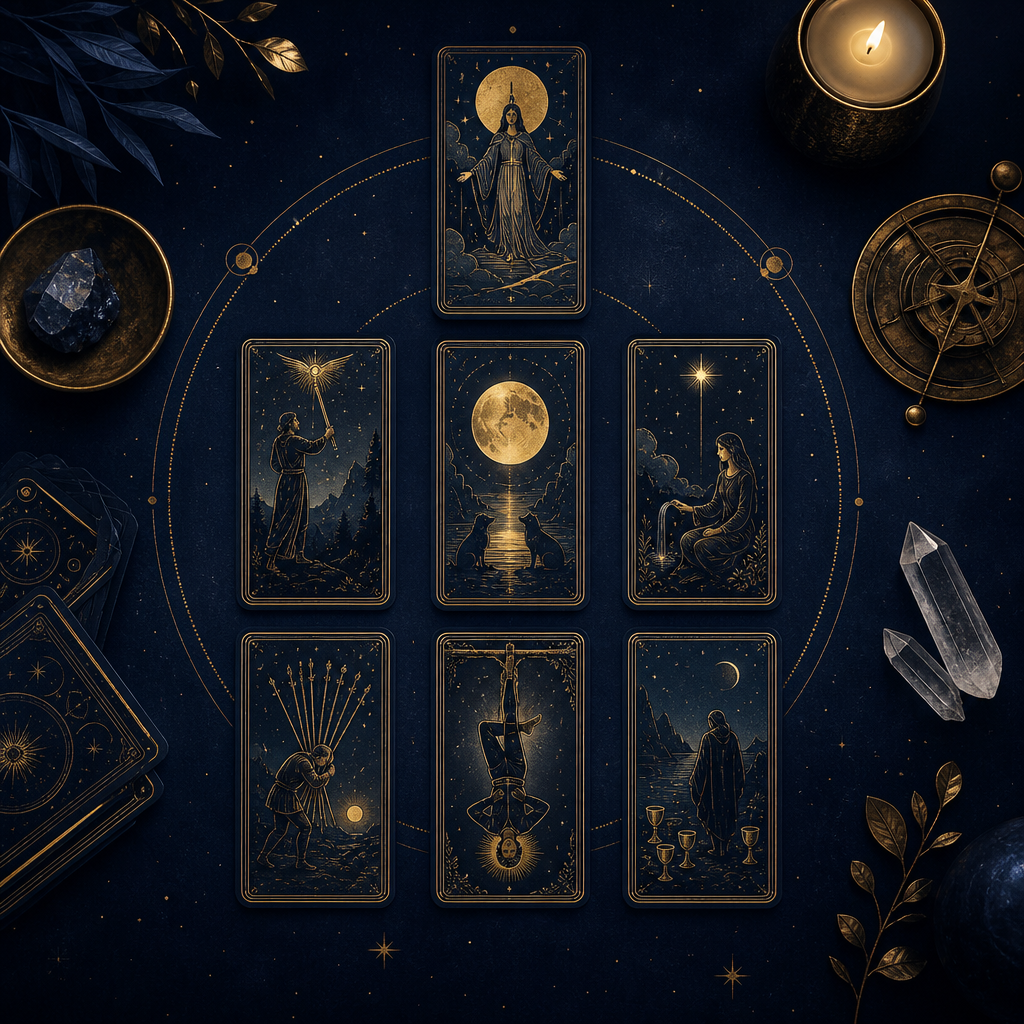
For example, a three-card spread might use: Current Direction, Key Influence, and Best Response. This still addresses the future, but the reading becomes actionable rather than fatalistic.
Frequently Asked Questions
Can Tarot tell exactly what will happen?
No reliable method has established that Tarot can tell exactly what will happen. Tarot predictions are better treated as interpretations of possibilities, patterns, and potential directions.
How far into the future can Tarot predict?
There is no scientifically validated time limit. Readers use different traditions and spreads, but uncertainty generally increases as the time horizon becomes longer because more decisions and external events can intervene.
Can a Tarot prediction change?
Yes, if the reading is understood as a conditional outlook. New information, choices, behavior, and circumstances can change the direction of a situation.
Why did a Tarot prediction come true?
There can be multiple interpretations: the reader may have recognized an existing trajectory, the symbolism may have matched later events, behavior may have contributed to the outcome, or coincidence and selective memory may play a role. A single accurate-seeming reading does not establish scientific predictive validity.
Should I make decisions based on Tarot?
Tarot can be one reflective input for low-risk personal decisions, but important decisions should also consider facts, consequences, expert advice when relevant, and your own values and judgment.
Is predictive Tarot different from reflective Tarot?
Yes. Predictive Tarot focuses on what may happen next, while reflective Tarot focuses on understanding the present, emotions, choices, or patterns. Many modern readings combine both approaches.
The Bottom Line
Tarot can explore possible futures, but it should not be treated as a guaranteed map of events that must happen. There is no established scientific evidence that Tarot consistently predicts unknown future events. Its more defensible value lies in symbolism, reflection, scenario-building, and examining the relationship between current patterns and possible outcomes.
A balanced Tarot reading therefore does not need to choose between “the cards know everything” and “the cards are meaningless.” It can acknowledge uncertainty while still using the cards as a structured way to think about direction, influences, choices, and consequences.
When future-focused Tarot encourages clearer questions and thoughtful action rather than fear or dependency, prediction becomes less about surrendering control to fate and more about understanding what may be developing—and what you can still influence.