
Journaling with astrology, Tarot, and numerology can turn symbolic systems into a practical self-reflection habit. Instead of using them only to ask what will happen next, you can use a journal to record what you notice, compare interpretations with lived experience, identify repeating patterns, and ask better questions about your choices.
You do not need to believe that planets, cards, or numbers determine your future. A reflective journal can treat these systems as prompts: astrology offers cycles and themes, Tarot offers visual symbols and questions, and numerology offers recurring number-based frameworks. The journal is where those prompts meet your actual experiences.
What Is Astrology, Tarot, and Numerology Journaling?
Astrology, Tarot, and numerology journaling is the practice of recording symbolic information alongside your thoughts, emotions, events, and decisions. The goal is not to prove that every symbol predicts reality. The goal is to create enough context to reflect more clearly.
For example, an astrology entry might record a New Moon and ask what you want to begin. A Tarot entry might record three cards and your first reaction to them. A numerology entry might calculate a Personal Year or Personal Month and compare its traditional theme with what is actually happening in your life.
Over time, the journal becomes a record you can revisit instead of relying on memory.
Why Combine All Three Systems?
Each system emphasizes a different layer of reflection. Used together, they can create a richer journaling structure without requiring you to treat any one system as absolute truth.
| System | Useful Journaling Focus | Example Question |
|---|---|---|
| Astrology | Cycles, timing, recurring themes | What theme feels especially active for me right now? |
| Tarot | Symbols, perspective, choices | What am I not seeing clearly about this situation? |
| Numerology | Number cycles, identity themes, milestones | How does this Personal Year theme compare with my real priorities? |
The benefit of combining them is not that three systems make a prediction more certain. Instead, they provide three different prompts for looking at the same experience.
Start With a Journal That Is Easy to Maintain
Your journal can be a notebook, a notes app, a document, or a dedicated journaling platform. The best format is the one you will actually return to.
Keep the first version simple. You might create five fields for every entry: date, current situation, symbolic prompt, personal interpretation, and next action. This prevents the practice from becoming an elaborate tracking project that you abandon after a week.
If you enjoy more detail, add mood, sleep, important conversations, decisions, or outcomes. The purpose of additional data should always be reflection rather than collecting information for its own sake.

How to Journal With Astrology
Astrology journaling works best when you focus on a manageable number of placements or cycles. Trying to record every transit every day can create more noise than insight.
Begin with your natal chart as a reference. Your Sun, Moon, rising sign, and major house placements can provide recurring themes to explore. Then choose one or two current cycles that matter to you, such as a New Moon, Full Moon, Mercury retrograde, Saturn return, or a major transit to a natal planet.
A Simple Astrology Journal Entry
Write the date and the astrological event you want to observe. Then answer three questions: What is happening in my life? What does this astrological symbolism traditionally emphasize? Where do I see a meaningful connection, and where do I not?
That final question is important. A useful journal should allow disagreement. If a transit description does not match your experience, record that rather than forcing events to fit the interpretation.
New Moon and Full Moon Journaling
Lunar phases offer an easy recurring rhythm. At a New Moon, you might journal about intentions, beginnings, or areas that need renewed attention. At a Full Moon, you might review what has become clearer, what reached a turning point, or what you are ready to release.
You do not need to assume the Moon caused an event. The regular lunar cycle can simply provide a consistent schedule for checking in with yourself.
How to Journal With Tarot
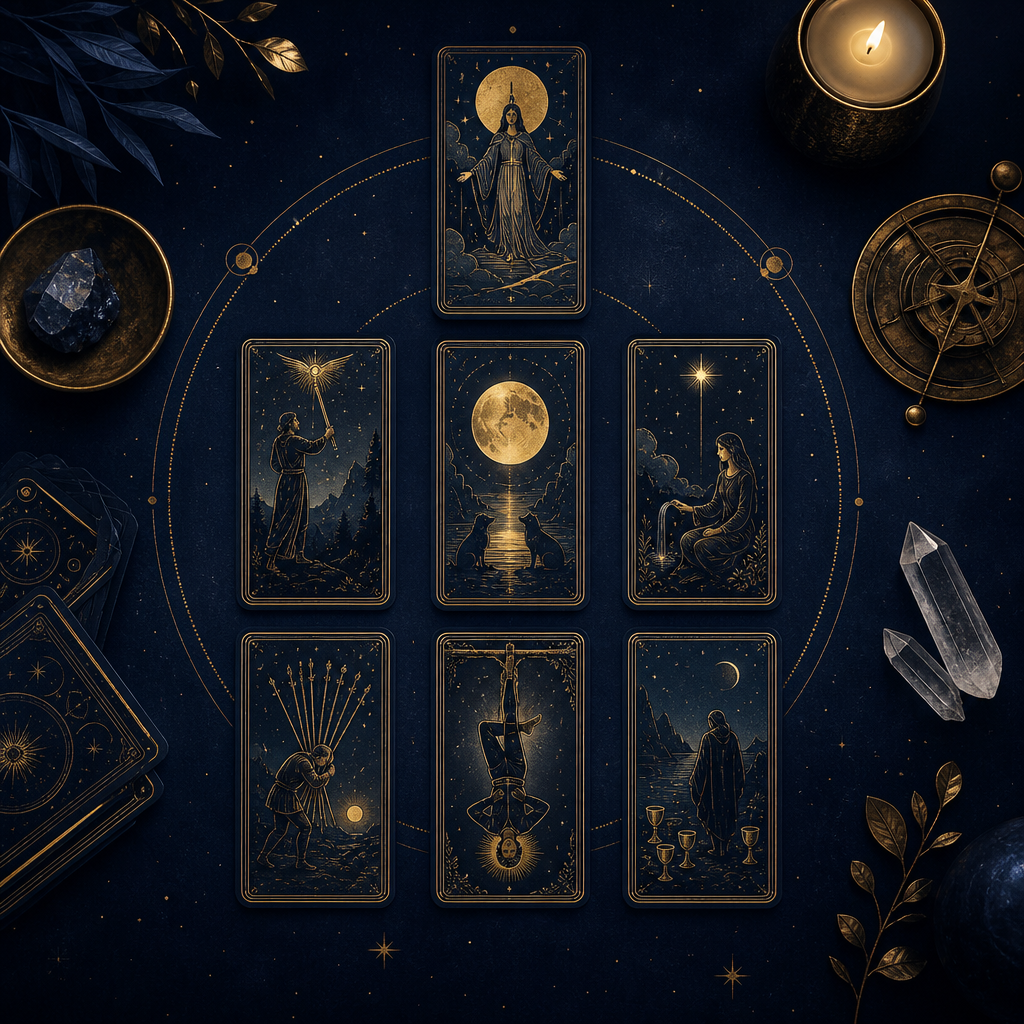
Tarot journaling is especially useful because cards are visual and open to interpretation. Writing down your response before checking a guidebook helps separate your own associations from meanings you learn elsewhere.
Start by recording the question, card or spread, orientation if you use reversals, and your immediate impression. Notice which detail in the image catches your attention first. Then record the traditional meaning and compare it with your initial reaction.
Try a One-Card Daily Reflection
Draw one card and ask, “What perspective could be useful today?” Write two or three sentences before beginning your day. In the evening, return to the entry and ask whether the card helped you notice anything meaningful.
Avoid rewriting the day to make the card appear accurate. If there was no clear connection, write that. This keeps your journal grounded and makes later reviews more informative.
Use Three Cards for a Specific Situation
A three-card spread can organize a more focused reflection. Try Current Situation, Key Influence, and Helpful Response. Another useful structure is What I Know, What I May Be Missing, and What I Can Do.
These spreads emphasize perspective and agency rather than fixed prediction. They can be especially useful when you feel stuck between several choices.
How to Journal With Numerology
Numerology journaling can focus on stable numbers, such as a Life Path Number, or changing cycles, such as Personal Year, Personal Month, and Personal Day numbers.
Rather than repeatedly recalculating the same numbers, write the calculation once and use later entries to explore how the traditional theme relates—or does not relate—to your experience.
Journal With Your Life Path Number
Your Life Path Number is traditionally calculated from your birth date. In a journal, use it as a long-term reflection theme rather than a label that defines everything about you.
Ask: Which parts of this description feel familiar? Which parts do not? Have I changed in how I express these qualities? Are there traits I am interpreting too broadly because I expect them to fit?
This creates a healthier distance between symbolic descriptions and personal identity.
Track Personal Year and Personal Month Themes
Personal Year and Personal Month numbers are useful for periodic reviews because they change on a predictable schedule. At the beginning of a month, record the traditional theme. At the end, compare it with actual events and decisions.
For example, if a cycle is traditionally associated with change, do not count every minor change as confirmation. Look for significant patterns and also record evidence that does not fit. This reduces confirmation bias and makes your journal more useful.
A 15-Minute Combined Journaling Routine
You do not need three separate rituals. A short combined practice can fit into fifteen minutes.
First, spend three minutes describing your current state without using astrology, Tarot, or numerology. Write what you are feeling, what happened recently, and what question is on your mind. This creates a baseline before symbolic interpretation enters the entry.
Next, spend three minutes noting one relevant astrology theme. Keep it specific: perhaps the current lunar phase or one transit you are already following.
Then spend four minutes with one Tarot card or a simple three-card spread. Record your immediate interpretation before consulting references.
Use another two minutes to note a numerology cycle if it is relevant, such as your Personal Month. Finally, spend three minutes answering: What did these prompts help me notice, and what practical action—if any—makes sense?
Use Observation Before Interpretation
One of the most valuable habits in symbolic journaling is separating observation from interpretation.
“I had an argument with my colleague at 2 p.m.” is an observation. “Mercury retrograde caused the argument” is an interpretation. “The Five of Wands predicted the argument” is also an interpretation.
Write the observable event first. Then add possible symbolic connections. This simple separation makes your journal clearer and prevents assumptions from becoming indistinguishable from facts.
How to Avoid Confirmation Bias
Confirmation bias is the tendency to notice information that supports an existing belief while overlooking information that challenges it. Journaling can either strengthen this bias or help reveal it.
To make your practice more balanced, record misses as carefully as matches. If you expected a highly social month and instead spent most of it working alone, include that. If a Tarot reading suggested one concern but another issue became far more important, record both.
You can also review predictions or interpretations only after a defined period rather than constantly adjusting them. A monthly review often gives a clearer picture than checking every day for evidence that a symbol was “right.”
Questions That Work Well for Self-Reflection
Good journal prompts invite exploration rather than demanding certainty. Useful questions include: What pattern am I repeating? What am I avoiding? What assumption am I making? What is within my control? What would change if I viewed this situation differently? What evidence supports my current interpretation? What evidence challenges it?
For relationships, try: What do I need to communicate more clearly? For work: What trade-off am I reluctant to acknowledge? For personal growth: What behavior would better reflect the person I want to become?
Astrology, Tarot, or numerology can supply the initial theme, but your journal should bring the focus back to your lived choices.
Weekly and Monthly Review
The real value of journaling often appears during review. Once a week, scan your entries for recurring emotions, decisions, and questions. Once a month, compare your symbolic notes with what actually occurred.
Ask which interpretations were useful, which were too vague, and which turned out to be wrong. Notice whether you repeatedly draw similar Tarot themes, focus on the same astrological house, or interpret numerology cycles through the same concern.
Repeated attention can reveal something about your priorities even if you do not believe the symbolic system itself is causing events.
When Journaling Becomes Unhelpful
A reflective practice should support your ability to make decisions, not replace it. If you feel unable to act without drawing another card, checking another transit, or calculating another number, reduce the frequency of the practice.
Avoid using symbolic journaling as the sole basis for medical, legal, financial, or other high-stakes decisions. In those situations, qualified professional advice and reliable evidence should take priority.
Also consider taking a break if journaling increases anxiety or makes you feel that ordinary events are controlled by signs you must constantly decode.
A Reusable Journal Template
| Section | What to Write |
|---|---|
| Date and context | What is happening before you interpret anything? |
| Astrology | One relevant cycle, transit, or placement |
| Tarot | Card(s), first impression, traditional meaning |
| Numerology | Relevant core number or current cycle |
| Reflection | What themes appear across the prompts? |
| Reality check | What evidence supports or challenges your interpretation? |
| Action | What practical next step is within your control? |
You can copy this template for weekly entries or simplify it for daily use.
Frequently Asked Questions
Do I need to know astrology before starting a journal?
No. Start with one simple element, such as the Moon phase or your Sun, Moon, and rising signs. Add more only when you understand why you are tracking it.
Do I need to draw Tarot cards every day?
No. Daily draws can be useful, but weekly or situation-based readings may provide more space for reflection. Frequency matters less than consistency and thoughtful review.
Which numerology numbers are best for journaling?
Life Path is useful for long-term identity reflection, while Personal Year and Personal Month numbers work well for periodic reviews. You do not need to track every available numerology calculation.
Can I use astrology, Tarot, and numerology in the same journal?
Yes. Keeping them together can make it easier to compare themes, but clearly label each system so you can later see which prompts were actually useful.
Is this a form of prediction?
It can include future-oriented questions, but reflective journaling does not require prediction. You can use all three systems to examine the present, review past patterns, and consider possible choices.
What if a reading or forecast does not match my life?
Write that down. A mismatch is useful information. Do not force your experiences to fit an interpretation simply because you recorded it in your journal.
The Bottom Line
The most useful astrology, Tarot, and numerology journal is not a record of whether the universe was “right.” It is a record of how you thought, felt, interpreted, decided, and changed.
Astrology can provide a language for cycles. Tarot can introduce symbols and alternative perspectives. Numerology can provide recurring frameworks for reviewing identity and time. Your journal gives you a place to test those ideas against real experience.
Keep observations separate from interpretations, record misses as well as matches, review entries over time, and always bring the final question back to agency: What do I understand more clearly now, and what can I realistically do with that understanding?