Your Life Path Number is one of the most widely used numbers in numerology. It is calculated from your full date of birth and is traditionally interpreted as a symbolic description of the themes, tendencies, lessons, and opportunities you may encounter throughout life.
The arithmetic is simple, but there is one important detail: numerology systems do not always use exactly the same reduction method. This guide uses a clear, consistent method, explains how to handle the master numbers 11, 22, and 33, and walks through several examples so you can calculate your Life Path Number without guessing.
Quick Answer: How Do You Calculate a Life Path Number?
Write your birth date as month, day, and year. Reduce the month, day, and year separately to a single digit, while preserving 11, 22, or 33 when they appear as master numbers. Then add the three results together and reduce the total again until you reach 1–9 or a recognized master number.
Example: For July 24, 1992:
- Month: July = 7
- Day: 24 → 2 + 4 = 6
- Year: 1992 → 1 + 9 + 9 + 2 = 21 → 2 + 1 = 3
- Total: 7 + 6 + 3 = 16 → 1 + 6 = 7
The Life Path Number is 7.
What Is a Life Path Number?
In numerology, the Life Path Number is derived from your birth date rather than your name. Numerologists commonly use it as a broad framework for discussing how a person approaches growth, relationships, responsibility, work, creativity, independence, and meaning.
It is sometimes compared with an astrological Sun sign because both are used as high-level identity symbols, but the systems are different. Astrology calculates placements from astronomical positions, while numerology works symbolically with numbers derived from dates and names.
Numerology is a spiritual and interpretive practice rather than a scientifically validated method of predicting personality or future events. It is best used for reflection, self-inquiry, and exploring symbolic patterns rather than as a substitute for evidence-based decisions.
Step 1: Write Down Your Full Birth Date
Use the complete date on which you were born. For example:
December 29, 1987
Separate it into three components:
- Month: 12
- Day: 29
- Year: 1987
You will reduce each component before combining them. This separate-component approach makes the calculation easy to audit and helps prevent mistakes with master numbers.
Step 2: Reduce the Birth Month
If the month is already a single digit, keep it. January through September therefore correspond to 1 through 9.
For October, November, and December:
- October = 10 → 1 + 0 = 1
- November = 11 → keep 11 if your method preserves master numbers at this stage
- December = 12 → 1 + 2 = 3
For our December 29, 1987 example, the month becomes 3.
Step 3: Reduce the Birth Day
Next, reduce the day of the month. Single-digit days remain unchanged. For a two-digit day, add the digits together.
For day 29:
2 + 9 = 11
Because 11 is commonly treated as a master number, we preserve it rather than immediately reducing it to 2.
Another example: day 26 becomes 2 + 6 = 8. Day 19 becomes 1 + 9 = 10, then 1 + 0 = 1.
Step 4: Reduce the Birth Year
Add all four digits of the birth year, then continue reducing if necessary.
For 1987:
1 + 9 + 8 + 7 = 25
Then:
2 + 5 = 7
The reduced year is therefore 7.
Step 5: Add the Reduced Month, Day, and Year
We now have:
- Month = 3
- Day = 11
- Year = 7
Add them:
3 + 11 + 7 = 21
Reduce 21:
2 + 1 = 3
For December 29, 1987, the Life Path Number is therefore 3.
What About Master Numbers 11, 22, and 33?
Many modern numerology traditions recognize 11, 22, and 33 as master numbers. Instead of reducing them immediately to 2, 4, and 6, they may be retained because they are given an additional symbolic interpretation.
Master Number 11 is often associated with intuition, inspiration, sensitivity, and vision. Master Number 22 is commonly called the “Master Builder” and is associated with translating ambitious ideas into practical structures. Master Number 33 is often connected with service, compassion, teaching, and responsibility.
These interpretations do not mean that a master-number Life Path is automatically more important, fortunate, spiritual, or successful than another number. In numerology, every Life Path has constructive expressions and potential challenges.
Worked Example: Life Path 11
Consider someone born on January 1, 1990.
- Month: January = 1
- Day: 1 = 1
- Year: 1 + 9 + 9 + 0 = 19 → 1 + 9 = 10 → 1 + 0 = 1
- Total: 1 + 1 + 1 = 3
This example produces 3, not 11—which illustrates why you should calculate rather than assume a master number from one part of the date.
Now consider May 25, 1985:
- Month: May = 5
- Day: 25 → 2 + 5 = 7
- Year: 1985 → 1 + 9 + 8 + 5 = 23 → 2 + 3 = 5
- Total: 5 + 7 + 5 = 17 → 1 + 7 = 8
The Life Path Number is 8. The key principle is consistency: follow the same calculation sequence for every date.
Why Do Some Numerology Calculators Give Different Results?
You may encounter a calculator that adds every digit of the birth date in one continuous equation. Another may reduce the month, day, and year separately. Some preserve master numbers during intermediate stages, while others preserve them only when they appear in the final total.
For many birth dates, these methods lead to the same single-digit result. For certain dates, however, they can produce different master-number notation or interpretations. That is why a trustworthy explanation should state the calculation method instead of displaying a number with no working.
When comparing numerology readings, check the methodology first. A difference does not necessarily mean one calculator made an arithmetic error; it may be using a different numerological convention.
Life Path Number Meanings at a Glance
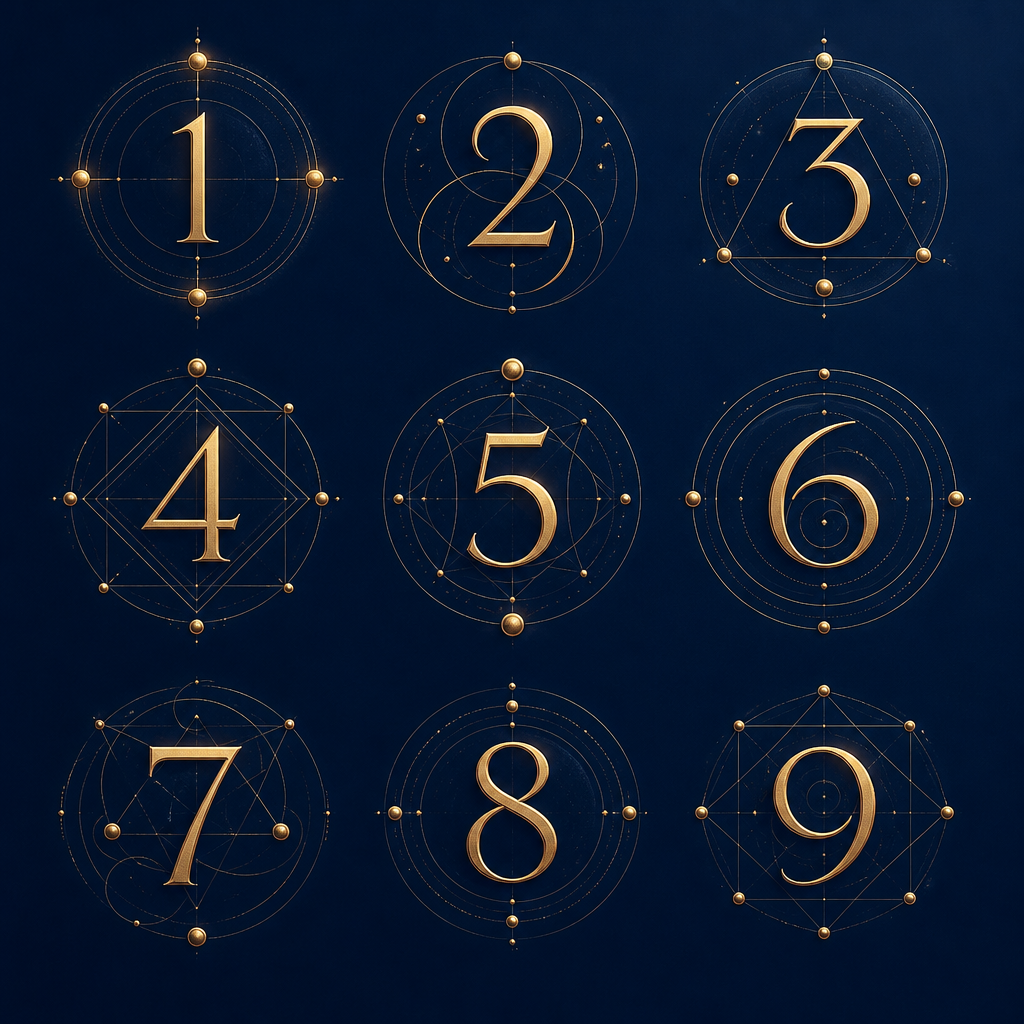
Once you have calculated your number, the following keywords provide a starting point for interpretation:
- Life Path 1: independence, initiative, leadership, originality.
- Life Path 2: cooperation, diplomacy, sensitivity, partnership.
- Life Path 3: creativity, expression, communication, optimism.
- Life Path 4: structure, discipline, reliability, practical effort.
- Life Path 5: freedom, adaptability, exploration, change.
- Life Path 6: responsibility, care, harmony, community.
- Life Path 7: analysis, introspection, knowledge, inner inquiry.
- Life Path 8: ambition, organization, authority, material mastery.
- Life Path 9: compassion, completion, idealism, broad perspective.
- Life Path 11: intuition, inspiration, heightened sensitivity, vision.
- Life Path 22: large-scale building, practicality, vision made tangible.
- Life Path 33: service, teaching, compassion, responsible care.
These are broad archetypes, not fixed personality labels. A useful numerology reading explores how the themes may appear constructively, where they can become imbalanced, and how they interact with other numbers in a chart.
Common Life Path Calculation Mistakes
Reducing the final number too quickly
If your chosen system recognizes master numbers, do not automatically turn 11 into 2, 22 into 4, or 33 into 6 before checking whether the master number should be preserved.
Using only the birth day
Your birthday number and Life Path Number are not the same calculation. Someone born on the 7th has a birthday number of 7, but their Life Path requires the month, day, and full year.
Using the current year
The Life Path Number comes from your birth date and does not change annually. Numerology calculations such as a Personal Year Number use the calendar year, but that is a different technique.
Mixing calculation systems midway
If you preserve master numbers in one component but use a different convention elsewhere without a clear reason, the result can become inconsistent. Pick a method, document it, and use it from beginning to end.
Does Your Life Path Number Ever Change?
No. Because it is calculated from your date of birth, your Life Path Number remains the same throughout your life. What may change is how you understand or express the symbolic themes associated with it.
Other numerology cycles are designed to describe changing periods. Personal Year, Personal Month, and Personal Day calculations, for example, incorporate calendar dates and therefore change over time. Your Life Path serves as a stable reference point within those systems.
Life Path Number vs. Destiny Number
These terms are sometimes confused. The Life Path Number is calculated from your birth date. In many numerology systems, the Destiny Number—also called the Expression Number—is calculated from the letters of your full birth name.
The two numbers therefore answer different symbolic questions. Life Path is generally associated with the journey and lessons of life, while the Destiny or Expression Number is often interpreted in relation to abilities, expression, and potential. Terminology can vary between numerology schools, so always check how a source defines its terms.
Can Two People Have the Same Life Path Number?
Absolutely. Millions of people share each Life Path Number. Numerology does not claim that everyone with the same number has an identical personality or life story.
In a fuller numerology chart, practitioners may compare the Life Path with birthday, expression, soul urge, personality, maturity, and cycle numbers. In relationship numerology, two Life Path Numbers can also be compared to explore symbolic areas of ease, tension, and mutual growth.
Frequently Asked Questions
What is the easiest way to calculate my Life Path Number?
Reduce your birth month, birth day, and birth year separately, add those three values, and reduce the result to 1–9 unless the final result is a master number recognized by your chosen system.
Do I use my birth date or my legal registration date?
Numerology normally uses the actual date of birth. If official records contain a different date, traditional Life Path calculations still refer to the date on which you were born.
Is 10 a Life Path Number?
In the common reduction system, 10 becomes 1 + 0 = 1. Some numerologists may discuss 10/1 as a compound influence, but the core Life Path is generally written as 1.
Is 11 reduced to 2?
It depends on the numerology school. In master-number systems, 11 is usually written as 11/2: the qualities associated with 11 are emphasized while 2 remains its underlying reduced vibration.
Can a Life Path Number predict my future?
Numerology is not a scientifically established forecasting method. It can provide a symbolic framework for reflection, but major financial, medical, legal, relationship, or career decisions should not be based on a numerology number alone.
Final Takeaway
Calculating your Life Path Number is straightforward once you use a consistent method: reduce the month, reduce the day, reduce the year, add the results, and reduce the final total while handling master numbers deliberately.
The number you obtain is not a verdict about who you must become. In numerology, it works better as an archetypal lens—a way to ask questions about recurring strengths, challenges, motivations, and patterns. After calculating your Life Path, the next useful step is to study its meaning in depth and then compare it with the other core numbers in your numerology chart.