
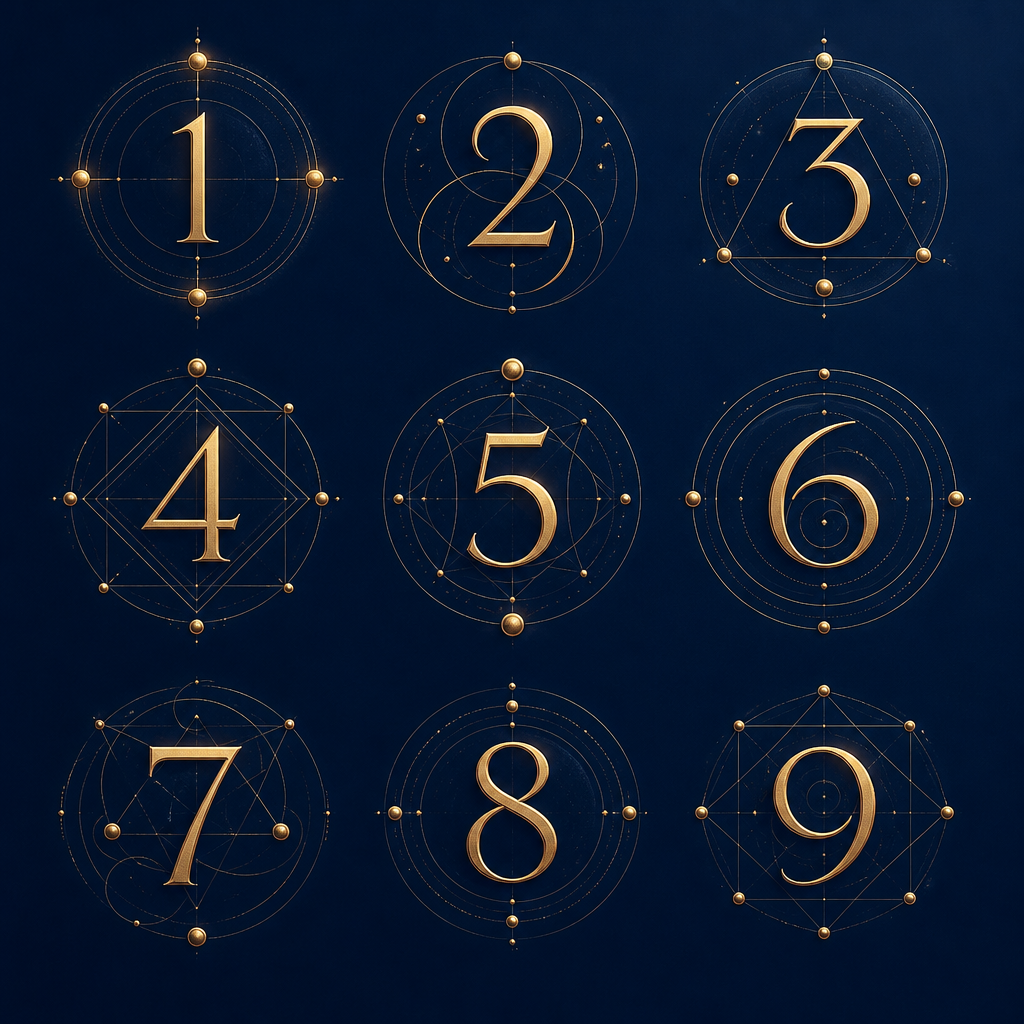
Numerology love compatibility compares two Life Path numbers to explore how each person approaches love, independence, communication, responsibility, intimacy, and long-term growth. It does not determine whether a relationship will succeed or fail. Instead, it offers a symbolic framework for understanding where two people may naturally cooperate, where they may misunderstand one another, and what each partner may need in order to feel respected and supported.
In most modern numerology systems, the Life Path number is calculated from a person’s full date of birth and reduced to a single digit from 1 to 9, with 11, 22, and sometimes 33 treated as Master Numbers. Because the Life Path is associated with broad life direction and recurring personal themes, comparing two Life Path numbers can be useful for discussing relationship dynamics at a high level.
This guide explains how Life Path compatibility works, what each number tends to bring into relationships, which pairings may feel naturally easy or demanding, and why no single compatibility score should replace communication, emotional maturity, consent, or real-world behavior.
What Is Numerology Love Compatibility?
Numerology love compatibility is the practice of comparing core numerology numbers to understand how two people may relate. The Life Path number is usually the starting point because it is derived from the birth date and is often interpreted as a broad indicator of temperament, motivation, lessons, and life direction.
A compatibility reading may ask questions such as: Do both people need independence, or does one prefer closeness? Does one partner move quickly while the other needs time? Do they share similar values around ambition, family, freedom, or emotional expression? Are their differences complementary or repeatedly frustrating?
The goal is not to rank one pairing as “good” and another as “bad.” A challenging combination can become strong when both people understand the pattern and work with it consciously. An apparently easy combination can still struggle if communication, trust, or responsibility are weak.
How to Calculate a Life Path Number
To calculate a Life Path number, add the digits of the full birth date and reduce the total until you reach a single digit, unless you are preserving a Master Number such as 11, 22, or 33.
For example, someone born on July 24, 1992 would calculate:
7 + 2 + 4 + 1 + 9 + 9 + 2 = 34 → 3 + 4 = 7.
The Life Path number is therefore 7.
Different numerology traditions sometimes use slightly different reduction methods, especially when handling Master Numbers. For compatibility work, consistency matters more than mixing methods. Calculate both people using the same system.
Why Life Path Numbers Matter in Relationships
The Life Path number is useful in relationship numerology because it describes broad patterns rather than a single temporary mood. It can symbolize how a person moves through life, what kinds of lessons repeat, and how they tend to balance freedom, duty, ambition, security, expression, and connection.
When two Life Path numbers are compared, similarities may create immediate understanding. Differences may create attraction, growth, or tension. Compatibility often depends on whether those differences are complementary or whether they repeatedly trigger incompatible expectations.
For example, a Life Path 1 may prioritize autonomy and initiative, while a Life Path 6 may focus more strongly on responsibility and relational care. That difference can be supportive when both partners appreciate what the other contributes. It can become frustrating when independence is interpreted as emotional distance or care is interpreted as control.
Life Path 1 in Love: Independence and Initiative
Life Path 1 is associated with independence, leadership, self-direction, and initiative. In relationships, 1 often needs room to make decisions, pursue goals, and maintain a strong sense of individuality.
At its best, 1 brings courage, momentum, confidence, and a willingness to move a relationship forward. The challenge is learning that partnership is not the same as losing autonomy. A 1 may need to practice listening, compromise, and shared decision-making rather than automatically taking the lead.
Life Path 1 may connect easily with 3, 5, or another strong independent number, but any pairing can work when expectations around freedom and cooperation are clear.
Life Path 2 in Love: Partnership and Sensitivity
Life Path 2 is associated with cooperation, diplomacy, sensitivity, patience, and emotional attunement. In love, 2 often values mutual consideration and may be highly responsive to the emotional climate of the relationship.
Its strengths include empathy, mediation, loyalty, and the ability to notice subtle interpersonal needs. The challenge can be over-accommodation, fear of conflict, or difficulty expressing personal needs directly.
Life Path 2 may feel comfortable with 4, 6, 8, or other numbers that appreciate reliability and partnership. More independent or unpredictable partners can still be compatible if reassurance and boundaries are handled well.
Life Path 3 in Love: Expression and Joy
Life Path 3 is linked with creativity, communication, optimism, sociability, and self-expression. In relationships, 3 often wants emotional movement, humor, conversation, and a sense that the connection remains alive and inspiring.
At its best, 3 brings warmth, playfulness, verbal affection, and creative energy. The challenge can be inconsistency, avoidance of difficult emotions, or a tendency to use charm instead of confronting serious issues.
Life Path 3 often enjoys 1, 5, and 6 because these pairings can support energy, movement, or warmth. More structured numbers can also be valuable by helping 3 build stability without suppressing spontaneity.
Life Path 4 in Love: Stability and Commitment
Life Path 4 is associated with structure, discipline, practicality, consistency, and responsibility. In relationships, 4 often values trust built through actions, predictability, and shared effort.
At its best, 4 is loyal, dependable, and willing to build something slowly. The challenge can be rigidity, overplanning, resistance to change, or expecting love to follow a fixed structure.
Life Path 4 may work smoothly with 2, 6, or 8, especially when both partners value responsibility. A pairing with 3 or 5 may require more negotiation around spontaneity versus routine.
Life Path 5 in Love: Freedom and Change
Life Path 5 is associated with freedom, curiosity, variety, movement, and experience. In relationships, 5 often needs space, novelty, stimulation, and the feeling that love expands life rather than restricts it.
At its best, 5 brings flexibility, adventure, sensuality, adaptability, and openness to new experiences. The challenge can be restlessness, inconsistency, difficulty with routine, or fear of being controlled.
Life Path 5 may connect easily with 1, 3, or 7 because these numbers can respect independence or curiosity. Stronger structure from 4, 6, or 8 can work too, but freedom and commitment must be negotiated rather than assumed.
Life Path 6 in Love: Care and Responsibility
Life Path 6 is associated with care, responsibility, harmony, family, service, and commitment. In love, 6 often wants to create emotional security and may invest deeply in the well-being of the relationship.
Its strengths include loyalty, nurturing, patience, and a strong sense of duty. The challenge can be overfunctioning, perfectionism, rescuing, or becoming controlling when care turns into responsibility for another adult.
Life Path 6 often feels comfortable with 2, 4, and 9, although pairings with more independent numbers can work when 6 learns not to equate love with constant involvement.
Life Path 7 in Love: Depth and Privacy
Life Path 7 is associated with introspection, analysis, spirituality, privacy, and the search for deeper meaning. In relationships, 7 may need more personal space than average and often prefers meaningful connection over constant social interaction.
At its best, 7 brings depth, insight, loyalty, and thoughtful conversation. The challenge can be emotional withdrawal, overanalysis, guardedness, or difficulty explaining inner needs.
Life Path 7 may feel understood by 5, 7, or 9, especially when the relationship allows intellectual or spiritual exploration. More emotionally expressive numbers can help 7 open up, provided privacy is respected.
Life Path 8 in Love: Ambition and Shared Power
Life Path 8 is associated with ambition, authority, material responsibility, resilience, and the management of power. In relationships, 8 often cares about competence, reliability, long-term direction, and building a strong shared life.
At its best, 8 brings protection, determination, financial awareness, and commitment to results. The challenge can involve control, work-life imbalance, competitiveness, or difficulty showing vulnerability.
Life Path 8 may pair naturally with 2, 4, or another 8 when both partners respect responsibility and ambition. Softer numbers can help 8 develop emotional openness, while 8 can provide structure and confidence.
Life Path 9 in Love: Compassion and Idealism
Life Path 9 is associated with compassion, idealism, generosity, emotional breadth, and service. In relationships, 9 often wants love to have meaning beyond simple personal comfort.
At its best, 9 is forgiving, empathetic, creative, and emotionally generous. The challenge can be unrealistic expectations, difficulty with boundaries, or becoming attached to the idea of what a relationship could be instead of what it actually is.
Life Path 9 may connect well with 2, 6, or 7, especially where compassion and meaning are shared. More pragmatic partners can help 9 stay grounded.
Master Number 11 in Love
Life Path 11 is often interpreted as an intensified form of 2, adding intuition, inspiration, sensitivity, and idealism. In relationships, 11 may crave emotional and spiritual resonance and can be deeply affected by the quality of connection.
The strengths include empathy, creativity, intuition, and the ability to inspire a partner. The challenge can be nervous sensitivity, idealization, emotional overwhelm, or expecting a relationship to feel extraordinary all the time.
Compatibility improves when 11 balances intuition with practical communication and does not confuse intensity with certainty.
Master Number 22 in Love
Life Path 22 is often called the Master Builder and may combine the practical qualities of 4 with a larger sense of purpose. In relationships, 22 may value shared goals, long-term construction, responsibility, and the ability to turn vision into reality.
At its best, 22 can be steady, capable, protective, and highly committed. The challenge can be overwork, pressure, emotional seriousness, or prioritizing achievement over intimacy.
A compatible partner often respects both the ambition and the need for emotional grounding.
Master Number 33 in Love
Some numerology systems preserve 33 as a Master Number associated with compassion, teaching, service, and responsibility. In relationships, 33 may feel a strong desire to care for, heal, or support others.
The growth lesson is often learning that love is not self-sacrifice. Healthy compatibility requires reciprocity, boundaries, and the recognition that one person cannot carry the emotional development of the entire relationship.
Life Path Compatibility Matrix: A Practical Overview
The following table is not a fixed ranking. It summarizes common themes that may appear when comparing numbers.
| Life Path | Often Values | Potential Relationship Challenge |
|---|---|---|
| 1 | Independence, initiative, direction | Dominance or difficulty compromising |
| 2 | Partnership, harmony, sensitivity | Over-accommodation or conflict avoidance |
| 3 | Expression, joy, creativity | Inconsistency or avoiding seriousness |
| 4 | Stability, loyalty, structure | Rigidity or resistance to change |
| 5 | Freedom, variety, experience | Restlessness or fear of restriction |
| 6 | Care, family, responsibility | Overfunctioning or control through care |
| 7 | Depth, privacy, meaning | Withdrawal or emotional distance |
| 8 | Ambition, strength, shared goals | Power struggles or work-life imbalance |
| 9 | Compassion, meaning, generosity | Idealization or weak boundaries |
Which Life Path Numbers Are Most Compatible?
There is no universally “best” pairing, because compatibility depends on maturity, communication, values, timing, and the rest of each person’s numerology profile. Still, some combinations may feel naturally smoother because their priorities overlap.
For example, 2 and 6 may understand each other’s need for connection and care. 1 and 5 may respect independence and movement. 4 and 8 may appreciate structure, ambition, and reliability. 3 and 5 may enjoy spontaneity, expression, and variety.
But similarity can create blind spots. Two 5s may both resist routine. Two 8s may struggle over control. Two 2s may avoid necessary conflict. Two 7s may become too private. Compatibility is not only about having the same needs; it is about whether both people can handle the consequences of those needs together.
Challenging Life Path Pairings Can Still Work
A numerology pairing may look challenging when the two numbers prioritize opposite things. One may need structure while the other needs freedom. One may communicate emotionally while the other communicates through action. One may want constant partnership while the other needs solitude.
These differences do not automatically mean incompatibility. They identify the negotiation required.
A 4 and 5 pairing, for instance, may struggle with routine versus spontaneity. Yet if 4 provides stability without control and 5 brings flexibility without unreliability, the relationship can become stronger because each partner develops a skill they might not naturally prioritize.
A 1 and 2 pairing may need to balance leadership with mutuality. A 6 and 7 pairing may need to balance emotional involvement with privacy. An 8 and 9 pairing may need to integrate practical ambition with idealistic purpose.
Life Path Compatibility Is Not the Whole Numerology Relationship
Life Path numbers are only one part of a full numerology comparison. A more complete relationship reading may also compare Expression or Destiny numbers, Soul Urge numbers, Personality numbers, Birthday numbers, and personal cycles.
Two people with apparently difficult Life Paths may have highly supportive Soul Urge or Expression combinations. Conversely, two Life Paths that appear naturally compatible may still have different emotional needs or communication styles elsewhere in the chart.
This is why a single Life Path pairing should be treated as an entry point rather than a final verdict.
How to Compare Two Life Path Numbers Step by Step
- Calculate both Life Path numbers using the same method. Be consistent about whether you preserve Master Numbers.
- Identify the core needs of each number. Focus on freedom, security, expression, responsibility, privacy, ambition, or connection.
- Look for shared values. Similar priorities can create ease and mutual understanding.
- Identify the main tension. Ask where each person’s natural style may frustrate the other.
- Separate difference from dysfunction. Different needs are not automatically unhealthy.
- Look for complementary strengths. One person may provide structure while the other contributes flexibility.
- Compare other core numerology numbers. Life Path compatibility becomes more useful when supported by Soul Urge and Expression analysis.
- Compare the symbolism with real behavior. Real communication, trust, boundaries, and respect matter more than any number pairing.
Numerology Compatibility and Communication
Many relationship conflicts are not about whether two people care for each other. They are about how they express needs. Numerology can be useful when it provides language for those differences.
A 1 may communicate directly and quickly. A 2 may prefer tact and emotional sensitivity. A 3 may process through conversation. A 4 may focus on facts and practical solutions. A 5 may resist repetitive discussions. A 6 may focus on how the issue affects the relationship. A 7 may need time alone before answering. An 8 may move toward solutions and control. A 9 may emphasize empathy and the wider emotional meaning.
Understanding these patterns can reduce unnecessary personalization. The goal is not to excuse poor communication but to help each person translate their style into something the other can hear.
Numerology Compatibility and Long-Term Relationships
Long-term compatibility involves more than attraction. It includes the ability to make decisions together, manage money, handle stress, repair conflict, support growth, and maintain individual identity.
Life Path comparison can highlight where these issues may become important. A 5 may need ongoing novelty. A 4 may need predictable systems. A 6 may prioritize home and responsibility. An 8 may prioritize achievement. A 7 may need solitude. A 3 may need expression and social movement.
The strongest relationships do not require identical Life Path numbers. They require enough flexibility for both people to have their essential needs recognized.
Common Mistakes in Numerology Love Compatibility
The first mistake is treating compatibility tables as destiny. A “high compatibility” pairing can still become unhealthy, while a difficult pairing can become stable and supportive.
The second mistake is reducing a person to one number. A full numerology profile contains multiple numbers, and real personality is more complex than any symbolic system.
The third mistake is using numerology to justify harmful behavior. No Life Path number explains away manipulation, dishonesty, coercion, disrespect, or repeated boundary violations.
The fourth mistake is assuming similarity is always better. Two people can share strengths and also amplify the same weakness.
The fifth mistake is ignoring life stage and timing. People express the same number differently depending on maturity, experience, stress, and current circumstances.
Numerology Love Compatibility FAQ
What is the best Life Path number for love?
There is no single best Life Path number for love. Every number has relational strengths and growth areas. Compatibility depends on how two people manage their differences and whether they share enough values to build trust.
Can two people with the same Life Path number be compatible?
Yes. They may understand each other quickly because they share similar priorities. However, they may also magnify the same weaknesses, so self-awareness remains important.
Which Life Path numbers are considered difficult together?
Pairings with strongly different priorities may require more negotiation, such as 4 with 5 or 1 with 2. But “difficult” does not mean impossible. The real issue is whether both people can respect and adapt to different needs.
Should Master Numbers be reduced for compatibility?
Many numerologists keep 11, 22, and sometimes 33 visible while also considering their reduced forms of 2, 4, and 6. The important point is to use the same method consistently for both people.
Can numerology predict marriage?
No. Numerology can describe symbolic patterns around compatibility, priorities, and growth, but it cannot reliably predict whether two people will marry or remain together.
Is Life Path compatibility more important than Soul Urge compatibility?
They describe different layers. Life Path concerns broad direction and recurring themes, while the Soul Urge is often used to describe inner motivation and emotional desire. A fuller relationship reading considers both.
Can a low-compatibility numerology pairing become a strong relationship?
Yes. Relationships are shaped by choices, communication, accountability, emotional maturity, and shared effort. Numerology can identify patterns, but it does not control outcomes.
Final Takeaway
Numerology love compatibility is most useful when Life Path numbers are treated as a map of relationship tendencies rather than a score of who belongs together. Each number brings a different approach to love: 1 seeks autonomy, 2 partnership, 3 expression, 4 stability, 5 freedom, 6 care, 7 depth, 8 strength and achievement, and 9 compassion and meaning.
When comparing two Life Paths, look for both ease and tension. Ask where the partners naturally understand each other, where they need to translate different needs, and whether those differences can become complementary rather than competitive.
Use Life Path compatibility alongside other numerology numbers and, most importantly, alongside real evidence of respect, trust, communication, consent, and responsibility. Numerology can help describe the pattern, but the relationship is built by the people living it.