

The New Moon is often treated as a symbolic beginning: a quiet point in the lunar cycle when the Moon is positioned near the Sun from Earth’s perspective and its illuminated side is largely turned away from us. In astrology and many modern spiritual practices, this phase is commonly associated with reflection, intention-setting, and beginning a new cycle.
A grounded New Moon ritual does not need candles, crystals, complicated rules, or promises that the universe will deliver whatever you write down. At its most practical, a ritual can simply create a deliberate pause: review where you are, decide what deserves attention, choose a realistic next step, and record it so you can revisit it later.
Quick Answer: What Is a New Moon Ritual?
A New Moon ritual is a structured reflection practice performed around the New Moon. It may include journaling, reviewing the previous month, identifying priorities, setting intentions, clearing distractions, meditating, or planning one or two concrete actions for the weeks ahead.
The ritual can be spiritual, secular, or somewhere in between. The important distinction is that an intention is not the same as a prediction or guarantee. Writing down a goal may clarify your priorities, but progress still depends on decisions, circumstances, resources, habits, and action.
What Actually Happens at the New Moon?
A New Moon occurs when the Moon is approximately aligned with the Sun as seen from Earth. Because the illuminated half of the Moon is mostly facing away from Earth, the Moon is difficult or impossible to see under ordinary conditions.
This astronomical event is real and measurable. The symbolic meanings attached to it—renewal, beginnings, inward focus, planting seeds, or setting intentions—belong to astrological, spiritual, and cultural interpretive traditions. Keeping astronomy and symbolism distinct makes it possible to enjoy a lunar ritual without presenting symbolic ideas as scientific facts.
Why People Use the New Moon for Reflection
Humans often benefit from recurring checkpoints. Calendars give us Mondays, birthdays, New Year’s Day, quarterly reviews, and anniversaries. A lunar cycle offers another natural rhythm that can be used as a reminder to pause approximately once a month.
The value may come less from the Moon causing a psychological change and more from the structure of the practice itself. A repeated New Moon check-in can encourage you to review unfinished goals, notice changing priorities, identify emotional patterns, and make deliberate choices rather than operating entirely on autopilot.
New Moon Rituals Do Not Need to Be Mystical
The word “ritual” can sound supernatural, but a ritual is simply a repeated sequence of actions given particular meaning. Making coffee before writing, reviewing finances on the first weekend of each month, or taking a walk before an important conversation can all function as personal rituals.
Your New Moon practice can therefore be extremely simple. You might silence your phone, sit somewhere comfortable, open a notebook, review the previous lunar cycle, and write three priorities. If incense, candles, Tarot cards, or crystals help create a reflective atmosphere, you may include them—but they are optional tools, not requirements for the ritual to “work.”
Step 1: Create a Quiet Transition
Begin by creating a small boundary between ordinary activity and reflection. You do not need a perfect meditation room. Ten to twenty minutes without notifications can be enough.
Put your phone on silent, close unnecessary browser tabs, make tea, lower the lights, or take a few slow breaths. The goal is not to create a magical state. It is to reduce competing inputs so you can pay attention to your thoughts.
If sitting still makes reflection harder, try walking, stretching, or journaling outdoors. A useful ritual should fit your nervous system and lifestyle rather than forcing you into someone else’s aesthetic.
Step 2: Review the Previous Cycle Before Setting New Intentions
Before writing new goals, look backward. Ask what changed since the previous New Moon or over roughly the last month.
- What did I complete?
- What remained unfinished?
- What became less important?
- What repeatedly consumed my time or energy?
- What went better than expected?
- What needs a different approach?
This review prevents intention-setting from becoming an endless collection of new wishes. Sometimes the most useful New Moon decision is not adding a goal but removing one that no longer deserves your attention.
Step 3: Choose One Area of Life to Focus On
A common mistake is writing ten or twenty intentions across career, money, health, relationships, creativity, travel, spirituality, and personal development all at once. The result may feel inspiring for an evening but difficult to translate into action.
Instead, choose one primary area. You might focus on work, relationships, home, learning, health habits, finances, creativity, or rest. If two areas are closely connected, you can include both, but keep the ritual narrow enough to produce clarity.
Step 4: Turn Wishes Into Grounded Intentions
An intention describes a direction you want to support. A useful intention should be meaningful but flexible enough to accommodate reality.
Compare “I will become successful this month” with “I intend to give consistent attention to the project that matters most.” The second statement does not promise an outcome outside your control. It identifies a direction that can guide decisions.
You can strengthen an intention by adding a behavior: “I intend to improve my financial awareness by reviewing spending every Friday,” or “I intend to support an important relationship by having one uninterrupted conversation each week.”
Step 5: Use New Moon Journal Prompts
If you do not know what to write, use prompts that move from observation to action:
- What feels ready for a fresh approach?
- What am I carrying forward that no longer fits?
- Where do I want more consistency rather than more intensity?
- What is one decision I have been avoiding?
- What would meaningful progress look like by the next New Moon?
- What is within my control?
- What support, information, or resources do I need?
- What is the smallest action that would move this intention forward?
Good prompts do not require you to predict the future. They help clarify present priorities.
Step 6: Choose One to Three Concrete Actions
This is where a reflective ritual becomes practical. For each major intention, write one action that can actually be scheduled or observed.
If your intention is “create more financial stability,” actions might include reviewing recurring subscriptions, setting a savings transfer, or creating a realistic monthly spending plan. If your intention is “make more room for creativity,” an action could be reserving two thirty-minute sessions each week.
Keep the list short. A ritual that produces twenty tasks can create more pressure than clarity.
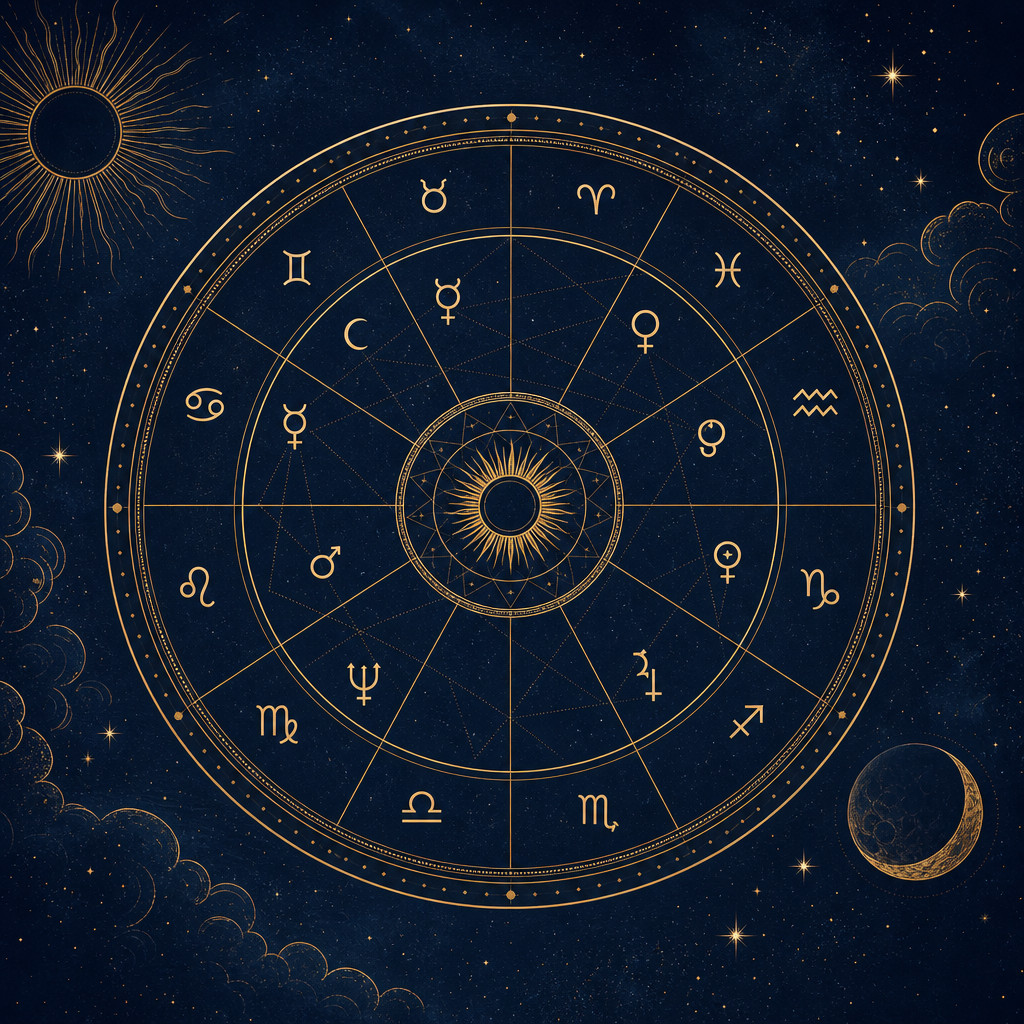
Step 7: If You Use Astrology, Find the New Moon in Your Birth Chart
Astrology adds a personalized symbolic layer by locating the New Moon in your natal houses. To do this accurately, you generally need a reliable birth time because the Ascendant and house cusps depend heavily on time and location.
For example, a New Moon falling in the 2nd house may be interpreted through themes of money, resources, values, or self-worth. In the 4th house, reflection might center on home, family, privacy, or emotional foundations. In the 10th house, career direction, responsibility, visibility, or public goals may receive more attention.
This does not mean the New Moon causes a specific event in that house. The house can instead function as a thematic prompt: “What deserves a fresh review in this part of my life?”
New Moon Through the Twelve Houses: Reflection Prompts
- 1st house: How do I want to approach life differently?
- 2nd house: Which resources and values deserve more intentional management?
- 3rd house: What communication or learning habit could I improve?
- 4th house: What would make home or private life feel more supportive?
- 5th house: Where do I want more creativity, play, romance, or self-expression?
- 6th house: Which routine would make everyday life work better?
- 7th house: What do I want to practice in close partnerships?
- 8th house: What shared resource, vulnerability, or deeper issue needs attention?
- 9th house: What do I want to learn, explore, or understand more deeply?
- 10th house: What direction deserves more commitment in my public or professional life?
- 11th house: Which friendships, communities, or long-term goals matter most now?
- 12th house: What needs rest, closure, solitude, or compassionate observation?
Should You Use the New Moon’s Zodiac Sign?
If astrology is part of your practice, the zodiac sign of the New Moon can provide another symbolic lens. An Aries New Moon may inspire questions about initiative and independence; Taurus may emphasize stability and values; Gemini communication and curiosity; Cancer home and emotional security; Leo creativity and visibility; Virgo routines and improvement.
Libra can bring attention to balance and partnership, Scorpio to intimacy and deeper change, Sagittarius to exploration and belief, Capricorn to structure and responsibility, Aquarius to community and experimentation, and Pisces to imagination, compassion, or surrender.
These are broad archetypal associations. Your personal natal chart can substantially change which themes feel most relevant.
A Simple 15-Minute New Moon Ritual
If you want a repeatable routine, try this:
- Minutes 1–2: Put away distractions and settle into the space.
- Minutes 3–5: Review the previous month and note one success, one challenge, and one unfinished issue.
- Minutes 6–8: Choose one area of life that deserves attention.
- Minutes 9–11: Write one to three intentions in language that emphasizes direction rather than guaranteed outcomes.
- Minutes 12–14: Attach one concrete action to each intention.
- Minute 15: Schedule the first action or write when you will review your progress.
This ritual is short enough to repeat every lunar cycle and practical enough to connect reflection with real behavior.
Do Candles, Crystals, or Tarot Cards Help?
They can help if they make the ritual feel focused or meaningful to you. A candle can mark the beginning and end of reflection. A crystal can function as a symbolic object. A Tarot card can provide a journaling prompt. None of these tools has to be treated as a mechanism that guarantees external results.
If you use Tarot, consider asking an open question such as “What quality should I pay attention to during this cycle?” rather than “Will my intention definitely come true?” This keeps the practice reflective rather than deterministic.
New Moon Intention-Setting vs. Manifestation
The language of “manifestation” can mean different things. For some people it simply means clarifying a goal and deliberately working toward it. For others it implies that thoughts or lunar timing directly cause desired external outcomes.
A grounded approach separates these ideas. Reflection can influence attention, planning, habits, and choices. Those changes may improve the likelihood of certain outcomes, but they do not give a person complete control over other people, markets, health conditions, chance events, or complex circumstances.
Instead of “The New Moon will bring me a new job,” try: “During this cycle, I will clarify the roles I want, update my résumé, contact three relevant people, and submit applications that fit my criteria.”
What Should You Avoid During a New Moon Ritual?
There are no universal activities that everyone must avoid during a New Moon. Claims that you must not sign documents, spend money, travel, cut your hair, make decisions, or begin certain activities vary by tradition and are not scientific rules.
A more useful boundary is psychological: avoid turning the ritual into a source of fear. If missing the exact New Moon time makes you anxious, broaden the window. If an intention list becomes a test of whether you are “aligned enough,” simplify it. The practice should support reflection, not create another standard you feel compelled to perform perfectly.
Do You Need to Perform the Ritual at the Exact New Moon?
No. If your purpose is reflection, there is no practical reason to wake at an inconvenient hour just to match the astronomical minute. You can practice on the same day, the evening before, the next morning, or whenever you have enough time and attention.
Astrological traditions differ about timing, but consistency is often more useful for personal reflection than perfect timing.
How to Review Your Intentions at the Full Moon
Some people pair New Moon intention-setting with a Full Moon review roughly two weeks later. You can use that midpoint to ask what has moved, what has stalled, and what needs adjustment.
Do not assume that every intention should be completed within half a lunar cycle. Some goals require months or years. The Full Moon review is simply another checkpoint.
How to Build a New Moon Journal
A dedicated journal makes it easier to see patterns over time. For each New Moon, record the date, your primary area of focus, one to three intentions, planned actions, and any astrological information you choose to track.
At the next New Moon, review the previous entry before writing a new one. After six or twelve cycles, you will have a useful record of what repeatedly mattered, which goals changed, and where intentions translated into action.
This longitudinal record can also reduce hindsight bias. You can see what you actually wrote instead of remembering an intention differently after events unfold.
When a New Moon Ritual Feels Emotionally Heavy
Not every monthly check-in will feel optimistic. Sometimes reflection highlights grief, uncertainty, exhaustion, conflict, or a goal that did not work out. You do not need to force positivity.
A grounded intention might simply be “I will make more room for recovery,” “I will ask for help,” or “I will postpone a decision until I have better information.” Rituals can hold uncertainty as well as ambition.
If reflection brings up persistent distress or concerns about mental or physical health, a ritual is not a substitute for appropriate professional support.
Common New Moon Ritual Mistakes
Setting too many intentions. A short list is easier to remember and act on.
Writing only outcomes. Include behaviors you can control, not just results you want.
Using astrology as certainty. Symbolic themes can guide questions without guaranteeing events.
Forgetting to review. An intention written once and never revisited has limited practical value.
Comparing rituals online. A visually elaborate ritual is not automatically more meaningful than ten focused minutes with a notebook.
Ignoring real-world constraints. Goals involving money, health, relationships, or work need practical information and realistic planning.
Frequently Asked Questions
What should I write during a New Moon?
Write what you learned from the previous cycle, what currently deserves attention, one to three intentions, and the first concrete action attached to each intention.
How many intentions should I set?
There is no fixed rule. One to three meaningful intentions are often easier to act on than a long list of wishes.
Can I do a New Moon ritual without believing in astrology?
Yes. You can use the lunar cycle simply as a recurring calendar cue for reflection, journaling, planning, and habit review.
What if I miss the New Moon?
Do the reflection when you have time. Consistency and usefulness matter more than performing it at an exact minute.
Should I burn my intention list?
You can if it has symbolic meaning and you can do so safely, but it is not necessary. Keeping the list may actually be more useful because you can review what you wrote later.
Can New Moon rituals make something happen?
There is no established scientific evidence that a New Moon ritual itself causes desired external events. The practical value lies in reflection, clarity, planning, and behaviors that may follow from the ritual.
Which house is my New Moon in?
You need the New Moon’s zodiac position and your natal chart to determine the house. Accurate house placement generally requires a reliable birth time and birthplace.
Final Takeaway
A New Moon ritual can be meaningful without becoming complicated or predictive. Use the lunar cycle as a recurring checkpoint: reduce distractions, review the previous month, choose what matters now, write a small number of intentions, and connect each one to a realistic action.
If astrology is important to you, add the New Moon’s zodiac sign and natal house as symbolic prompts. If it is not, the ritual can work perfectly well as a monthly reflection practice.
The most grounded approach treats intention-setting as a way to clarify attention rather than control the future. You can choose your direction, prepare carefully, and act consistently while still acknowledging uncertainty and factors outside your control. That balance makes a New Moon practice both reflective and practical.