A birth chart, also called a natal chart, is a map of the sky calculated for the date, time, and place you were born. In astrology, it is used as a symbolic framework for exploring identity, emotional patterns, communication style, relationships, motivation, values, career themes, and other areas of life.
A birth chart does not contain only your zodiac Sun sign. It includes the Sun, Moon, planets, rising sign, twelve houses, and the angular relationships between planets known as aspects. Reading a chart means combining these layers rather than interpreting each placement in isolation.
What Information Is Needed for a Birth Chart?
To calculate a complete chart, you normally need three pieces of information: birth date, exact birth time, and birthplace.
The birth date determines the planetary positions for that day. The birth time helps calculate the Ascendant and houses. The birthplace provides coordinates and the correct local time context.
Why Birth Time Matters
The rising sign changes throughout the day, and the house structure rotates with it. If your birth time is unknown or inaccurate, the houses and Ascendant may also be uncertain.
You can still learn a great deal from planets in signs and many aspects without an exact time, but a responsible chart should label time-sensitive information as uncertain instead of guessing.
The Zodiac Wheel
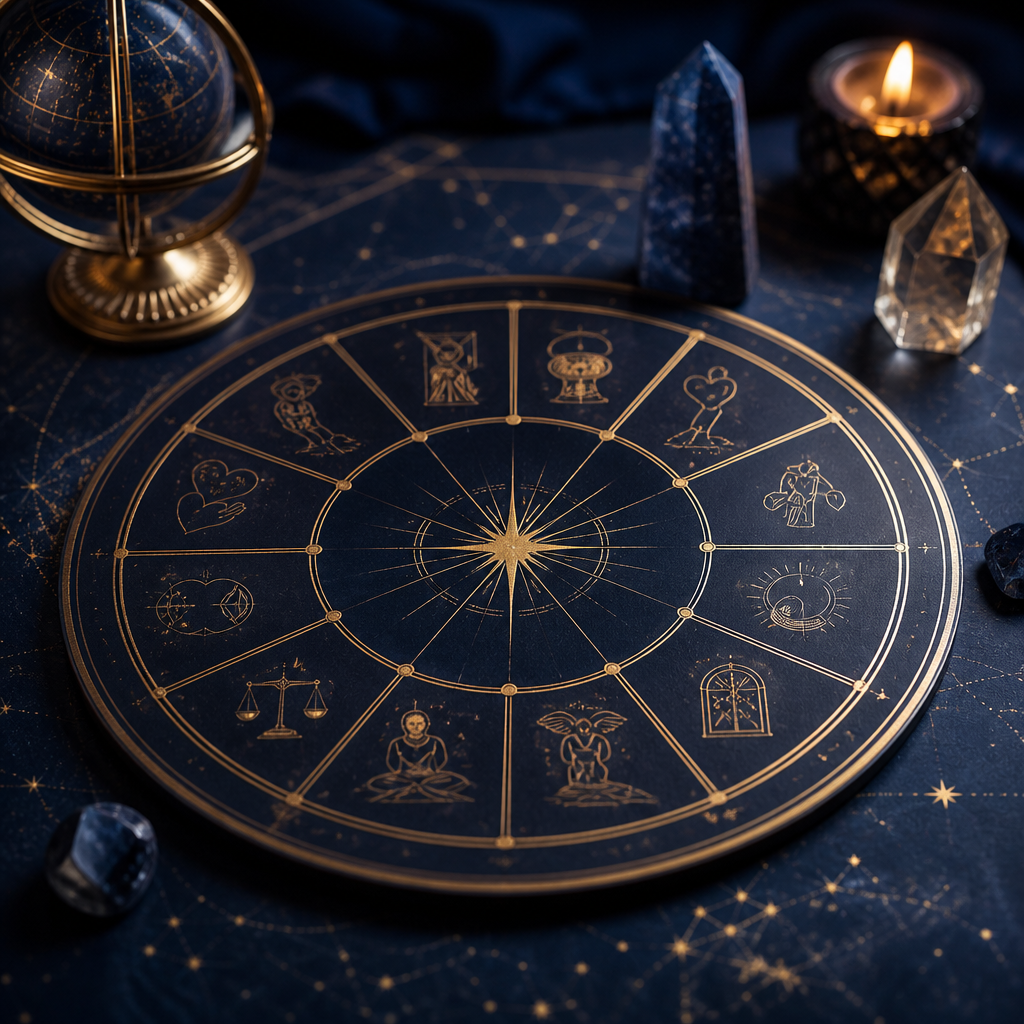
The chart is usually shown as a circle divided into twelve zodiac signs and twelve houses. The zodiac signs form a 360-degree band, with each sign occupying 30 degrees.
Planets are placed at exact degrees within the signs. These positions allow astrologers to calculate aspects between them.
The Sun
The Sun is associated with identity, vitality, confidence, purpose, and conscious self-expression. Your Sun sign is the zodiac sign most people know from their birthday.
However, the Sun also occupies a house and forms aspects with other planets, which adds significant context.
The Moon
The Moon is associated with emotional needs, instinctive reactions, memory, habits, comfort, and security. Because it changes signs quickly, the Moon can be one of the factors that makes two people born only a few days apart feel very different.
The Moon’s house placement can show where emotional needs are most strongly experienced.
The Ascendant
The Ascendant, or rising sign, is the zodiac sign rising on the eastern horizon at birth. It describes approach, first impressions, and the way the person engages with the immediate environment.
It also establishes the first house and identifies the chart ruler, making it structurally important.
Mercury
Mercury is linked with communication, reasoning, language, learning, perception, and the exchange of information. Its sign can describe communication style, while its house shows where mental activity is emphasized.
Venus
Venus is associated with attraction, affection, aesthetics, relationships, pleasure, values, and what a person finds enjoyable or desirable.
Venus is often important in compatibility work, but it is only one part of relationship analysis.
Mars
Mars symbolizes drive, assertion, desire, motivation, competition, and the way energy is directed. It can also provide clues about conflict style and how a person pursues goals.
Jupiter
Jupiter is associated with growth, expansion, learning, optimism, belief, opportunity, and broader perspective. In a chart, it may show where someone seeks meaning or tends to think bigger.
Saturn
Saturn is linked with structure, responsibility, boundaries, discipline, limitation, patience, and long-term development. Its symbolism can describe areas that require sustained effort.
Uranus, Neptune, and Pluto
The outer planets move slowly and are shared by many people in the same generation. Uranus is associated with innovation, disruption, independence, and change. Neptune relates to imagination, ideals, spirituality, sensitivity, and sometimes confusion. Pluto is connected with power, transformation, intensity, and deep change.
Their house placements and aspects to personal planets often make them more personally relevant.
The Twelve Houses
Houses describe areas of life. The first house relates to self and approach; the second to resources and values; the third to communication and learning; the fourth to home and foundations; the fifth to creativity and pleasure; the sixth to routines and work habits; the seventh to partnership; the eighth to shared resources and transformation; the ninth to beliefs and exploration; the tenth to career and public role; the eleventh to community and future goals; and the twelfth to inner life and retreat.
What Are Aspects?
Aspects are angles between planets. They show how different planetary themes interact.
Conjunctions combine energies. Sextiles and trines are often associated with easier cooperation. Squares and oppositions can describe tension, challenge, contrast, or development.
No aspect is automatically good or bad. A challenging aspect can create motivation, while an easy aspect can describe a talent that is taken for granted.
What Are Elements?
The zodiac signs belong to four elements. Fire signs emphasize action and inspiration. Earth signs emphasize practicality and stability. Air signs emphasize ideas and communication. Water signs emphasize emotion and intuition.
A chart with strong emphasis in one element may express that style more consistently, though the whole chart should still be considered.
What Are Modalities?
Signs also belong to three modalities. Cardinal signs initiate, fixed signs stabilize, and mutable signs adapt. A chart with many cardinal placements may prefer action and beginnings; a strong fixed chart may value consistency; a mutable chart may emphasize flexibility.
Chart Rulers
The planet that rules the rising sign is often called the chart ruler. Its sign, house, and aspects can provide a useful organizing theme.
For example, Gemini rising is ruled by Mercury. If Mercury is placed in the tenth house, communication or learning may connect strongly with career or public life symbolism.
House Systems
Astrologers use different house systems, including Placidus, Whole Sign, Equal House, and others. A planet can sometimes move from one house to another depending on the system.
This is a methodological difference, not necessarily a calculation error. When comparing readings, check which house system is being used.
How to Begin Reading Your Chart
Start with the Big Three: Sun, Moon, and rising sign. Then look at Mercury, Venus, and Mars. Next, study the house placements and major aspects.
Avoid trying to understand every symbol at once. A chart contains a great deal of information, and layered learning is easier than memorizing a large list of interpretations.
Look for Repeated Themes
Repeated themes are often more useful than one isolated placement. If communication appears through Mercury, the third house, and several air-sign placements, that theme may deserve more attention.
Likewise, relationship symbolism can appear through Venus, the seventh house, Libra, and aspects involving personal planets.
What a Birth Chart Cannot Tell You
A birth chart should not be treated as a deterministic script. It cannot responsibly guarantee a career, marriage, illness, financial outcome, or specific future event.
It is a symbolic map that can support reflection, not a replacement for evidence, personal agency, or professional advice.
Related Astrology Guides
- How to Read a Birth Chart
- Astrology Houses Explained
- The Planets in Astrology
- Astrology Aspects Explained
- Sun, Moon, and Rising Signs
Frequently Asked Questions
What information is needed for a birth chart?
A birth date, birth time, and birth location are normally used to calculate planetary positions, the Ascendant, and house placements.
Is a birth chart the same as a horoscope?
A birth chart is a map of the sky for a specific birth moment, while a horoscope is an interpretation that may use a birth chart, current transits, or broader sign-based methods.
Final Thoughts
A birth chart combines planets, signs, houses, and aspects into a structured symbolic map. The Sun, Moon, and rising sign provide a useful entry point, while Mercury, Venus, Mars, outer planets, house placements, and aspects add greater detail.
The best way to learn your chart is gradually. Understand the components, notice repeated themes, compare interpretations with real experience, and keep your own judgment at the center of the process.
Build a One-Page Birth Chart Summary
After studying the individual placements, create a short summary instead of keeping dozens of disconnected notes. Write one line for your Sun, Moon, rising sign, Mercury, Venus, and Mars. Add the most emphasized houses, two or three major aspects, and any repeated element or modality. Then identify three themes that appear more than once.
This exercise helps separate central patterns from minor details. It also makes later learning easier because new techniques can be added to an existing structure rather than creating a completely new interpretation each time. A good chart reading should eventually become more coherent, not more complicated.
3 thoughts on “What Is a Birth Chart? A Complete Beginner’s Guide”
Comments are closed.